
Buying Guides
5 Signs Your Multimeter Has Drifted Out of Calibration
A multimeter can drift out of calibration with no visible fault. Learn the five warning signs, how often to recalibrate, and what to ask your supplier.
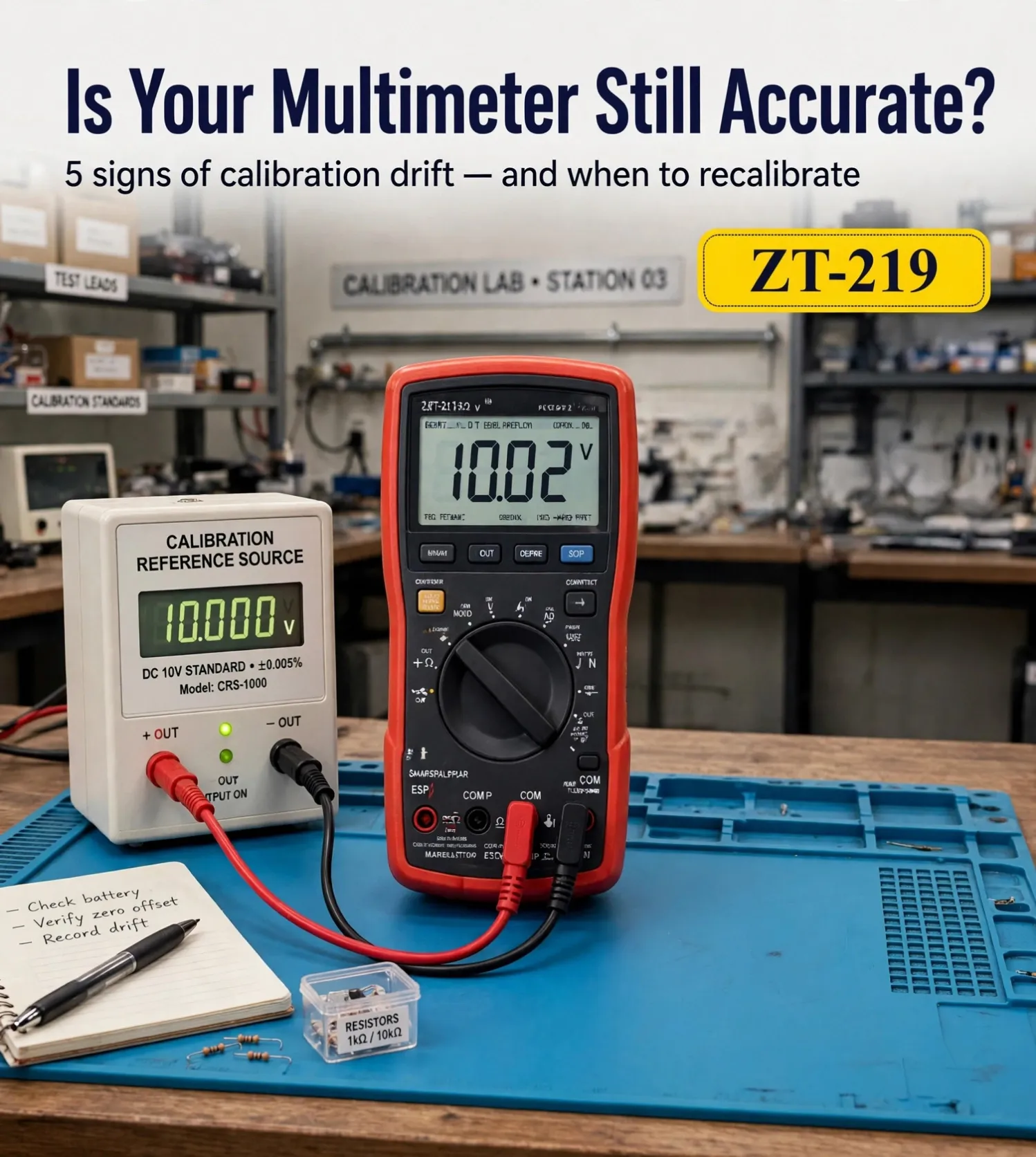
5 Signs Your Multimeter Has Drifted Out of Calibration
A digital multimeter can lose accuracy without any visible fault: the display still lights up and the readings still look plausible. That is why calibration drift is dangerous — nothing on the meter tells you the numbers have moved. Calibration compares your meter against a known reference standard; when a meter drifts, every decision based on its readings inherits the error. Drift leaves clues first. Here are five of them.
Why Multimeters Drift
Drift is not a defect in one brand or model — it is what happens to instruments over time. Calibration guides list the same four causes: ageing components, whose resistors, capacitors and reference circuits slowly shift in value; temperature extremes, humidity and dust; measuring beyond the rated range, which damages protection circuits; and a hard drop, which can misalign internal parts without marking the case. It is also easy to miss: drift is usually gradual, and published accuracy only applies while calibration is valid — typically one year after calibration for a precision handheld meter. A meter never calibrated carries no guarantee of accuracy, however new it looks.
Sign 1: Repeat Readings on the Same Source Disagree
Measure the same stable source several times. A healthy meter repeats within its stated accuracy; a drifting meter scatters — 12.1 V, then 12.4 V, then 11.9 V on a supply that has not changed. Try it with a fresh 1.5 V AA cell: forum users report a known 1.5 V battery reading 1.2 V. Rule out the cheap causes first — a low battery and worn test leads can both shift readings — before concluding the meter itself has drifted.
Sign 2: The Reading Creeps While the Input Stays Steady
Connect the meter to a stable DC source and watch the display for 30 to 60 seconds. It should settle and stay put; if it keeps creeping while the source is constant, the meter's internal reference is moving — the classic signature of drift. Allow a short warm-up first; a reading that jumps when you move the leads is a lead fault, and a floating AC reading on an open input is usually induced voltage. Creep on a steady DC source is different: the meter cannot hold a value, and no range change or fresh battery will fix it.
Sign 3: The Error Changes Across the Range
A meter can be right at one point on the dial and wrong everywhere else: 10 V reads correctly but 200 V is off, or the low resistance range is fine while the high range is not. Drift is rarely a fixed offset — calibration guides describe non-linear errors that grow or shrink as the measured value changes. That is why calibration checks several points across the range, recording the reading before adjustment (as-found) and after (as-left). One provider published a case of a meter showing 130 A against a true load near 145 A — a gap no operator would notice without a reference. If your error grows with the value, REL or zero will not save it.
Sign 4: Zero Will Not Settle
Short the inputs on DC volts, or the probe tips on ohms: the meter should settle close to zero and stay there. A drifting meter cannot — the zero wanders, or the ohms reading with shorted leads sits well above zero once the leads are ruled out. Pressing REL or an on-board "calibration" key only subtracts an offset for that moment; it does not restore accuracy across the ranges, and it is not a substitute for calibration.
Sign 5: The Calibration Date Has Passed — or It Failed Last Time
Check the calibration sticker and certificate. Most manufacturers recommend annual calibration as a starting point, and accreditation guidance for digital multimeters commonly specifies 12 months; critical or safety-related meters, or meters used hard every day, are often calibrated every 3 to 6 months. Three events are automatic triggers: an expired due date, a drop or overload, or a repair. If a meter was out of tolerance at its last calibration, every measurement since the previous one has to be reviewed. A meter with no sticker and no certificate history is not "uncalibrated but fine" — its accuracy is simply unknown.
A 10-Minute Check Before You Send It Away
- Fit a fresh battery and check the low-battery indicator is off.
- Test the leads first. Short the tips on the ohms range; good leads read about 0.5 ohms or less.
- Measure a known source, such as a fresh 1.5 V cell.
- Compare with a second meter on the same source, at a low and a high point.
- Hold the reading for a minute and watch for creep.
- Check the sticker and record the last and next calibration dates.
If any step fails, mark the meter "do not use for acceptance decisions". Do not open it to adjust trimmers — without a traceable reference you will make the error worse.
How Often Should a Multimeter Be Calibrated?
Use case | Suggested interval |
|---|---|
Light or occasional use | Every 1–2 years |
Daily professional use | Every 12 months |
Critical or safety-related measurements | Every 3–6 months |
After a drop, overload, or repair | Immediately |
These are starting points — the right interval depends on use, tolerances, and your quality system. Under ISO 9001, measuring equipment must be calibrated at specified intervals against traceable standards, and ISO/IEC 17025 accredited calibration is the recognised route for a defensible certificate. Record the interval you choose and why.
What Buyers and Distributors Should Ask the Supplier
Calibration is a buying criterion, not just a maintenance task. Before a volume order, ask the supplier: is a calibration certificate available, traceable to national standards, with as-found and as-left data? What interval does the manual recommend? Can the supplier recommend an accredited laboratory? Is a loan unit available while meters are away? For own-brand orders, can the manual state the interval and the certificate carry your brand?
For distributors, the fleet matters as much as each meter. Track calibration due dates across the meters you have sold or placed with service teams, and set a reminder before the due date rather than after a failure. A supplier that supports that costs less over the product's life than a cheaper meter with no calibration support. Shenzhen Zhanyueda supports OEM and ODM production, including logo, packaging, manual, and barcode customisation, so calibration guidance can be built into the documentation from the start.
The Bottom Line
A drifting multimeter does not warn you — it keeps showing reasonable-looking numbers while they quietly move away from the truth. Check repeatability, watch for creep, test more than one point, confirm the zero holds, and respect the calibration date. Any one of these signs is enough to pull the meter from acceptance work. A calibration costs little; a decision made on a wrong reading does not.
Need multimeters with calibration support? Contact us at zydhardware.com for the catalogue, sample terms, and OEM/ODM options.
Related categories: digital multimeters, clamp meters, calibration instruments and accessories.