Sep 11, 2026Buying Guides
Accuracy vs. Resolution: What Every Multimeter Buyer Should Know
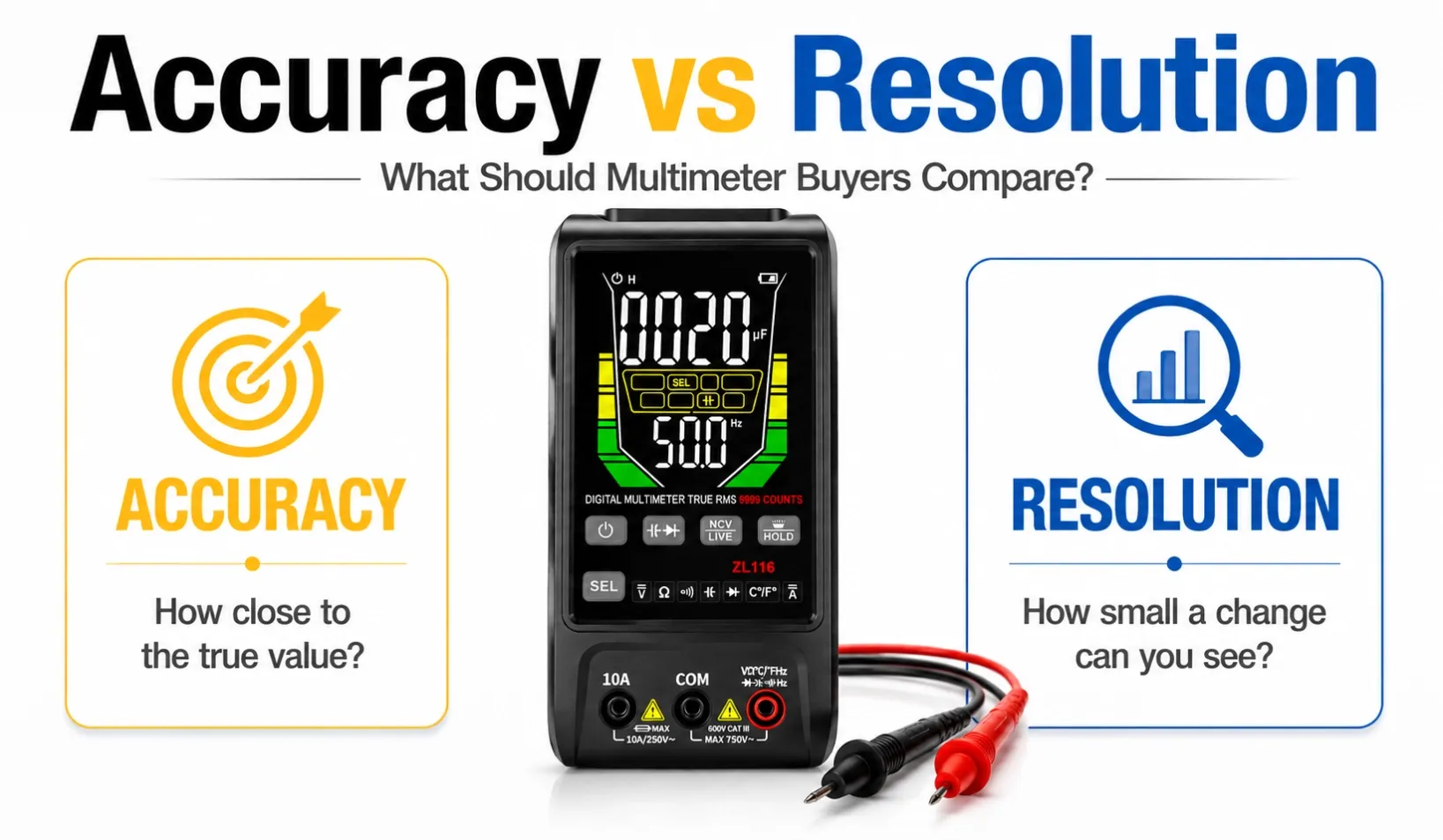
Accuracy tells you how close a multimeter reading is to the true value, while resolution tells you how small a change it can display.
Accuracy vs. Resolution: What Every Multimeter Buyer Should Know
When comparing digital multimeters, buyers often see specifications such as:
6,000 counts. 20,000 counts. 0.5% accuracy. 0.001 V resolution.
It is easy to assume that a meter displaying more digits must also be more accurate.
But that is not how digital multimeter performance works.
The key distinction is:
Resolution tells you how much detail a meter can display. Accuracy tells you how close the measurement is expected to be to the true value.
For distributors, wholesalers, and procurement teams, understanding this difference helps avoid over-specifying products, comparing meters incorrectly, and building a product range around headline numbers rather than real applications.
1. Accuracy: How Close Is the Reading to the True Value?
Accuracy describes how much a meter reading may deviate from the actual electrical value under specified conditions.
A typical specification may look like:
±(0.5% of reading + 2 counts)
This includes two parts.
The percentage of reading represents an error related to the measured value.
The additional counts represent uncertainty in the least significant displayed digit on the selected range.
For example, if a meter reads:
10.000 V
with an accuracy specification of:
±(0.5% + 2 counts)
and the resolution on that range is:
0.001 V
then:
0.5% of 10.000 V = 0.050 V
and:
2 counts × 0.001 V = 0.002 V
The total specified uncertainty would therefore be approximately:
±0.052 V
under the stated measurement conditions.
This is why the number of digits on the screen should never be used as a substitute for the accuracy specification.
2. Resolution: How Much Detail Can You See?
Resolution is the smallest change in a measured quantity that the meter can display on a particular range.
A simple analogy is a ruler.
Resolution is how finely the ruler is divided.
Accuracy is whether those divisions correctly represent the real distance.
For example, a multimeter may provide:
Voltage Range | Resolution |
|---|---|
6.000 V | 0.001 V |
60.00 V | 0.01 V |
600.0 V | 0.1 V |
Higher resolution can be useful when technicians need to observe small changes in:
- Sensor outputs
- Electronic circuits
- Resistance
- Low-voltage signals
- Power-supply behavior
But greater resolution does not automatically mean better measurement accuracy.
3. Precision vs. Accuracy
Another term often used in technical measurement is:
Precision.
Precision generally refers to repeatability — how consistently similar measurements can be reproduced under the same conditions.
A meter may be:
Accurate but less precise
Readings are centered near the true value but vary more between measurements.
Precise but less accurate
Readings are highly consistent but consistently offset from the true value.
A professional measurement instrument ideally provides a suitable combination of:
Accuracy + Resolution + Repeatability
for the intended application.
4. Accuracy vs. Resolution in Different Applications
Different users need different balances of measurement performance.
Application | Accuracy Priority | Resolution Priority | Other Important Factors |
|---|---|---|---|
General Electrical Work | High | Moderate | Safety rating, True RMS, input protection |
HVAC Servicing | High | Moderate | Capacitance, temperature, current |
Electronics Repair | High | High | Low-voltage ranges, small-current measurement |
Automotive Electrical Diagnosis | High | Moderate–High | DC current, frequency, Min/Max |
Industrial Maintenance | High | Moderate–High | True RMS, durability, safety |
Engineering / R&D | Very High | Very High | Stability, noise, calibration performance |
This table is a general guide rather than a universal specification requirement.
The important question is not:
“Which meter has the most digits?”
It is:
“Which meter provides the level of accuracy and resolution required by the application?”
5. The Buyer’s Dilemma: 6,000 vs. 20,000 Counts
This is where many product comparisons become misleading.
A 20,000-count meter provides more potential display resolution than a 6,000-count meter.
But that does not automatically make it the better instrument.
Consider two hypothetical products.
Meter A
- 6,000 counts
- ±(0.5% + 2 counts) DC voltage accuracy
- True RMS
- Appropriate CAT rating
- Fast continuity response
- Capacitance and temperature
Meter B
- 20,000 counts
- ±(1.0% + 5 counts) DC voltage accuracy
- Average-responding AC measurement
- Basic measurement functions
Meter B can display more digits.
Meter A may still be the more suitable choice for professional field electrical or HVAC work.
For many users, the practical value of a multimeter depends more on:
Safety + Accuracy + Measurement Functions + Reliability
than on maximum display count alone.
Higher resolution becomes more important when the application genuinely requires the user to observe smaller electrical changes.
6. Why More Digits Do Not Always Mean Better Measurement
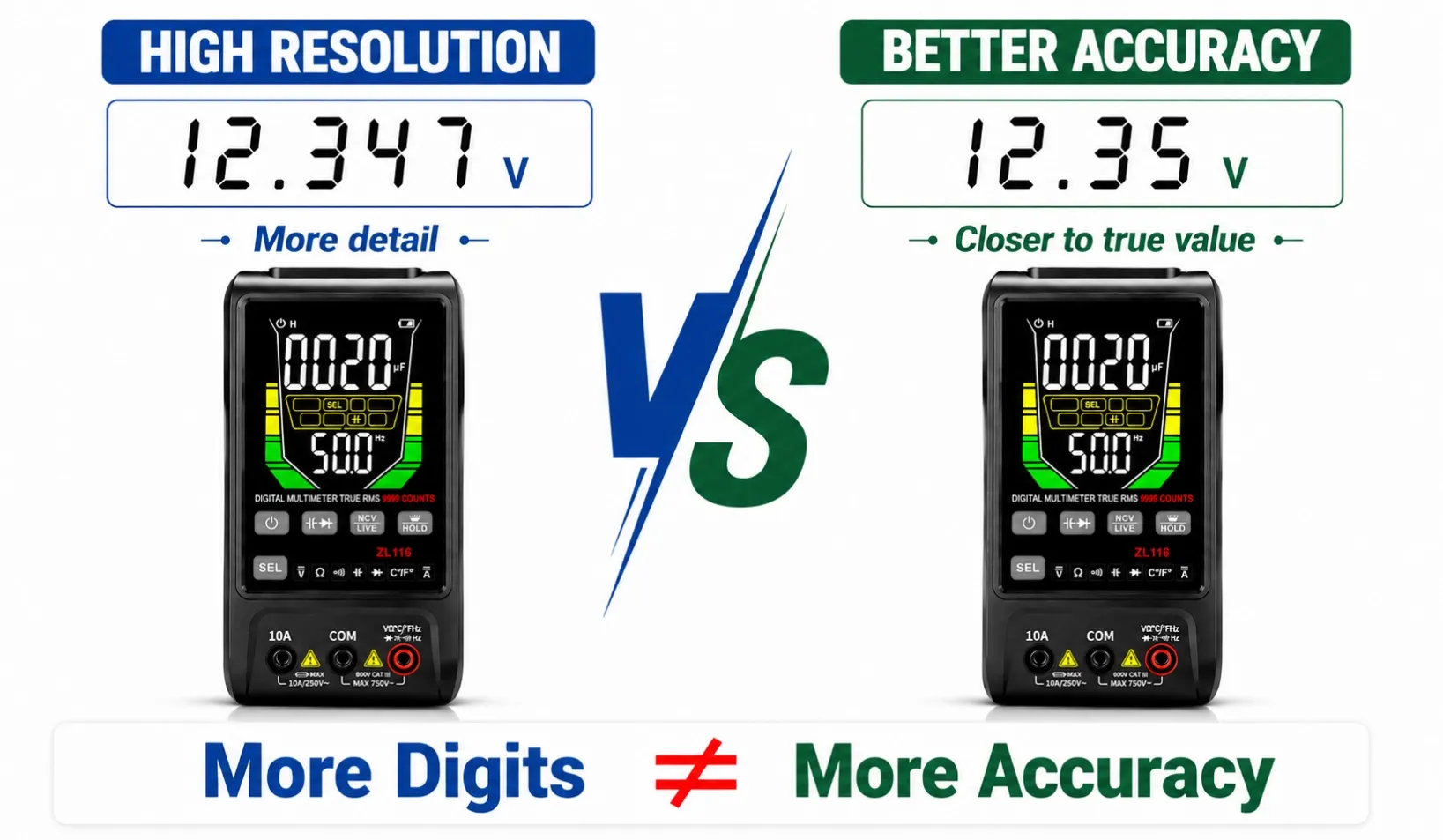
Suppose two meters measure the same source.
Meter A:
12.347 V
Meter B:
12.35 V
At first glance, Meter A looks more sophisticated.
But if Meter A has a wider accuracy specification and Meter B has a tighter one, the extra displayed digits do not necessarily provide a more trustworthy measurement.
That is why:
More digits ≠ more accuracy.
Displayed detail only becomes useful when the meter’s accuracy, stability, and overall design support the measurement requirement.
7. What Should Distributors Compare Besides Resolution?
For distributors and private-label buyers, a better sourcing checklist includes:
Accuracy
Compare the accuracy on the measurement ranges customers will actually use.
Resolution
Check whether the displayed resolution is appropriate for the intended task.
Counts
Use counts as a way to understand display resolution, not as a standalone quality ranking.
Safety
Evaluate:
- CAT rating
- Rated voltage
- Input protection
- Fuse protection
- Test-lead rating
- Applicable safety documentation
True RMS
For distorted AC waveforms and many modern electrical loads, True RMS capability may be more important than additional display counts.
Measurement Range
Make sure the instrument covers the voltage, current, resistance, capacitance, frequency, or temperature ranges required by the user.
Measurement Speed and Stability
A high-resolution display is less useful if readings fluctuate excessively or take too long to settle.
Application Fit
An electrician, HVAC technician, automotive technician, and electronics engineer may all require different combinations of functions.
8. Building a Better Multimeter Product Range
For wholesalers and distributors, multimeters can be positioned more clearly by application rather than by counts alone.
Entry-Level
Designed for basic electrical measurement and price-sensitive users.
Focus on:
- Core functions
- Simple operation
- Appropriate safety
- Competitive cost
Professional Field
Designed for electricians, HVAC technicians, and industrial maintenance.
Focus on:
- Suitable accuracy
- Useful resolution
- True RMS
- Strong protection
- Fast continuity
- Application-relevant functions
Advanced Technical
Designed for electronics, engineering, and more detailed measurement work.
Focus on:
- Higher resolution
- Tighter accuracy
- Advanced functions
- Better stability
- Data capabilities where required
This makes the difference between product levels easier for both sales teams and end users to understand.
Final Thoughts
When comparing multimeters, remember:
Resolution is what you can see.
Accuracy is how close the reading is expected to be to the true value.
A higher count or more decimal places can be useful, but they should never be treated as proof of higher measurement quality.
For professional buyers, the better comparison is:
Application + Safety + Range + Accuracy + Resolution + Functions
That combination tells you far more than the biggest number printed on the box.
Need Help Comparing Multimeter Specifications?
If you are building or expanding a professional multimeter range, we can help compare models based on:
- Target application
- Measurement functions
- Accuracy and resolution
- Safety requirements
- OEM / private-label needs
- Product positioning
Contact our team for product specifications, available models, and wholesale information.