
Buying Guides
Battery Tests Good but Car Won't Start? Here's Why
Battery tester says good, but the car still won't start? See why conductance tests can pass a weak battery — and the simple checks that find the real fault.
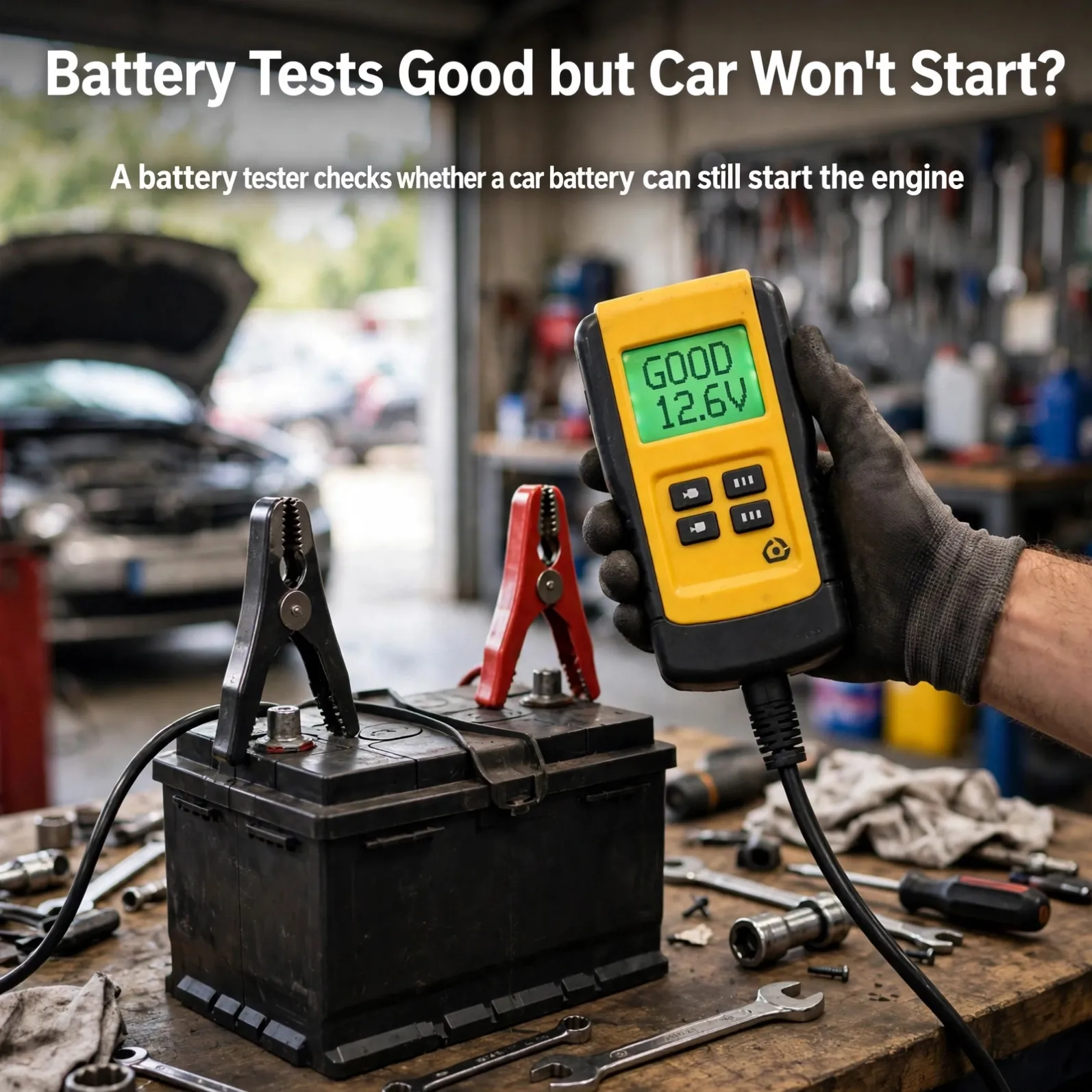
The Short Answer: "Good" on the Tester Is Not the Same as "Good" in the Car
A battery tester that reports "good" has usually answered a narrower question than the one you asked. Most handheld testers today are conductance testers: they send a small signal through the battery, measure internal resistance, and estimate the cold cranking amps (CCA) it can deliver — how easily current flows right now, not how much usable energy the battery can still store.
A battery can conduct well and still be nearly empty inside: sulfated plates or a weak cell can post a passing CCA number, then collapse when the starter asks for 200 amps or more. The tester was not lying — it measured something different from what the car needs.
What a Conductance Test Misses
A conductance test is fast and safe and does not heavily discharge the battery, which is why parts counters and fleet workshops use it. It screens well — but a pass is not a guarantee.
Lost capacity. Conductance reflects plate surface, not stored energy. A sulfated battery can still show a healthy CCA estimate because its remaining plates conduct fine — but it has lost reserve, the energy that keeps voltage up during cranking.
A weak cell. A 12V battery is six cells in series, and one weak cell can hide behind the other five. Voltage looks normal at rest, but under starter load the weak cell drags the whole battery down.
Surface charge. A battery fresh off a charger can read 12.6V or more and test well, because surface charge masks the true state of charge. Test minutes after charging and you invite a false pass — let it rest, or put a small load on it first.
Cold temperature. Capacity falls sharply in cold weather, which a reading taken in a warm workshop does not reflect. A battery marginal at 20°C can be useless at -10°C.
When the Battery Really Is Fine — and Something Else Is Wrong
Not every false pass is the battery's fault. If a load test confirms the battery holds voltage, look downstream.
Corroded or loose connections. Corrosion between terminal and clamp adds resistance the tester never sees. The battery is healthy; the path to the starter is not. Clean the terminals and check voltage drop while cranking.
A failing starter or solenoid. One solid click and no crank, with a battery that holds voltage, points at the starter or solenoid. Rapid clicking with dimming lights points back at the battery.
A parasitic draw. A battery that tests good in the morning can be drained overnight by a module that never sleeps. If the car starts after a jump and fails again the next morning, measure the draw after the vehicle has gone to sleep.
What happens when you turn the key | Most likely cause | Check first |
|---|---|---|
Rapid clicking, dash lights dim | Weak battery under load, or poor connections | Load test; clean terminals |
One solid click, no crank | Starter motor or solenoid | Voltage at the starter |
Normal crank, engine will not fire | Fuel, spark, or sensor fault | Fault codes; fuel pressure |
Nothing at all, lights work | Fuse, relay, or start-circuit fault | Starter fuse, relay, neutral switch |
Starts after a jump, dead again next morning | Parasitic draw | Draw after modules sleep |
The Check Sequence That Settles It
When a tester says "good" but the car disagrees, work through these steps first:
- Remove the surface charge. Turn the headlights on for 30 seconds with the engine off, switch them off, and wait a few minutes.
- Check the connections. Clean the terminals and clamps, tighten them, and retest. Many "bad batteries" are dirty terminals.
- Confirm the test inputs. Check that the battery type and rated CCA entered match the label on the battery.
- Load-test the battery. A load test applies roughly half the rated CCA for about 15 seconds and watches whether voltage holds — the closest test to what the starter demands. Below about 9.6V under load points at the battery; voltage that holds points downstream.
- Measure cranking voltage and voltage drop. Watch terminal voltage while someone cranks, then measure across each connection. A large drop across one connection names the faulty joint.
- Test for parasitic draw. If the battery passes every test but the car is dead again the next morning, something is draining it while parked.
Replacing a battery that was never faulty costs a workshop its credibility — and the customer remembers.
What This Means When You Buy Battery Testers
For distributors and own-brand buyers, the false-pass problem is a product-selection problem: a tester that only reports conductance generates "good" results your customers cannot trust — and they blame the tester, and the brand on it.
More than one test method. A tester that does both conductance screening and a real load test covers both jobs: fast screening in the fleet yard, and a convincing go or no-go verdict at the counter. In our catalogue, that is the AE300 conductance tester versus the BT-100A or BT-100B load tester, which applies a 100A load to 6V/12V batteries and reads the result on an analogue meter.
Correct type and rating prompts. A tester that asks for battery type and rated CCA — and warns when the input looks wrong — prevents mis-graded results. Check this on a sample: enter the wrong type and see whether the tester flags it.
Temperature awareness and repeatability. Ask how the tester handles cold batteries, and test the same battery three times on a sample unit — the verdict should agree every time.
Clear results. Pass, charge-and-retest, and replace are decisions, not numbers — a tester that forces the technician to interpret raw resistance values gives different verdicts from different technicians.
Questions to Ask Your Supplier
- Does this tester measure conductance only, or can it also apply a real load?
- Which battery types and ratings does it cover, and what happens if the operator enters the wrong type or rating?
- How repeatable are the results on the same battery, tested three times?
A supplier that answers directly — including where a tester's limits are — gives you material you can pass on to your own customers, and that honesty is what keeps them coming back after the first order.
Conclusion
A battery that tests good and still will not start the car is not a contradiction: the test measured conductivity when the car needed capacity, or the fault sits downstream — connections, starter, or a drain the tester never sees. The fix is the right sequence of checks — remove surface charge, then load-test. Choose testers that make that sequence easy, and your customers will stop replacing good batteries and start fixing the real fault.
For product details, samples, and OEM/ODM options, contact us via zydhardware.com — we will help you choose a battery tester that fits your market.