Sep 11, 2026Buying Guides
CAT III vs CAT IV Multimeter: Understanding Measurement Categories
When choosing a digital multimeter for professional electrical work, voltage range and accuracy are not the only specifications that matter.
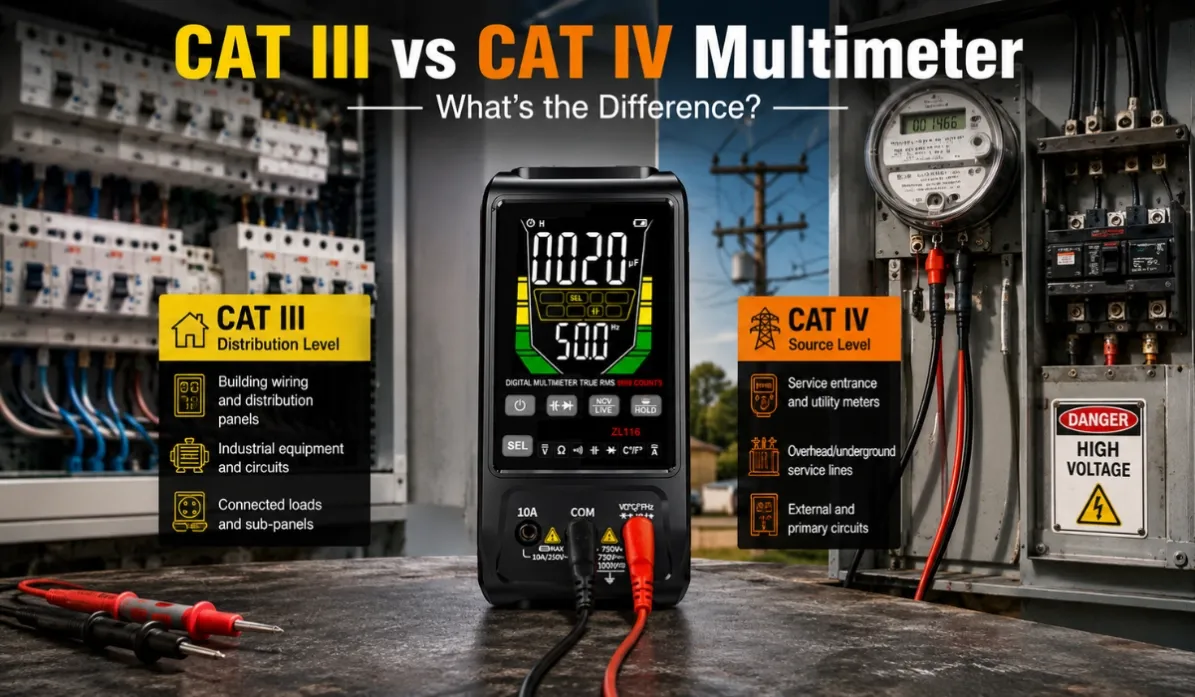
When choosing a digital multimeter for professional electrical work, voltage range and accuracy are not the only specifications that matter.
One of the most important safety specifications is the measurement category, commonly shown as CAT II, CAT III or CAT IV.
A meter marked CAT III 600 V is not simply a “600 V multimeter,” and CAT IV does not just mean “a better version” of CAT III. Measurement categories describe the electrical environment in which a test instrument is designed to withstand transient overvoltages.
Understanding the difference between CAT III and CAT IV can help electricians, maintenance technicians and professional buyers select a meter that is appropriate for the measurement location.
What Does CAT Rating Mean on a Multimeter?
CAT stands for measurement category.
IEC 61010 uses measurement categories to classify test and measurement circuits according to their position within a low-voltage electrical installation and the transient overvoltages that may occur there.
The closer the measurement point is to the source of the electrical installation, the greater the potential energy associated with a transient event can be.
For this reason, two circuits operating at a similar normal voltage may present very different measurement risks.
A CAT rating therefore tells you more than the maximum voltage a meter can display. It helps describe the electrical environment for which the instrument has been designed.
CAT II, CAT III and CAT IV at a Glance
For mains-connected electrical work, the three categories most commonly seen on handheld meters are CAT II, CAT III and CAT IV.
Measurement Category | Typical Measurement Environment |
|---|---|
CAT II | Loads and equipment connected to receptacle-level circuits |
CAT III | Fixed installations and the distribution section of a building |
CAT IV | Source of the low-voltage installation and service entrance |
The important point is that the categories describe where the measurement is made, not simply how many volts are present.
What Is CAT III?
CAT III applies to measurements performed on the distribution portion of a building’s low-voltage electrical installation.
Typical CAT III locations may include:
- Distribution boards
- Circuit breakers
- Fixed wiring
- Junction boxes
- Busbars
- Industrial equipment permanently connected to the installation
- Stationary motors
- Fixed switches and outlets
- Some photovoltaic distribution circuits
In practical terms, electricians and maintenance technicians often encounter CAT III environments while working inside electrical panels, commercial buildings, industrial facilities and fixed equipment.
This is why many professional multimeters are rated CAT III 600 V or CAT III 1000 V.
What Is CAT IV?
CAT IV applies closer to the source of the building’s low-voltage mains installation.
Typical CAT IV measurement locations may include:
- Utility service entrances
- Electricity meters
- Primary overcurrent protection
- Service conductors
- Overhead or underground service connections
- Measurement points close to the origin of the installation
These locations can be exposed to higher-energy transient events because there is generally less upstream impedance available to limit fault or surge energy.
CAT IV therefore represents a more demanding transient environment than CAT III at the same rated voltage.
CAT III vs CAT IV: What Is the Main Difference?
The main difference is the location within the electrical distribution system and the level of transient energy the instrument is designed to tolerate.
A simplified way to visualize the system is:
Utility source → Service entrance → Main distribution → Branch circuits → Connected equipment
Moving toward the utility source generally means moving toward higher measurement categories.
For example:
- Connected appliances may fall into CAT II environments.
- Distribution panels and fixed wiring may fall into CAT III environments.
- Service entrances and utility-side measurement points may fall into CAT IV environments.
This is why CAT IV should not simply be described as “higher voltage.”
It describes a different measurement environment.
CAT III 600 V vs CAT IV 600 V
Suppose two multimeters are both rated for 600 V:
- Meter A: CAT III 600 V
- Meter B: CAT IV 600 V
Although both carry a 600 V rating, they are not intended for exactly the same electrical environment.
The CAT IV 600 V instrument is designed for measurement locations closer to the source of the installation, where higher-energy transient overvoltages may occur.
This illustrates an important rule:
Never compare multimeters by voltage rating alone. Always read the CAT category and rated voltage together.
What About CAT III 1000 V vs CAT IV 600 V?
This is another common source of confusion.
A meter may be marked:
CAT III 1000 V / CAT IV 600 V
This does not mean that CAT III is somehow “better” because the voltage number is larger.
It means the instrument is rated for:
- CAT III environments up to 1000 V, and
- CAT IV environments up to 600 V.
Professional meters from established manufacturers commonly use this type of dual rating.
The correct rating therefore depends on both the measurement category and the voltage to ground at the measurement point.
Why Does the Measurement Location Matter?
Electrical systems can experience transient overvoltages caused by events such as:
- Load switching
- Motor switching
- Inductive loads
- Fault conditions
- Utility switching
- Lightning-related surges
The potential energy of these events is not the same everywhere in the installation.
A transient occurring close to the service entrance can present a much more severe hazard than a similar-voltage circuit connected farther downstream.
A professional test instrument therefore requires adequate insulation, spacing, input protection and overall construction for its intended environment.
CAT Rating Is Not the Same as Maximum Display Voltage
One of the biggest mistakes when choosing a multimeter is assuming:
“If the meter can display 1000 V, it is safe for any 1000 V circuit.”
That is not necessarily true.
A display range describes what the instrument can measure.
A measurement-category rating describes the safety environment for which the instrument has been designed.
These are related but different specifications.
Professional buyers should therefore examine both:
- Maximum measurement range
- CAT rating and associated working voltage
Do Test Leads Need a CAT Rating Too?
Yes.
The measurement system includes more than the multimeter itself.
Test leads, probes and accessories must also be appropriate for the measurement environment.
For CAT III and CAT IV work, probe-tip exposure can also matter. Protective probe caps are often used to reduce exposed conductive metal and decrease the chance of accidental short circuits in crowded panels.
A CAT IV-rated multimeter should not be treated as a CAT IV measurement system if the connected probes or accessories are unsuitable for that environment.
When selecting a professional meter, check:
- Test lead CAT rating
- Maximum voltage rating
- Probe-tip design
- Finger guards
- Insulation quality
- Connector condition
- Accessory compatibility
Is a Higher CAT Rating Always Better?
Not necessarily.
A higher CAT rating can provide a wider range of suitable electrical environments, but the best meter is the one that matches the application.
For example, an electronics technician working primarily on low-energy printed circuit boards may prioritize:
- Resolution
- Low-current accuracy
- Fast continuity
- Capacitance
- Frequency
- Fine test probes
A maintenance electrician working on industrial distribution panels may place much greater emphasis on:
- CAT III or CAT IV rating
- True RMS
- Input protection
- High-energy fuses
- Rugged test leads
- Min/Max recording
Buying the highest-rated meter available is not a substitute for understanding the actual measurement environment.
Which CAT Rating Do Electricians Usually Need?
The answer depends on the type of electrical work.
For work involving:
- Distribution panels
- Fixed installations
- Circuit breakers
- Commercial electrical systems
- Industrial equipment
a CAT III-rated instrument is commonly relevant.
For work closer to:
- Service entrances
- Utility connections
- Electricity meters
- Main incoming conductors
a CAT IV-rated instrument may be required.
The appropriate voltage rating must also match the circuit being measured.
Local electrical regulations, workplace procedures and applicable safety standards should always be followed.
What Should Professional Buyers Check Besides the CAT Rating?
CAT rating is important, but it should not be the only selection criterion.
When evaluating a professional multimeter, also compare:
True RMS capability
True RMS is useful when measuring non-sinusoidal signals generated by variable-frequency drives, inverters, switching power supplies and other modern electrical loads.
Input protection
Check whether current inputs are protected by suitable high-energy fuses and whether the meter provides overload protection.
Accuracy
Review the accuracy specification for the ranges that will actually be used.
Display count
Higher counts can provide greater displayed resolution, although they do not automatically guarantee better accuracy.
Continuity response
A fast continuity function can significantly improve productivity during wiring checks and repetitive troubleshooting.
Test lead quality
Professional probes should be durable, appropriately rated and suitable for the intended working environment.
Required functions
Depending on the application, useful additional functions may include:
- Capacitance
- Frequency
- Temperature
- Min/Max
- Relative measurement
- Duty cycle
- Low-pass filtering
- Data logging
What Should Distributors and OEM Buyers Pay Attention To?
For distributors, wholesalers and private-label buyers, a CAT marking should never be treated simply as a marketing feature.
Before placing a product into a professional electrical-testing range, buyers should verify:
- Declared CAT rating
- Rated voltage
- Applicable safety standard
- Test documentation
- Certification documents where applicable
- Test lead rating
- Fuse specification
- Input protection design
- User manual safety instructions
- Product labeling consistency
If a supplier claims a high measurement category, the buyer should request supporting documentation rather than relying only on markings printed on the enclosure.
This is particularly important for meters intended for professional electricians and industrial maintenance users.
Quick Selection Guide
A simplified decision process can look like this:
Electronics and bench repair
Focus primarily on measurement performance, resolution and suitable input protection.
Residential and commercial electrical service
Look for an appropriate CAT III rating, working-voltage rating and robust test leads.
Industrial maintenance
CAT III is commonly relevant, while some applications may require CAT IV. True RMS and strong input protection are also important.
Service entrance and utility-side work
CAT IV-rated equipment may be required depending on the measurement location and system voltage.
Professional distribution product range
Consider offering several levels rather than a single meter:
- General-purpose model
- CAT III professional model
- CAT III/CAT IV industrial model
- Specialized HVAC or electronics model
This makes the product range easier to position for different end users.
Common CAT Rating Mistakes
Mistake 1: Choosing by voltage only
A 1000 V measurement range does not automatically mean the instrument is appropriate for every 1000 V environment.
Mistake 2: Assuming CAT IV simply means higher voltage
CAT IV primarily describes the measurement environment and transient exposure closer to the source of an installation.
Mistake 3: Ignoring the test leads
The meter and test leads should be treated as one measurement system.
Mistake 4: Assuming every printed CAT marking is equally reliable
Professional buyers should verify relevant documentation, construction and applicable safety standards.
Mistake 5: Using the highest CAT rating as a substitute for safe work practices
A properly rated instrument does not remove the need for appropriate PPE, procedures, training and electrical safety practices.
Frequently Asked Questions
Is CAT IV better than CAT III?
CAT IV is designed for a more demanding measurement environment closer to the source of the electrical installation. That does not automatically make it the best choice for every application.
Can I use a CAT IV meter in a CAT III environment?
Generally, an instrument rated for the appropriate voltage in CAT IV can also be suitable farther downstream in CAT III environments, but users should always follow the manufacturer’s specifications and applicable safety procedures.
Is CAT III 1000 V better than CAT IV 600 V?
They describe different combinations of measurement category and rated voltage. Neither description should be judged from the voltage number alone.
What CAT rating is commonly used for distribution panels?
Distribution panels are typically associated with CAT III measurement environments.
What CAT rating is associated with service entrances?
Measurements at the source of a building’s low-voltage installation, including service-entrance locations, are typically associated with CAT IV.
Does a multimeter test lead need the same CAT rating?
Test leads and probes should be rated appropriately for the measurement environment because the protection of the complete measurement setup depends on all connected components.
Final Thoughts
Understanding CAT III and CAT IV is an essential part of selecting a professional digital multimeter.
The key principle is simple:
CAT rating describes the electrical environment, while the associated voltage rating describes the maximum rated voltage within that environment.
For general electronics work, measurement performance may be the primary concern.
For electrical distribution, industrial maintenance and service-entrance work, measurement category becomes a critical part of instrument selection.
Professional buyers should therefore evaluate CAT rating, rated voltage, input protection, test leads, measurement functions and supporting documentation together rather than relying on a single specification.
Looking for Professional Digital Multimeters?
Explore our digital multimeter range for electrical maintenance, HVAC service, industrial troubleshooting and professional distribution.
Available options may include:
- True RMS measurement
- CAT III / CAT IV models
- Auto-ranging
- NCV detection
- Capacitance and frequency
- Temperature measurement
- OEM logo and packaging options
- Private-label customization