Sep 11, 2026Buying Guides
Circuit Breaker Finder vs Multimeter: Which Tool Is Right for Electrical Troubleshooting?
Compare a circuit breaker finder vs multimeter, learn what each tool does, when to use them, and which is better for locating circuits and electrical troubleshooting.
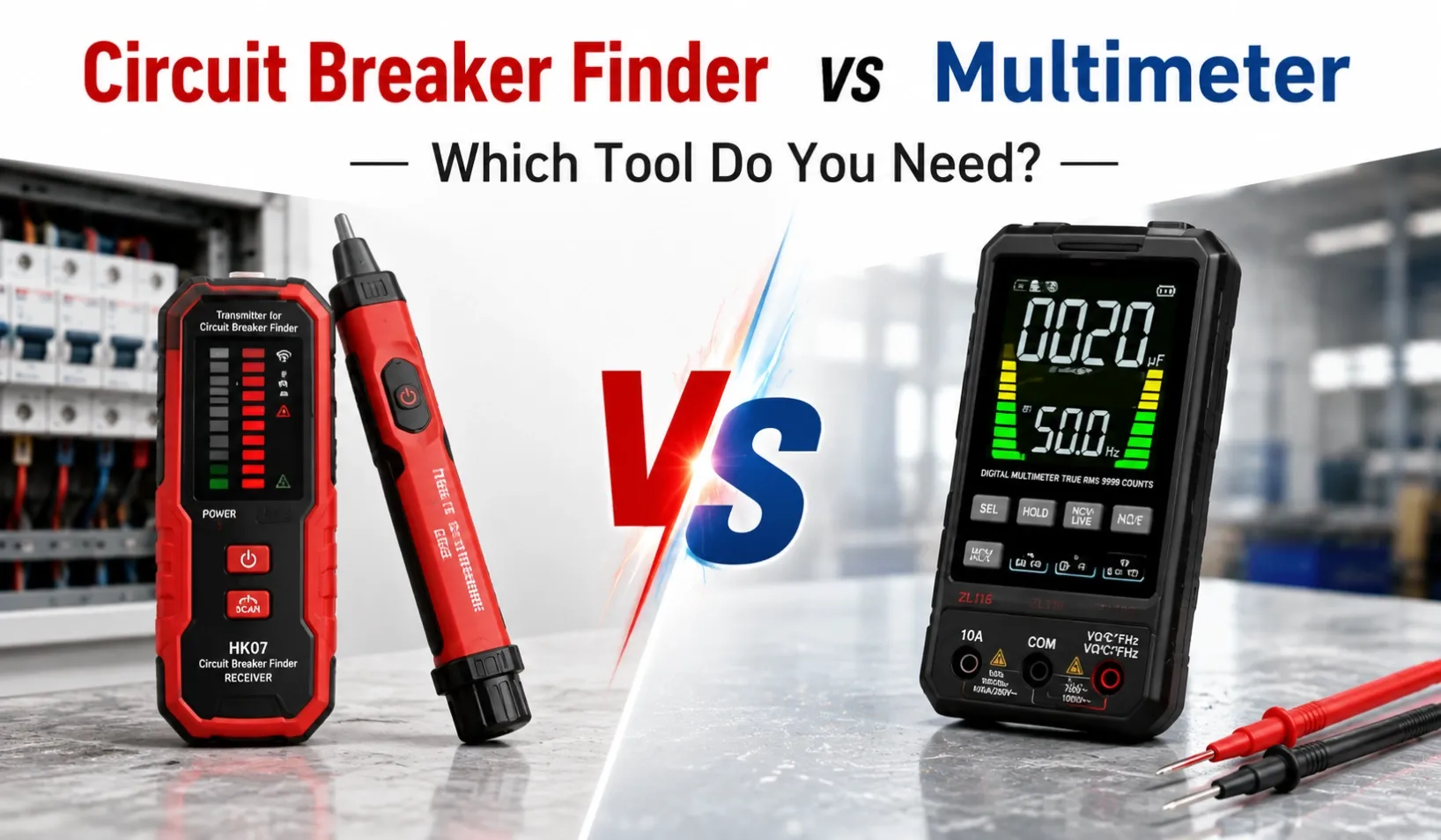
When an outlet, lighting circuit or electrical device needs to be identified or diagnosed, two tools are often considered: a circuit breaker finder and a digital multimeter.
They may both appear in an electrician’s toolbox, but they solve very different problems.
A circuit breaker finder is primarily designed to identify which breaker controls a particular outlet, fixture or circuit. A digital multimeter, on the other hand, is designed to measure electrical values such as voltage, resistance and continuity.
In many real troubleshooting situations, the question is therefore not “Which tool is better?”
The better question is:
Which tool should be used at each stage of the job?
This guide explains the difference between a circuit breaker finder and a multimeter, what each tool can and cannot do, and how professional electricians and buyers can choose the right tool for the application.
Quick Answer: Circuit Breaker Finder vs Multimeter
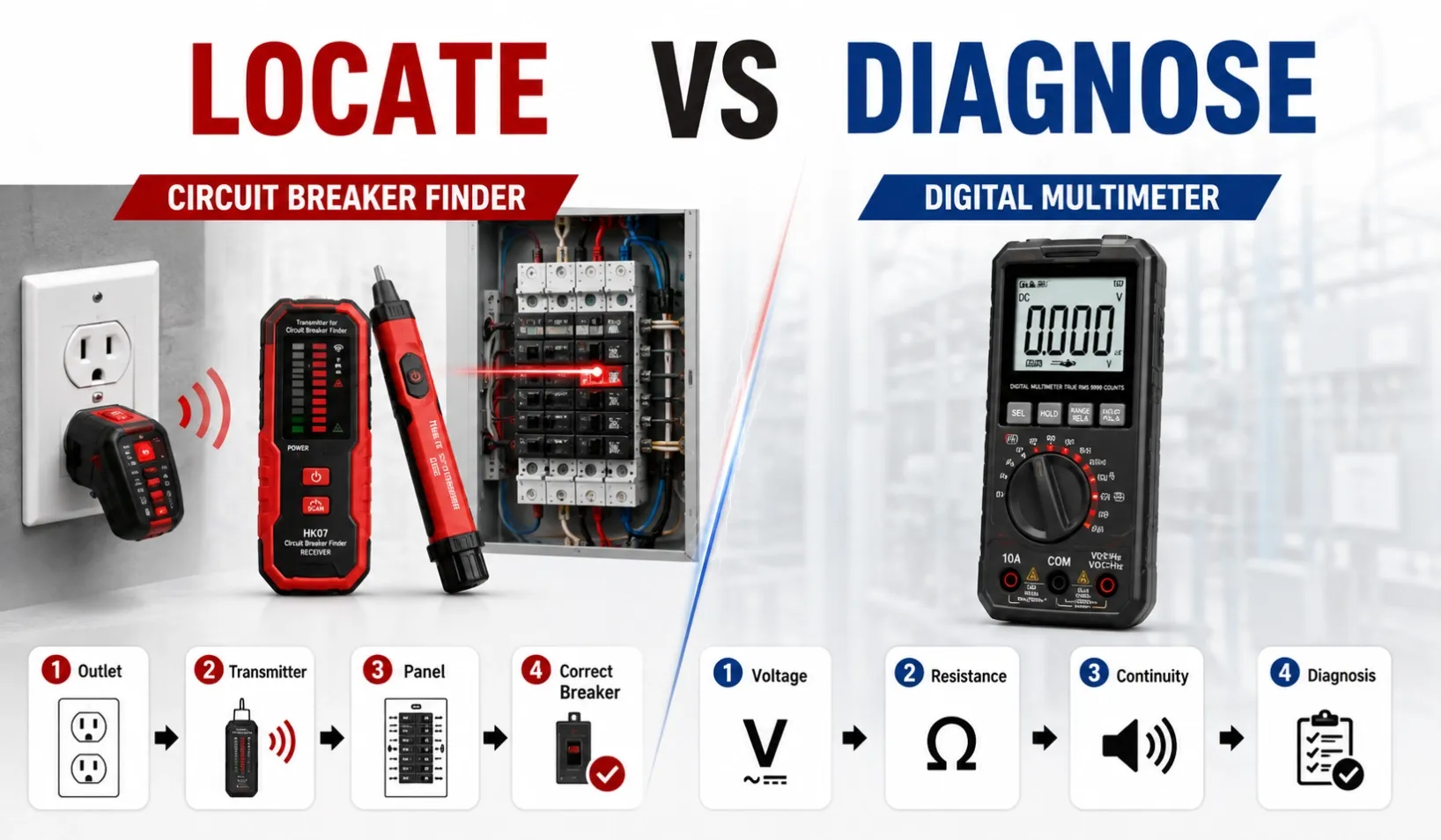
A circuit breaker finder helps locate the breaker that corresponds to a particular outlet or electrical circuit.
A digital multimeter helps diagnose the electrical condition of that circuit.
In simple terms:
- Use a circuit breaker finder when you need to locate a circuit.
- Use a multimeter when you need to measure or diagnose it.
For many electricians, the two tools are complementary rather than interchangeable.
What Is a Circuit Breaker Finder?
A circuit breaker finder is designed to help identify the breaker associated with a specific electrical outlet, fixture or branch circuit.
Most basic models use two components:
- A transmitter
- A receiver
The transmitter is connected to an outlet or fixture on the circuit being identified.
The receiver is then moved across the breakers in the electrical panel. It detects the transmitter signal and indicates the breaker most likely associated with that circuit.
More advanced circuit tracers may also be capable of tracing:
- Energized circuits
- De-energized circuits
- Fuses
- Wires behind walls
- Individual wires in bundles
- Certain underground conductors
The exact capability depends heavily on the model.
What Is a Digital Multimeter?
A digital multimeter, or DMM, is an electrical measurement instrument used for testing and troubleshooting circuits.
Depending on the model, a multimeter may measure:
- AC voltage
- DC voltage
- AC current
- DC current
- Resistance
- Continuity
- Capacitance
- Frequency
- Temperature
- Diodes
- Duty cycle
More advanced meters may also include:
- True RMS
- Min/Max recording
- Low-pass filtering
- Data logging
- Bluetooth connectivity
- NCV detection
A multimeter therefore answers questions such as:
- Is voltage present?
- Is the voltage correct?
- Is the wire continuous?
- Is a component open or shorted?
- Is resistance within the expected range?
- Is the circuit behaving normally?
It is a diagnostic tool rather than a circuit-location tool.
Circuit Breaker Finder vs Multimeter: Main Differences
Feature | Circuit Breaker Finder | Digital Multimeter |
|---|---|---|
Locate the corresponding breaker | Yes | No |
Identify branch circuits quickly | Yes | Not efficiently |
Measure exact AC/DC voltage | Usually no or limited | Yes |
Measure resistance | No | Yes |
Continuity testing | Usually no | Yes |
Measure current | No | Yes, model-dependent |
Measure capacitance | No | Yes, model-dependent |
Diagnose electrical faults | Limited | Strong |
Trace wiring | Model-dependent | No |
Test GFCI outlets | Model-dependent | Usually no |
Best use | Circuit identification | Electrical diagnosis |
The key difference is therefore straightforward:
A breaker finder tells you where the circuit goes. A multimeter tells you what is happening electrically.
When Should You Use a Circuit Breaker Finder?
A circuit breaker finder is useful when the primary problem is circuit identification.
1. Finding an unlabeled breaker
If an outlet or light fixture is working but the panel is poorly labeled, a breaker finder can help identify the correct breaker without repeatedly switching breakers on and off.
2. Mapping a distribution panel
When multiple branch circuits need to be identified, a breaker finder can make panel mapping faster and more systematic.
3. Identifying the breaker before maintenance
Before carrying out work on an outlet or fixture, electricians often need to determine which breaker controls the circuit.
A breaker finder can help locate it quickly.
This does not replace proper lockout, verification and electrical safety procedures.
4. Troubleshooting buildings with unclear circuit labels
Older commercial or residential installations may have incomplete or inaccurate panel labels.
A circuit breaker finder can reduce unnecessary trial-and-error.
5. Tracing wires with an advanced circuit tracer
Professional tracers may go beyond breaker identification and help locate conductors behind walls or trace de-energized wiring.
This capability should not be assumed for every breaker finder.
When Should You Use a Circuit Breaker Finder?
A circuit breaker finder is useful when the primary problem is circuit identification.
1. Finding an unlabeled breaker
If an outlet or light fixture is working but the panel is poorly labeled, a breaker finder can help identify the correct breaker without repeatedly switching breakers on and off.
2. Mapping a distribution panel
When multiple branch circuits need to be identified, a breaker finder can make panel mapping faster and more systematic.
3. Identifying the breaker before maintenance
Before carrying out work on an outlet or fixture, electricians often need to determine which breaker controls the circuit.
A breaker finder can help locate it quickly.
This does not replace proper lockout, verification and electrical safety procedures.
4. Troubleshooting buildings with unclear circuit labels
Older commercial or residential installations may have incomplete or inaccurate panel labels.
A circuit breaker finder can reduce unnecessary trial-and-error.
5. Tracing wires with an advanced circuit tracer
Professional tracers may go beyond breaker identification and help locate conductors behind walls or trace de-energized wiring.
This capability should not be assumed for every breaker finder.
When Should You Use a Multimeter?
A multimeter becomes important when the problem is not simply “Which breaker controls this outlet?”
Instead, the technician needs to understand the electrical condition.
1. Checking whether voltage is present
A multimeter can confirm the actual voltage at an outlet, terminal or component.
2. Diagnosing a dead outlet
If an outlet is not working, possible causes may include:
- No supply voltage
- Loose connection
- Open conductor
- Faulty breaker
- Failed outlet
- Damaged wiring
A multimeter can help distinguish between these possibilities.
3. Checking continuity
Continuity testing can help identify:
- Broken wires
- Open fuses
- Faulty switches
- Poor connections
Continuity testing should normally be performed on a de-energized circuit according to the instrument manufacturer’s instructions.
4. Measuring resistance
Resistance measurements are useful when testing components, conductors and certain electrical loads.
5. Measuring current
Depending on the meter and application, a multimeter can measure current by being connected appropriately in the circuit.
For frequent current measurement, however, a clamp meter may be more convenient.
6. Checking components
A multimeter may be used to test:
- Fuses
- Switches
- Sensors
- Batteries
- Heating elements
- Motors
- Electronic components
The available functions depend on the model.
Can a Multimeter Find a Circuit Breaker?
Not efficiently.
A multimeter can help confirm whether voltage disappears when a specific breaker is switched off, but this is not the same as automatically locating the corresponding breaker.
A technician could theoretically:
- Measure voltage at an outlet.
- Switch off a breaker.
- Measure again.
- Repeat until the correct breaker is found.
This may work, but it can be slow, especially in a large panel.
A circuit breaker finder is specifically designed to make this process faster.
For mapping many outlets or identifying an unknown breaker, the dedicated finder is generally more practical.
Can a Circuit Breaker Finder Replace a Multimeter?
No.
A circuit breaker finder may identify which breaker controls a circuit, but it usually cannot provide the detailed measurements needed for electrical diagnosis.
For example, a breaker finder generally cannot tell you:
- Whether the supply is 120 V, 230 V or another value
- Whether voltage is low under load
- Whether a conductor is open
- Whether resistance is abnormal
- Whether a component has failed
- Whether continuity exists through a circuit
- Whether current draw is within specification
That is the role of a multimeter or another appropriate electrical test instrument.
The Better Professional Workflow: Use Both
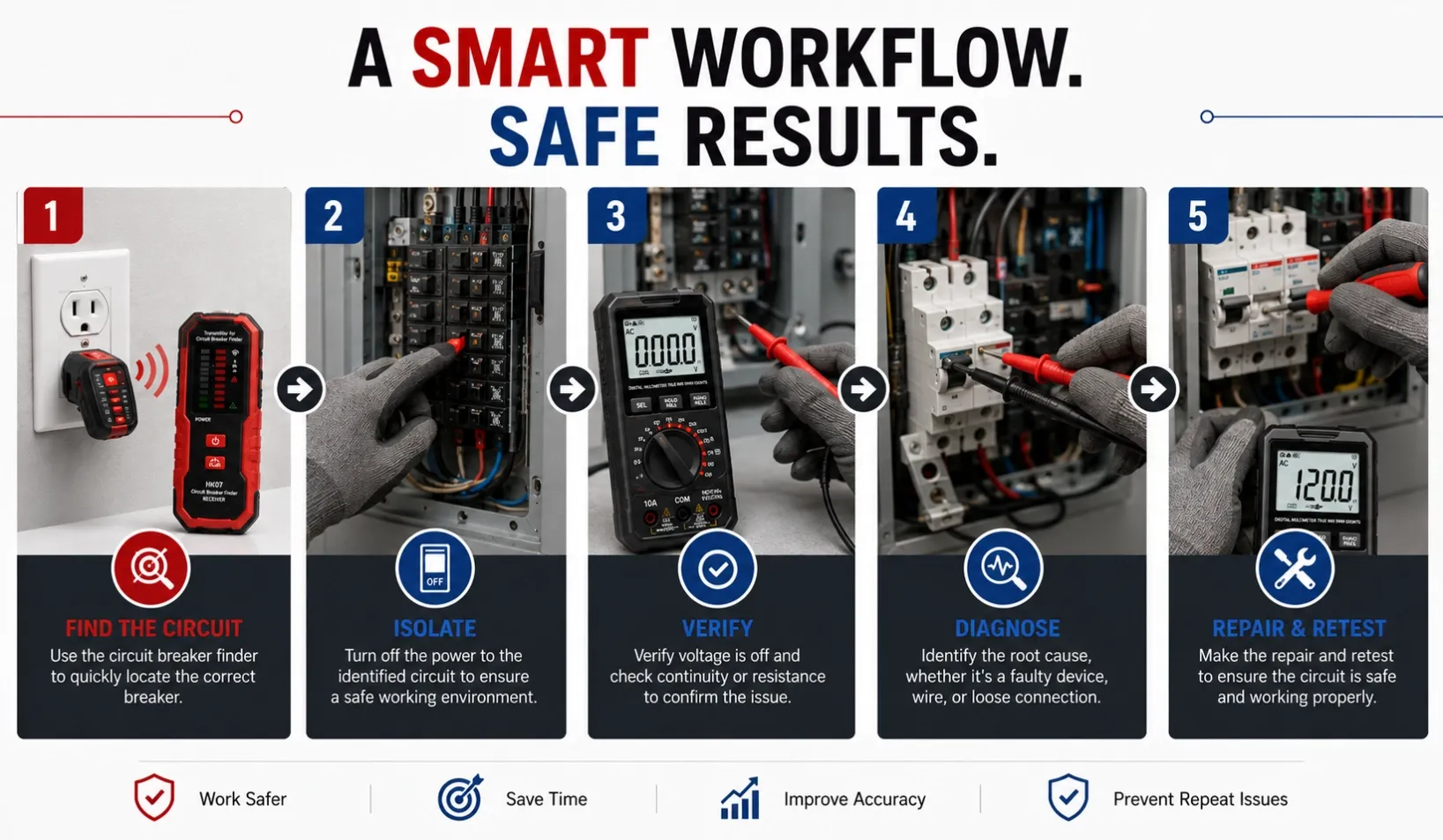
For many troubleshooting tasks, the most efficient approach is to use the tools together.
Step 1: Locate the circuit
Use a circuit breaker finder to identify the breaker associated with the outlet or fixture.
Step 2: Isolate the circuit
Switch off the identified breaker and follow applicable electrical safety and lockout procedures.
Step 3: Verify the electrical condition
Use an appropriately rated test instrument to confirm the circuit condition before work begins.
Step 4: Diagnose the problem
Use a multimeter to check:
- Voltage
- Continuity
- Resistance
- Components
- Wiring
Step 5: Repair and retest
After correcting the fault, perform the necessary measurements again to verify proper operation.
This workflow illustrates why professional electricians often carry multiple test instruments rather than relying on a single tool.
Example: A Dead Wall Outlet
Imagine an electrician is called to inspect an outlet that no longer works.
A useful troubleshooting sequence may look like this:
First question: Which breaker controls the outlet?
Use a circuit breaker finder if the panel is not clearly labeled.
Second question: Is the outlet receiving voltage?
Use a multimeter or appropriate voltage-testing device.
Third question: If voltage is missing, why?
Possible causes may include:
- Open conductor
- Loose terminal
- Tripped upstream device
- Faulty breaker
- Damaged cable
Further electrical testing is required.
The breaker finder locates the circuit.
The multimeter helps diagnose the fault.
Circuit Breaker Finder vs Circuit Tracer
These terms are sometimes used interchangeably, but the products can differ.
A basic breaker finder is typically designed to identify a corresponding breaker in a distribution panel.
A more advanced circuit tracer may support:
- Energized wiring
- De-energized wiring
- Wire tracing through walls
- Fuse identification
- Conduit tracing
- Higher-sensitivity signal detection
For professional buyers, it is important to check the actual specification rather than relying only on the product name.
What About GFCI Testing?
Some circuit breaker finder transmitters include additional outlet-testing functions.
Depending on the model, these may include:
- Wiring status indication
- GFCI testing
- Open-ground indication
- Reverse wiring indication
However, these functions vary significantly between products.
A buyer should not assume that every breaker finder includes GFCI or socket-testing capabilities.
Which Tool Is Better for Electricians?
For professional electrical work, the tools solve different problems.
Choose a circuit breaker finder when:
- You frequently work with unlabeled panels
- You need to map outlets to breakers
- You work in commercial buildings
- You perform remodeling or maintenance
- Fast circuit identification matters
Choose a multimeter when:
- You troubleshoot electrical faults
- You need exact voltage readings
- You test continuity or resistance
- You diagnose components
- You measure electrical parameters
Choose both when:
Your work involves both circuit identification and troubleshooting.
For many professional electricians, this is the most practical approach.
What Should Distributors and OEM Buyers Compare?
For distributors, wholesalers and private-label buyers, product selection should go beyond the basic question of functionality.
Circuit breaker finder purchasing criteria
Consider:
- Supported voltage range
- Outlet type
- Target market
- Transmitter/receiver sensitivity
- Auto-calibration
- Signal indication
- Audible and visual alerts
- GFCI/RCD functionality
- Wiring-status detection
- Adapter availability
- Energized/de-energized tracing capability
- Working distance
- Display type
- Battery type
- Carrying case
- Certifications
- Manual language
- OEM packaging options
Multimeter purchasing criteria
Consider:
- CAT rating
- Maximum voltage
- True RMS
- Display count
- Accuracy
- Measurement ranges
- Continuity response
- Input protection
- Fuse design
- Test lead rating
- Temperature function
- Capacitance
- Frequency
- NCV
- Accessories
- Certification
- Private-label options
Regional Compatibility Matters
Circuit breaker finders can be more market-specific than multimeters.
For example, products designed for North American electrical systems may be optimized for 90–120 V outlets and US-style receptacles.
Products for European and other international markets may require different:
- Voltage ranges
- Plugs
- Outlet adapters
- RCD/GFCI functions
- Certification requirements
This is particularly important for distributors importing products for multiple countries.
Before selecting a circuit breaker finder, buyers should confirm that the product matches the electrical system and outlet configuration of the intended market.
Common Buying Mistakes
Mistake 1: Assuming both tools perform the same job
They do not.
Circuit location and electrical diagnosis are separate tasks.
Mistake 2: Buying a breaker finder without checking the voltage range
A product designed for one electrical system may not be suitable for another.
Mistake 3: Assuming all breaker finders trace hidden wires
Advanced tracing is model-dependent.
Mistake 4: Choosing a multimeter only by feature count
Safety rating, input protection, accuracy and intended application matter more than simply having more functions.
Mistake 5: Ignoring accessories
Adapters, probes, clips and carrying cases can significantly affect usability.
Frequently Asked Questions
Can you use a multimeter to find the correct circuit breaker?
A multimeter can help confirm whether voltage disappears when a breaker is switched off, but it does not automatically locate the breaker. A dedicated circuit breaker finder is usually faster for this task.
Does a circuit breaker finder measure voltage?
Some models may provide basic voltage or wiring indication, but most are not designed to replace a multimeter for accurate electrical measurement.
Can a circuit breaker finder work on a dead circuit?
Some advanced circuit tracers can trace de-energized circuits, but many basic breaker finders require an energized circuit. Always check the product specification.
Is a circuit breaker finder useful for professional electricians?
Yes. It can save significant time when identifying circuits in unlabeled or complex panels.
Do electricians need both a breaker finder and a multimeter?
Many electricians benefit from carrying both because the breaker finder identifies circuits while the multimeter diagnoses electrical conditions.
What is the difference between a breaker finder and a circuit tracer?
A breaker finder primarily identifies the breaker associated with a circuit. A professional circuit tracer may offer additional capabilities such as tracing energized or de-energized wires through walls or conduit.
Final Thoughts
A circuit breaker finder and a digital multimeter should not be viewed as competing versions of the same tool.
They perform different jobs.
A circuit breaker finder is primarily a locating tool.
A digital multimeter is primarily a measurement and troubleshooting tool.
When the task is simply identifying the correct breaker, the breaker finder can save time.
When the task involves understanding why a circuit is not working correctly, the multimeter becomes essential.
For professional electrical work, the most effective approach is often to use both tools as part of a structured troubleshooting process.
Looking for Electrical Testing Instruments for Distribution or Private Label?
Explore our range of electrical testing instruments for professional maintenance, troubleshooting and distribution.
Available product categories include:
- Digital Multimeters
- Clamp Meters
- Voltage Testers
- Socket Testers
- Circuit Testing Tools
- Insulation Resistance Testers
- Earth Resistance Testers
OEM and private-label options may include:
- Logo customization
- Packaging
- Manuals
- Accessories
- Product labeling