
Buying Guides
Clamp Meter vs Multimeter: Which One Should You Buy?
Clamp meter vs multimeter: when to measure current without breaking a circuit, which tool suits electrical and HVAC work, and what to check before ordering.
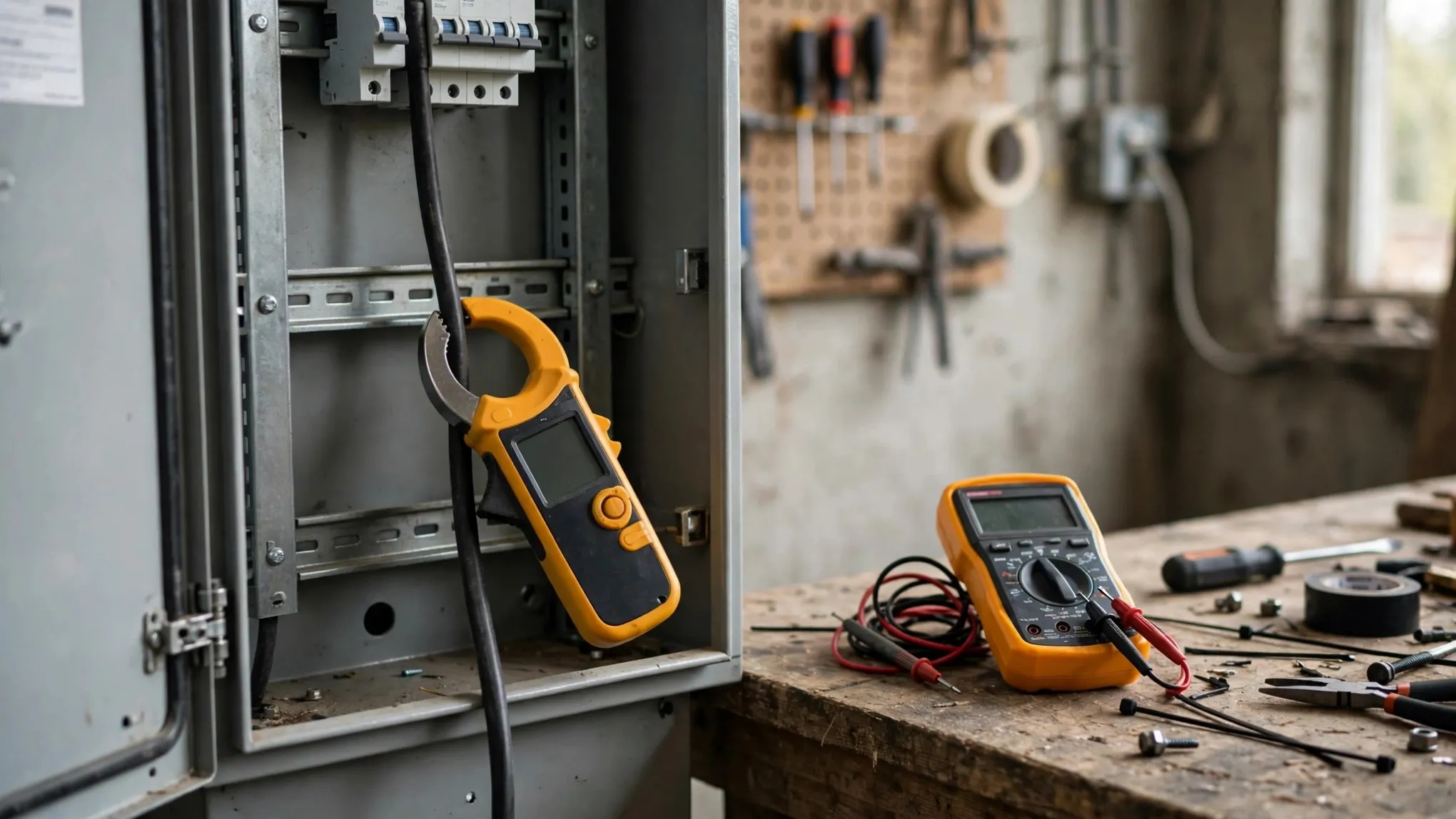
The short answer
If you mainly troubleshoot circuits, measure voltage, resistance, and continuity, start with a digital multimeter. If you regularly need to check live current — especially on motors, HVAC systems, or distribution panels — a clamp meter saves time and reduces risk because it measures current without disconnecting a conductor. Many electricians and maintenance teams carry both, and that is often the most practical answer: the two tools overlap, but they are not substitutes for each other.
For buyers, the same distinction matters: stocking the wrong mix leads to slow-moving inventory, while a well-chosen range covers both routine diagnostics and live-current checks.
What each tool does best
A digital multimeter connects to a circuit through test leads. It is the general-purpose diagnostic tool: voltage, resistance, continuity, and often capacitance, frequency, and temperature, depending on the model. It suits precise readings at a specific point, or tracing a fault through a control panel or wiring harness.
A clamp meter clamps around a single conductor and measures current through the magnetic field around it. You do not need to break the circuit, shut down the equipment, or insert the meter in series — faster and safer for live-current checks, load balancing, and verifying whether a motor or compressor is drawing the current you expect.
In short: a multimeter answers "what is happening at this point?", while a clamp meter answers "how much current is flowing through this conductor?"
Clamp meter vs multimeter at a glance
Measure voltage: Multimeter - Yes, the core use case; Clamp meter - Many models also measure voltage with leads.
Measure current without breaking the circuit: Multimeter - No; Clamp meter - Yes, its main advantage.
Measure resistance and continuity: Multimeter - Yes; Clamp meter - Often, but with fewer ranges on basic models.
Check motor or HVAC load current: Multimeter - Possible, but slower and more disruptive; Clamp meter - Fast and practical on live equipment.
Fine electronics and board-level work: Multimeter - Better suited; Clamp meter - Usually too bulky for small work.
Everyday carry for general troubleshooting: Multimeter - Excellent; Clamp meter - Excellent for field service and plant maintenance.
How to choose a clamp meter
Start with the work, not the feature list. A meter for residential service does not need the same jaw size or range as one for industrial motors, and the largest range is not automatically better: resolution at low currents matters just as much.
Check these points before you shortlist: AC, DC, or both: AC-only models suit mains and many HVAC loads. For batteries, solar, electric vehicles, or DC drives, you need DC current measurement too. Confirm this explicitly; do not assume it. Jaw size and access: The jaws must close fully around a single conductor, not a whole cable bundle. Tight panels favour a slimmer jaw; large conductors need a wider opening. True RMS: For variable-speed drives, LED lighting, or other non-sinusoidal loads, a True RMS reading is more reliable than a simple averaging reading. Safety rating: Match the measurement category and voltage rating to the environment — distribution panels demand a higher rating than bench work. If a supplier cannot state the rating clearly, treat that as a warning sign. Low-current resolution: A meter that only reads in whole amps is of limited use for small control circuits or standby-current checks. Durability and readability: Field tools get dropped, used in low light, and operated with gloves. A clear display, a hold function, and a robust case are practical features, not extras.
How to choose a multimeter
For a multimeter, accuracy and usability matter more than the longest specification sheet. Look for a clear display, reliable auto-ranging, a continuity beeper you can hear in a noisy plant, and test leads that feel secure in the sockets. The meter, leads, and fuses should be rated as a system for the work you do.
For electronics work, low-voltage ranges and good resolution count. For building services and industrial maintenance, ruggedness, a backlit display, and temperature measurement may matter more. If your team covers both, standardising on one capable model can be cheaper than managing two fleets with different leads, batteries, and training needs.
Common mistakes buyers make
The most common mistake is buying on current range alone: a meter that reads very high currents but cannot resolve a small load is a poor fit for diagnostics. The second is ignoring the safety rating, or assuming a household meter suits a three-phase panel. The third is forgetting the whole kit — leads, batteries, a case, and a manual in the language your technicians actually read.
Another frequent error is ordering in bulk before anyone has used the tool on a real job. A sample that passes a bench test can still fail in the field if the jaws do not fit your panels, the display washes out in sunlight, or auto-ranging is slow on an intermittent fault.
Sample evaluation: what to test before a bulk order
Before committing to volume, put samples through work your customers actually do: 1. Clamp a live conductor and compare the reading with a known load or a second instrument. 2. Test continuity and voltage on a familiar panel, checking speed and display clarity. 3. Try the tool with gloves, in low light, and in the tightest space your technicians face. 4. Check the jaw action after repeated use, and confirm whether leads, batteries, and a case are included.
Ask the supplier how calibration and after-sales support work: who handles a faulty unit, what the warranty process looks like, and whether calibration support is available for customers who need traceable records.
A note for importers, distributors, and private-label buyers
If you are building a range rather than buying a single tool, think in pairs: a dependable multimeter for diagnostics and a clamp meter for live-current work covers most field-service needs. Consistent branding, packaging, manuals, and barcodes reduce handling costs, and suppliers who support OEM and ODM orders can help you present that range as a coherent brand. Confirm artwork, labelling, and manual requirements early, because late changes are expensive and slow.
Questions to ask your supplier
What current types and ranges does each model cover, and what is its safety rating? What is included in the box, and what accessories are available? How are warranty claims and faulty units handled? Is calibration support available, and what documentation is provided? Can packaging, labelling, and manuals be customised for our market? What is the recommended storage and handling guidance for our climate and transport route?
If any answer is vague, ask for it in writing before you order.
Bottom line
Choose a multimeter when your priority is circuit diagnostics, and a clamp meter when your priority is measuring live current quickly and safely. If your team does both — and most field-service teams do — carry both, and choose each one against the work it will actually do. The cheapest tool is rarely the cheapest decision.
To discuss multimeters, clamp meters, and private-label options for your market, visit zydhardware.com and send an enquiry.