
Buying Guides
DC Power Supply Buying Guide for Electronics Testing
Choosing a DC power supply? Compare voltage, current, regulation, ripple and protection — plus a buyer checklist for labs and production lines.
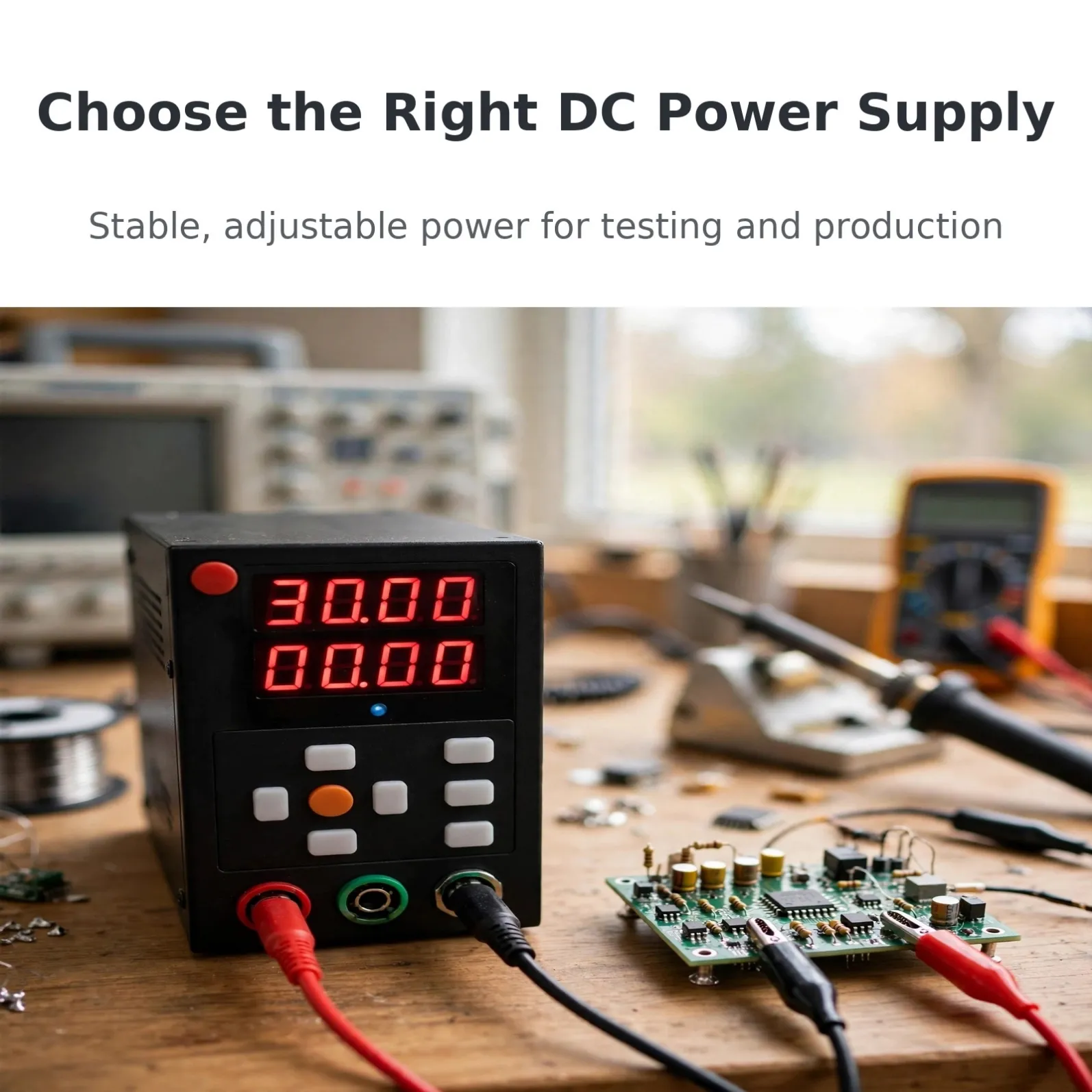
The short answer: buy for the load you actually power
A DC power supply converts mains AC into the stable, adjustable DC voltage your circuit, board, or product needs during testing, burn-in, or production. Buyers get it wrong in two predictable ways: they size it for the nominal voltage and forget the current peaks, or they pick the cheapest unit and discover ripple, drift, or missing protection only after boards start failing tests. Decide first what you will power — a 3.3 V microcontroller board, a 24 V industrial controller, a 48 V telecom module — then check voltage range, current headroom, regulation, and protection.
What a bench DC power supply actually does
A bench supply gives you a voltage you can set and a current limit you can set. In constant-voltage (CV) mode it holds the voltage steady while the load draws whatever current it needs, up to the limit. When the load tries to draw more, a good supply switches automatically to constant-current (CC) mode and caps the current instead of letting the voltage collapse or the board burn. That automatic CV/CC switching is the most important behaviour to verify — it protects both the device under test and the supply itself.
Modern bench supplies add what production and lab buyers use every day: digital displays of voltage and current, preset memory slots for common test voltages, and remote control over RS232, USB, or LAN so a test sequence can be repeated exactly.
Linear vs switching: a practical trade-off
Most bench supplies today are switching designs, but the distinction still matters. Linear supplies regulate by dissipating excess power as heat. They are quiet — low ripple and electrical noise — which suits sensitive analogue circuits and sensor front ends, but they are heavier and usually limited to lower power. Switching supplies convert power efficiently and pack far more watts into a small bench footprint; a 300 W unit in a 190 mm-wide chassis is a switching design. The trade-off is ripple and noise, so check the ripple specification when the load is noise-sensitive.
The five selection criteria that decide the purchase
1. Voltage and current range — with headroom
List every voltage your products need: 3.3 V and 5 V logic, 12 V and 24 V industrial controls, 48 V telecom or PoE equipment. A 0–30 V, 0–10 A single-output unit covers the large majority of electronics work. If you test 48 V equipment, you need a 60 V-class supply instead.
Size current with headroom. Motors, relays, and radios draw inrush current well above their steady draw. As a rule, buy at least 20–30% more current capacity than the highest peak you expect — running a supply permanently at its maximum rating shortens its life and leaves no margin for a faulty board that draws extra current.
2. Regulation and ripple
Load regulation describes how steady the voltage stays when the load current changes; line regulation describes how steady it stays when the mains voltage fluctuates. A supply whose output sags when a board wakes from sleep will produce test failures that look like product faults. Ripple is the small AC residue on the DC output, and it matters most for precision analogue circuits, ADC reference rails, and sensor measurements. If your products include any of these, ask the supplier for the ripple and noise figure at full load, and compare it in the same units (mVrms or mVp-p) across suppliers.
3. Protection: OVP, OCP, and OTP
A supply without protection is a risk to every board it powers. Check for three protections as a minimum: over-voltage protection (OVP), which cuts the output if the voltage exceeds the set limit so a fault cannot feed 30 V into a 5 V board; over-current protection (OCP), which limits or cuts output current; and over-temperature protection (OTP), which shuts the unit down before heat damages it. If a supplier cannot confirm them, treat that as a gap, not a detail.
4. Channels: single, dual, or triple output
One board often needs more than one rail — 5 V for logic, 12 V for a driver, 3.3 V for a sensor.
Configuration | Best for | Watch out for |
|---|---|---|
Single output | One rail, simple tests, repair benches | One unit per rail; bench space adds up |
Dual output, independently adjustable | Two-rail boards, comparing two units | Check whether outputs are truly independent |
Triple output / programmable | Automated test, production lines, multi-rail products | Confirm the control interface your test software supports |
A dual-output unit with independent adjustment plus a fixed 2.5 V / 3.3 V / 5 V auxiliary output covers many real test benches in one box. For production lines, a programmable three-channel unit with data logging and timed-output sequences is usually worth the premium — it removes operator error from repetitive tests.
5. Display, controls, and remote operation
In daily use, the interface matters more than buyers expect. A clear LED or LCD display showing voltage and current at a glance, an encoder knob that adjusts values precisely, and preset memory slots for common test voltages save real time across a shift. For automated testing, confirm the remote interface before ordering: RS232 is common, USB and LAN are increasingly standard, and SCPI support is what lets your test software drive the supply.
Sample evaluation: test it on your own bench first
Ask for one sample unit and run it through your real work, not just a datasheet check. Load it to your typical current at your most common voltage and watch for drift over 30 minutes. Trigger the current limit on purpose and confirm the supply switches cleanly to CC mode and recovers when the load is removed. Power your most sensitive board — if it has an ADC or a sensor front end, compare its readings against a known-good reference, because ripple shows up here first. Finally, test the remote interface from your test PC. If the supplier cannot provide a sample, or the sample behaves differently from the datasheet, pause the order and ask why.
OEM/ODM and ordering notes for distributors and brand owners
Bench power supplies are a natural private-label product: the same hardware can carry your brand, your manual, your packaging, and your barcode. Before ordering, confirm the customisation scope in writing — logo placement and printing method, manual language and content, packaging design, and the serial-number or barcode format your warehouse system needs. Ask about after-sales support the same way you would for any instrument: warranty length and what it covers, availability of spare parts such as fans and output terminals, and the lead time for repeat orders.
Questions to ask your supplier before you buy
- What are the exact voltage and current ranges, and what is the continuous (not peak) power rating?
- What are the load regulation, line regulation, and ripple figures at full load?
- Which protections are included — OVP, OCP, OTP — and how do they behave when triggered?
- How many outputs, are they independently adjustable, and what remote interfaces (RS232, USB, LAN, SCPI) are supported?
- Can I evaluate one sample unit before committing to volume?
- What OEM/ODM customisation is available — logo, manual, packaging, barcode — and what is the warranty?
The bottom line
Choose the supply by the load, not by the price tag. Match the voltage range to your products, leave current headroom, verify regulation and ripple where they matter, insist on OVP, OCP, and OTP, and test a sample on your own bench before ordering in volume.
Looking for a reliable DC power supply for your testing bench or production line? Contact us at zydhardware.com for specifications, samples, and OEM/ODM options.
Related reading on zydhardware.com: our guides to choosing an industrial multimeter, a handheld oscilloscope, and a calibration meter — the instruments that work alongside a bench supply in a complete test setup.