
Buying Guides
Do You Really Need a 20,000-Count Multimeter?
A 20,000-count display looks impressive, but counts are not accuracy. Learn when high counts help — and when a 6,000-count meter does the job better for you.
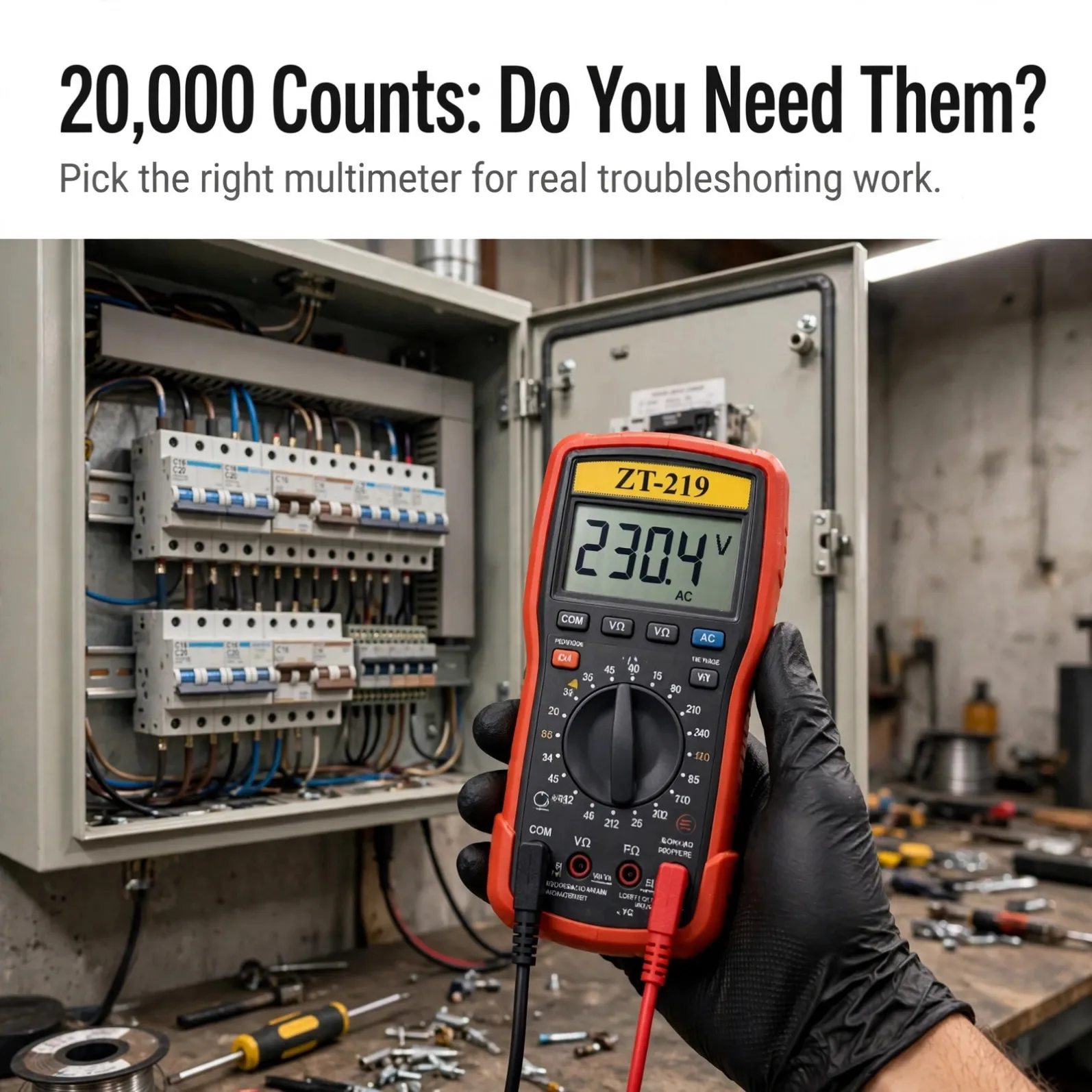
The short answer: usually not — unless you measure small signals
A 20,000-count multimeter can display up to 19,999 before it changes range. That sounds like a big step up from a 6,000-count meter, and sellers often present it that way. In practice, for most industrial troubleshooting — checking mains voltage, testing a motor, tracing a dead circuit — the extra digits change almost nothing about the decision you make from the reading.
Counts describe how finely the display can step, not how right the reading is. A 20,000-count meter with a basic accuracy specification can be less trustworthy than a well-built 6,000-count meter with tighter accuracy, proper input protection, and a readable display. Before paying for more digits, work out what you actually measure, and how small a difference matters to the fault you are chasing.
What "counts" actually mean
Counts are the largest number a meter can show on a range before it moves to the next range. A 6,000-count meter on its 6 V range shows up to 5.999 V in 0.001 V steps. A 20,000-count meter on its 20 V range shows up to 19.999 V, also in 0.001 V steps. The extra counts let the meter stay on one range over a wider span, but the smallest step is the same.
Display counts | Typical max reading on the low DC voltage range | Smallest step |
|---|---|---|
4,000 counts | 3.999 V | 0.001 V |
6,000 counts | 5.999 V | 0.001 V |
20,000 counts | 19.999 V | 0.001 V |
So the real question is rarely "how many counts?" It is "how small a change do I need to see, and at what voltage?" If your answer is "is this 230 V present or not," any of these meters answers it.
Resolution is not accuracy
This is the most expensive misunderstanding in multimeter buying. Resolution is how small a step the display can show. Accuracy is how close the reading is to the true value, written as a tolerance such as ±(% of reading + a number of digits).
Take a 24 V control supply. A meter with ±(0.5% + 3 digits) accuracy can be off by about 0.15 V at 24 V, even if its display steps in 0.001 V increments. Those last two digits look precise, but they sit inside the meter's own error band. Read the accuracy specification, not the count: two meters with the same count can have very different accuracy. And more digits can slow you down — a high-count display updates more slowly and flickers on the last digit, which makes quick go/no-go checks harder.
When high counts genuinely help
High counts earn their keep in a few jobs: low-voltage electronics and sensor signals, where 0–5 V outputs and thermocouple millivolts benefit from finer steps; 4–20 mA loop checks, where 12.02 mA versus 12.05 mA tells you something about a transmitter; small resistance changes, such as a winding drifting by fractions of an ohm; and calibration and comparison work, where finer resolution makes small differences visible. Note the pattern: high counts help when you measure small signals precisely. They add little when you measure mains, motors, and on/off states.
When 6,000 counts are more than enough
For the bulk of field work, a 4,000- or 6,000-count meter covers the job comfortably. In our catalogue, most handheld digital multimeters sit in this range, with selected models reaching 10,000 and 19,999 counts — which tells you where the industry itself draws the line for general-purpose instruments.
A 6,000-count meter is enough for verifying mains voltage (230 V, 400 V, 120 V), testing continuity, fuses, and cable runs, checking a 12 V or 24 V battery, doing HVAC checks, or working on automotive 12 V and 24 V systems. In these jobs the fault is usually a dead circuit, a bad ground, or a voltage drop of whole volts — not millivolts. Spend the money instead on what decides whether the meter survives the job: input protection, a clear backlit display, solid test leads, and a case that takes a drop.
What to check instead of counts
Put the count aside and check these five points first:
1. Accuracy where it counts. Compare the DC voltage accuracy specification, then AC voltage. A meter rated ±(0.5% + 3 digits) on DC voltage is a solid field instrument. Check the accuracy at the ranges you actually use — a meter can be accurate on DC voltage and mediocre on resistance or capacitance.
2. True RMS. On variable-frequency drives and UPS outputs, a non–True RMS meter can read far below the real voltage. If your site has drives or inverters, True RMS matters far more than an extra digit.
3. Safety rating. Check the CAT rating and the rated voltage for the measurement category where you work. A meter used on distribution boards and fixed installations needs a higher category rating than one used only on bench electronics. Confirm the rating with the supplier, and check the test leads carry the same rating.
4. Durability and readability. A meter that lives in a tool bag needs a protective holster and a display readable in sunlight and in a dark panel. Drop resistance and battery life decide whether the meter is still in service in a year.
5. The functions you actually use. Relative measurement, min/max recording, non-contact voltage detection, and a low-impedance mode for ghost voltages each solve a real field problem — the right three functions beat twenty you never touch.
How to evaluate a sample before you order
Order one sample before committing to a batch. Measure a known stable voltage and compare it with a trusted reference meter — a difference outside the stated accuracy is a reason to ask questions. Check the display at arm's length, in sunlight and in a dark cabinet, and test continuity speed. Confirm the accessories in the box — leads, probes, batteries, holster or case.
Questions to ask your supplier
- What is the DC and AC voltage accuracy, in full, including the digit count? Is the meter True RMS, and does it have a low-pass filter mode for variable-frequency drives? What is the CAT safety rating, and do the supplied test leads match it?
- What is the warranty period, and how are calibration and repair handled?
- Can the meter be supplied with a custom logo, packaging, and manual for your brand? Shenzhen Zhanyueda supports OEM and ODM orders, so branding and packaging can be arranged for volume orders — confirm the details and minimums with your supplier before you commit.
- Can you get a sample first, and what is the lead time for a trial batch?
The bottom line
Buy counts for the signals you actually measure, not for the specification sheet. For mains, motors, HVAC, and automotive work, a 4,000- or 6,000-count meter with good accuracy, True RMS, and the right safety rating does the job — and does it faster. Step up to 10,000 counts or more only when small signals are part of your daily work, and check accuracy before count.
Contact CTA: Need help choosing a multimeter for your market or your technicians? Contact us at zydhardware.com for a quotation and sample information.