
Buying Guides
Do You Really Need a 20,000-Count Multimeter?
Counts are resolution, not accuracy: a 20,000-count meter can still mislead you. Learn when high counts help, when 6,000 counts are enough, and what to check.
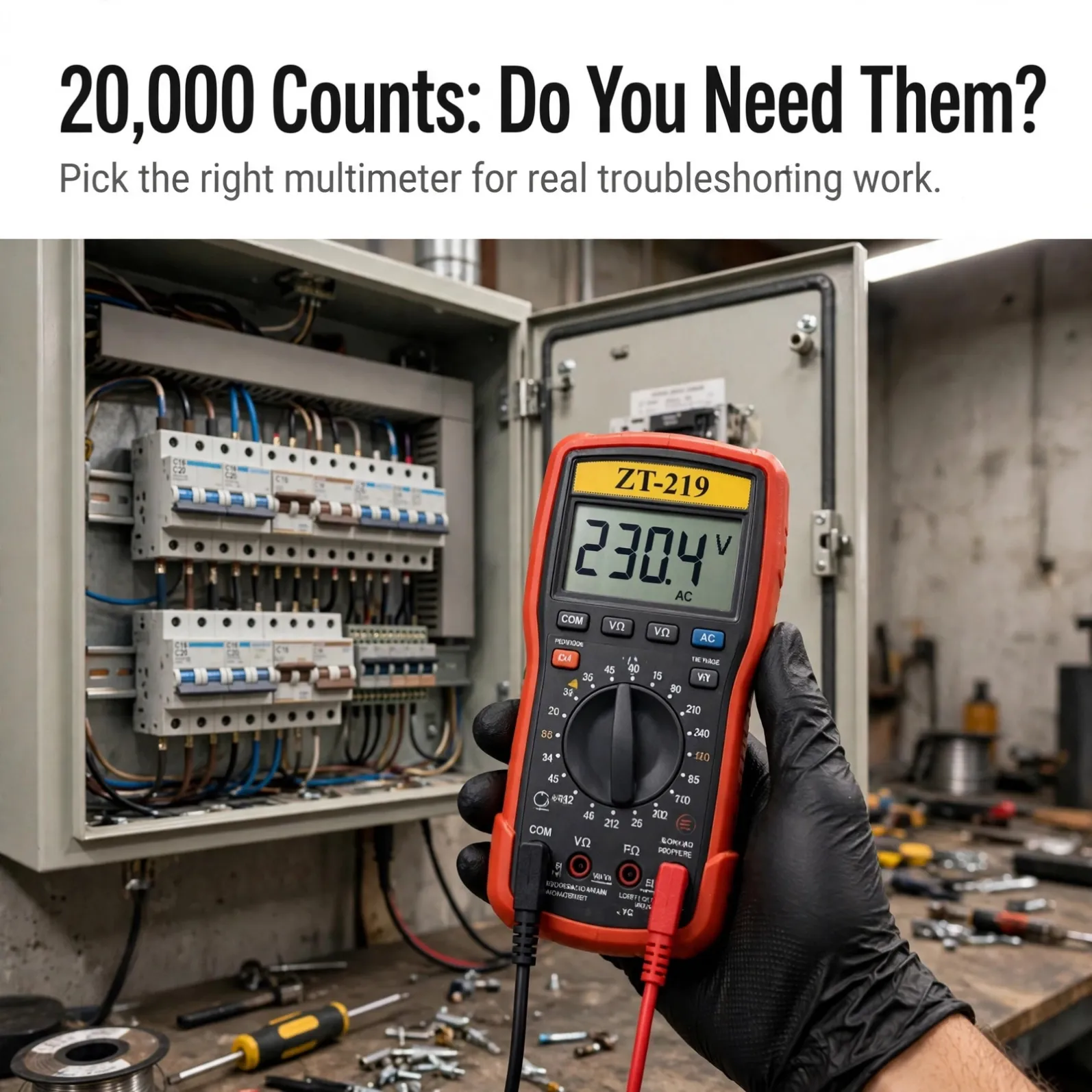
For most field work, no. A 6,000-count meter covers mains installation work, automotive 12 V checks, and HVAC troubleshooting. A 20,000-count meter earns its price only when you need millivolt-level differences — voltage drops across a connector, a sensor signal, or verification work. Counts measure resolution, not accuracy — accuracy decides whether the number is true.
1. What "counts" actually mean
Counts are the largest number a meter can display on one range before switching: 2,000 counts is 0 to 1999 (3½ digits), 6,000 is 0 to 5999, and 20,000 is 0 to 19999 (4½ digits). Resolution is the range divided by the counts, so it changes with the range in use.
A 6,000-count meter on its 6 V range resolves 1 mV per step, but a 12 V car battery forces it onto its 60 V range, where each step is 10 mV. A 20,000-count meter on its 20 V range resolves 1 mV, so it shows 12.345 V where the 6,000-count meter shows 12.34 V. The extra digit looks impressive, but a 1 mV difference changes no decision here: 12.6 V is charged, 12.0 V is not, and both meters tell you that. A 20,000-count meter is not "ten times more precise" in every situation — its advantage only appears where the job needs the extra digits.
2. Resolution is not accuracy
Accuracy is how close the displayed number is to the true value, specified as ±(percentage of reading + counts). A 20,000-count meter rated ±(0.5% + 3 counts) measuring 10.000 V can be off by 50 mV from the percentage term alone — the last two digits are decoration. A 6,000-count meter rated ±(0.05% + 1 count) measuring the same 10.00 V is off by about 5 mV: fewer digits, a more trustworthy number.
A meter can display 10.0000 V while the real voltage is 9.97 V — the display is not lying about what it computed; what it computed was simply off. Buyers fall into this trap when they buy resolution thinking they are buying accuracy, then trust a number that is quietly wrong.
Technicians on the EEVblog forum put it plainly: counts do not necessarily reflect the precision of a multimeter. Judge build quality and long-term stability first, then basic accuracy, and only then resolution. A high-count meter built from poor parts can be less accurate than a good 6,000-count meter, so read the specification table, not the headline count. Accuracy also has conditions: the Fluke 83V, a 6,000-count meter with ±0.1% DC accuracy, guarantees that figure only between 18 °C and 28 °C and for one year after calibration. An uncalibrated 20,000-count meter drifts like any other.
3. When 20,000 counts actually help
- Voltage-drop hunting. A corroded connector or tired relay contact can drop a few millivolts that a 10 mV step hides — 1 mV resolution finds faults that 10 mV steps miss.
- Small sensor signals. Thermocouple outputs, shunt voltages, and 4–20 mA loop drops all live in the millivolt range.
- Calibration and verification work. Comparing a meter against a reference source needs enough resolution to see the difference.
- Bench electronics. One EEVblog user working on battery-charging circuits needed millivolt precision below 10 V — and specified 0.1% DC accuracy to go with it. Resolution and accuracy together, not resolution alone.
4. When 6,000 counts are more than enough
For most field work, the fault is not a 2 mV difference. It is voltage present or absent, a circuit open or shorted, a capacitor failed:
- Mains installation and fault-finding: checking 230 V or 400 V presence, continuity, and insulation. Ten-millivolt resolution is irrelevant at these voltages.
- Automotive 12 V and 24 V systems: battery state (12.6 V charged, 12.0 V flat), charging voltage (13.8–14.7 V), parasitic drain. All visible at 10 mV steps.
- HVAC: capacitor values, flame-sensor microamps, temperature. What matters is a microamp range and a capacitance range, not a fourth decimal place.
In these jobs, spend the budget on what changes the result: True RMS for non-sinusoidal loads such as variable-frequency drives and LED drivers, a CAT rating matched to where you work, a low-impedance (LoZ) mode to reject ghost voltage on dead circuits, solid input protection, and a rugged housing. A 20,000-count meter without True RMS will misread a VFD output; a 6,000-count True RMS meter will read it correctly.
5. A quick decision guide
Your work | Counts that are enough | What matters more |
|---|---|---|
Mains installation and fault-finding | 6,000 | CAT rating, True RMS, LoZ mode, ruggedness |
Automotive 12 V / 24 V diagnostics | 6,000 | DC current range, duty cycle, temperature |
HVAC troubleshooting | 6,000 | Microamp range, capacitance, temperature |
Electronics repair and bench work | 20,000 | Basic accuracy of ±0.05–0.1%, low voltage ranges |
Calibration and verification | 20,000 or more | Accuracy, long-term stability, calibration certificate |
The catalogue ladder follows the same logic: 4,000-count models cover basic checks, 6,000-count True RMS models such as the ZT-M0 suit daily field work, an 8,000-count model such as the ZT-M1 adds a VFC mode, and a 19,999-count model such as the ZT-219 is for jobs where millivolt differences decide the diagnosis.
6. How to evaluate a sample before ordering in bulk
- Read the accuracy line, not the count line: compare ±(% of reading + counts) across models. A lower percentage beats a higher count.
- Compare two samples on the same known source. A stable power supply or a fresh battery is enough. If they disagree by more than their combined accuracy specifications, one of them has a problem.
- Check the low ranges. A 20,000-count meter should offer a 200 mV or 20 V range where the extra digits actually appear — otherwise the headline count buys nothing.
- Check the safety marking. Read the CAT rating printed on the meter and in its manual. A high count never compensates for a missing or fake CAT rating.
7. Questions to ask your supplier
- What is the basic DC accuracy, and how long is it valid after calibration?
- Which CAT rating applies, and has it been independently tested?
- Is True RMS standard, and is there a low-pass filter mode for drive measurements?
- Can you supply a sample and a calibration certificate before a bulk order?
- What OEM/ODM options are available — logo, packaging, manual, barcode — and what is the minimum order?
Related reading
- How to Choose an Industrial Multimeter
- Why Your Multimeter Shows the Wrong Voltage on a VFD
- How to Tell If a Multimeter's CAT Rating Is Real
- 5 Signs Your Multimeter Has Drifted Out of Calibration
The bottom line
Buy counts for the smallest difference you actually need to see. For most field work that is 10 mV, and a good 6,000-count meter with solid accuracy, True RMS, and the right CAT rating will serve for years. Choose 20,000 counts when millivolt differences decide the diagnosis, and pair it with an accuracy specification that deserves those digits. A precise display does not guarantee a precise measurement; the accuracy line does.
Looking for a multimeter matched to your market and your customers' applications? Contact Shenzhen Zhanyueda Technology Co., Ltd. at zydhardware.com for the catalogue, sample evaluation, and OEM/ODM options.