
EV NVH Testing: Why Electric Steering Needs It
EV steering whine comes from PWM switching and motor harmonics. Learn what handheld noise, vibration and speed checks can do — and when a lab NVH rig is needed.
The Short Answer
Electric steering needs NVH testing because the electric car removed the noise that hid it. In a petrol car, engine and exhaust masked the whine of the electric power steering (EPS) motor. In an EV that masking is gone, and the steering motor becomes one of the most noticeable cabin sounds. NVH (noise, vibration and harshness) testing is now a mandatory development gate. Handheld instruments cannot replace a laboratory rig, but they answer the first question: is this noise normal, is it getting worse, and where is it coming from?
Why Steering Noise Got Louder When Engines Got Quieter
First, the mask came off: an electric drivetrain is quiet at low speed, exactly when steering assist works hardest. Second, the noise source is electrical: the EPS motor is driven by pulse width modulation (PWM), switching at 4–16 kHz, with audible sidebands. The rotor magnets and stator slots also produce magnetic harmonics — a 2025 study (Energies, 2025) found the 24th order harmonic dominant in the cabin. Third, the system is mechanical too: the motor drives the column or rack through a worm gear, and a misaligned coupling adds harmonics.
The Three Sources of EPS Noise
Electromagnetic noise comes from the motor and its inverter: PWM switching, slot harmonics and torque ripple. It rises and falls with assist load, not road speed — often a pure tone that changes pitch.
Mechanical noise comes from the worm gear, the bearings and the coupling. A worn gear or loose mounting produces clicking when a turn starts, or grinding at full lock.
Structural noise is vibration travelling through the mounts into the column and body. A quiet motor can still be loud in the car if a mounting resonance amplifies one of its harmonics. It is the hardest to find by ear, since the sound seems to come from everywhere.
What Handheld Instruments Can Actually Measure
A full NVH laboratory uses a semi-anechoic chamber, multi-channel data acquisition and order-tracking software. For screening or batch checks, handheld instruments cover the measurements that matter first.
| Instrument | What it measures | What it tells you |
|---|---|---|
| Sound level meter | Sound pressure level in dB(A) | How loud the noise is, and whether it changed after a fix |
| Vibration meter | Velocity (mm/s RMS) and acceleration (m/s²) | Whether the housing is shaking, and at which frequency |
| Tachometer | Shaft speed in RPM | The speed reference for order tracking |
| Oscilloscope | PWM waveform and switching frequency | Whether the drive signal is the noise source |
| Multimeter | Supply voltage and current draw | Whether the motor draws excess current |
A sound level meter gives the noise a number instead of a description. Measure in dB(A), using Fast for a steady tone and Slow for a fluctuating one. The GM1356 (30–130 dBA, A and C weighting, USB, 4,700 readings stored) suits this spot check — but record the conditions with the number.
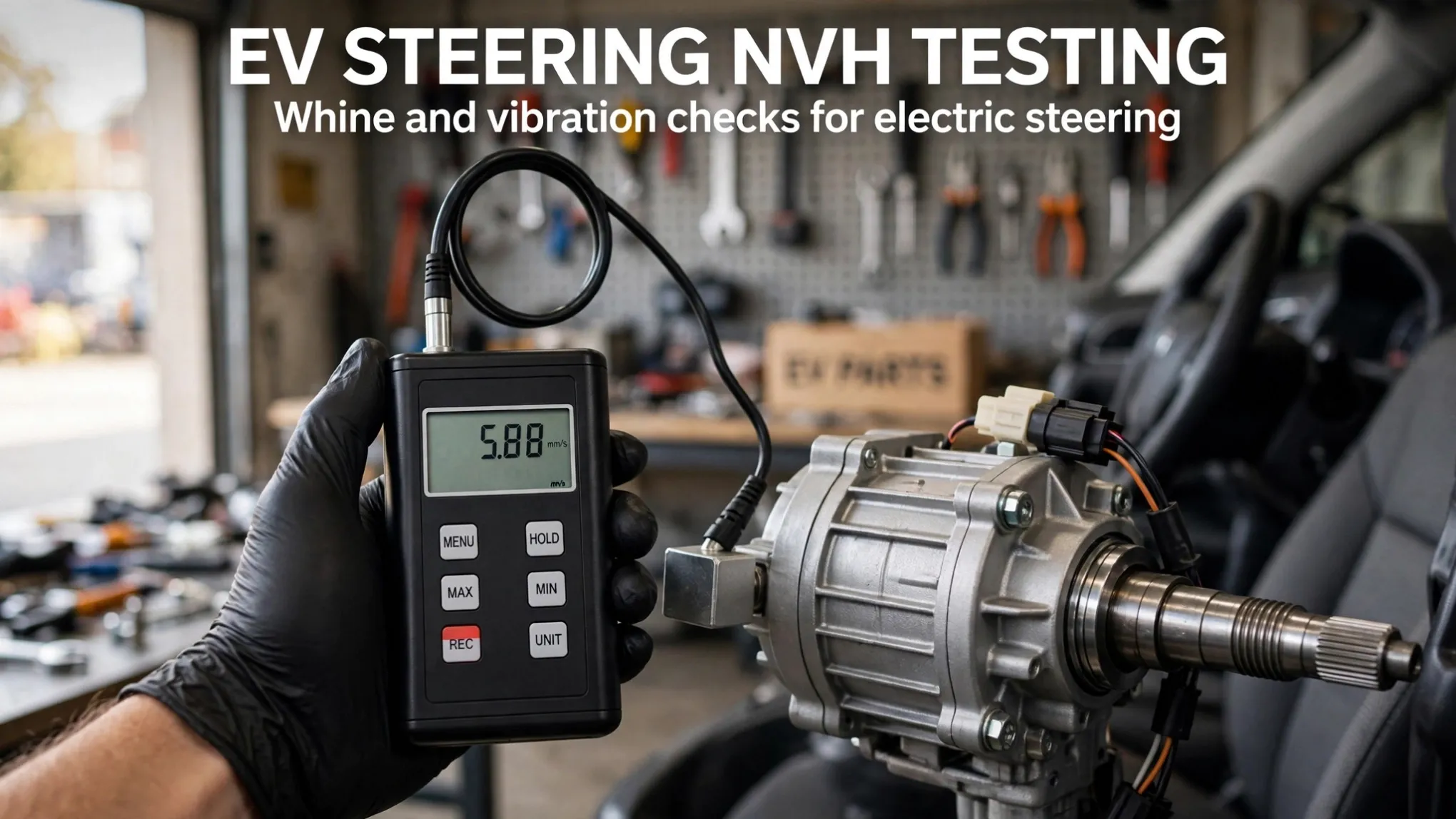
A vibration meter separates a low-frequency shake from a high-frequency bearing or gear problem: velocity in mm/s RMS is the classic overall reading, acceleration in m/s² catches the fast faults. The VM-6320 (0.1–200 m/s², 10 Hz–1 kHz and 10 Hz–10 kHz) and the VM-6380 (0.1–400 m/s², 0.01–400 mm/s True RMS) give all three in one meter. Always measure at the same point on the motor housing.
A tachometer supplies the missing link: a 24th-order whine sits at 24 times the shaft frequency, so the DT2234B (2.5–99,999 RPM) measures shaft speed without contact. The ZT-703S oscilloscope (50 MHz) shows the PWM waveform, and the ZT-219 multimeter (19,999 counts, True RMS) checks supply voltage and current draw.
What Handheld Instruments Cannot Do
A handheld meter gives single numbers — a level, a velocity, a speed. It cannot produce an order-tracked waterfall plot, measure sound power per ISO 1680, or judge how a noise feels. Those need a laboratory rig: an anechoic chamber, a microphone array, accelerometers, and software tracking each harmonic against motor speed. A certified sound power figure or a pass/fail certificate against an OEM limit is laboratory work. What the handheld kit does well is screening and trending: is this unit louder than the last one, did the noise change after a repair, is the vibration growing? For a workshop checking incoming stock, that is usually the question.
A Five-Step Field Check
A repeatable routine beats a one-off reading.
- Set the baseline. Park somewhere quiet, doors closed, radio and ventilation off. Record sound and vibration at the motor housing, steering centred, motor idle.
- Reproduce the complaint. Turn the wheel from lock to lock while stationary, then at low speed, and note when the noise appears.
- Change one variable at a time. If the noise follows steering load, the source is in the steering system; if it follows road speed, look at the drivetrain or the tyres.
- Localise the source. Move the probe from the motor housing to the column mount and then to the rack; the highest reading is closest to the source.
- Record and compare. Keep the readings with the date and vehicle; a single reading proves little, but a trend — same point, same method, rising over weeks — justifies a repair.
What to Ask a Supplier Before You Buy
Five questions separate a useful meter from a shelf ornament. Does the frequency range cover the fault? Bearing and gear-mesh vibration live in the kilohertz range. Does the sound level meter offer A and C weighting, Fast and Slow response, and data storage? Does one vibration meter give acceleration, velocity and displacement? What calibration support comes with it — a certificate and a stated interval? What accessories are in the box — a magnetic mount, a windscreen, a case that survives a workshop floor? If you buy in volume, ask about your own logo, packaging and manual, and confirm the minimum order, lead time and warranty in writing.
Frequently Asked Questions
What causes electric power steering whine?
Most often the EPS motor and inverter: PWM switching at 4–16 kHz and magnetic harmonics.
Can a handheld sound level meter do NVH testing?
It can do the screening part: how loud a noise is, and whether it changes after a repair. Full NVH testing needs a laboratory system.
What is the 24th order harmonic?
A tone at 24 times the motor's rotational frequency, from the rotor magnets and stator slots.
Why is steering noise worse at low speed?
Steering assist is highest at low speed, while road and wind noise are at their lowest. The masking disappears exactly when the assist motor works hardest.
Do I need a laboratory to fix steering NVH?
Not to find it: handheld instruments can localise the source and show whether a repair worked. A laboratory is needed only for a certified figure or a pass/fail verdict.
Next Step
Sourcing handheld instruments for EV service or motor quality checks? Start with the five-instrument kit above and test samples on a real steering motor first. For details and OEM/ODM options, contact us through www.zydhardware.com — tell us what you will measure.
Related reading: Why Your Vibration Meter Reads Differently, What Is True RMS and When Do You Actually Need It?