
Buying Guides
Ghost Voltage: Why Your Meter Reads a Dead Circuit
Your meter reads 50 V on a circuit you switched off. That is ghost voltage: induced, not real. Learn the cause and how LoZ mode proves a circuit is truly dead.
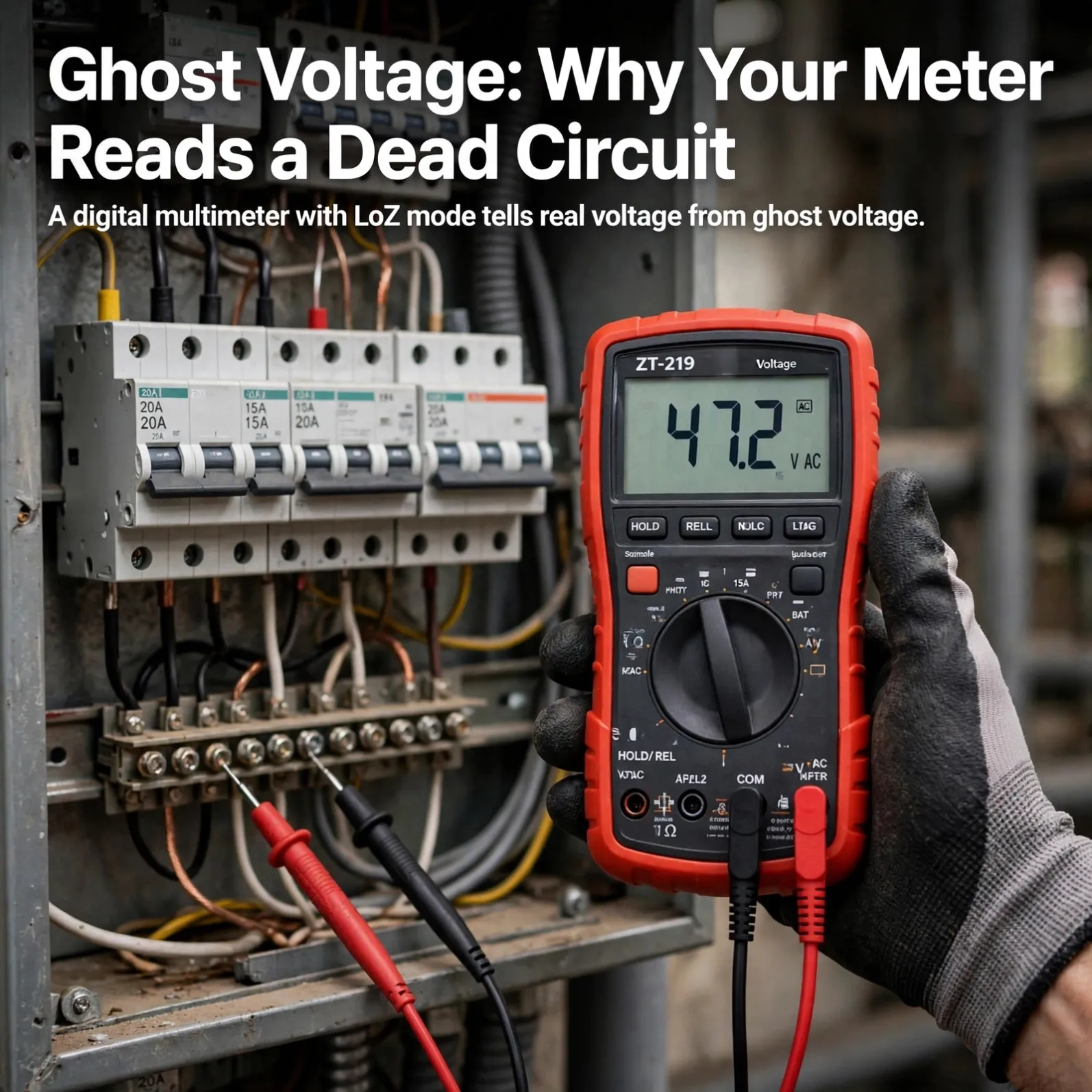
The short answer: the voltage is induced, not supplied
You switch off the breaker, put your meter on the wire, and it reads 50 V on a circuit that should be dead. The meter is not broken, and the circuit is usually not live either. That reading is ghost voltage: a small voltage induced into a disconnected wire by a live wire running beside it in the same conduit or cable. Ghost voltage can deliver almost no current, so it cannot power a load — but no electrician will touch a wire that reads 50 V, and it wastes hours chasing a fault that does not exist. The skill is telling the two apart, quickly and with proof.
What ghost voltage actually is
Ghost voltage, also called phantom voltage, comes from capacitive coupling. When an energized conductor and a disconnected conductor run side by side — in a conduit, trunking, or multi-core cable — the two act like the plates of a capacitor, with the insulation as the dielectric. The live wire's alternating field transfers a small charge to the dead wire, and a voltage appears on it. The longer the parallel run, the higher the reading: 40 to 90 V on a 120 V system is common. The meter measures a genuine potential difference, but no power source stands behind it: connect a small load and it collapses to zero.
Why a modern digital multimeter picks it up
Modern digital multimeters have a very high input impedance, typically 10 megohms or more. That is deliberate: the meter draws almost no current, so it does not disturb sensitive electronics or control circuits. But that sensitivity is also the trap. A ghost source can only supply microamps — far too little to light a lamp, yet more than enough for a 10-megohm meter to show a reading. The meter is working correctly; the error is in the interpretation. Older analogue meters and solenoid testers rarely showed ghost voltage, because their low impedance drained the coupled charge away. That points to the fix: load the circuit slightly and see whether the voltage survives.
Ghost voltage vs. real voltage: how to tell
A ghost reading has a signature. First, watch it: it is often unstable, wandering or settling on an odd value such as 45 V or 75 V. A real supply is stable and close to the expected value.
Second, test with a low-impedance (LoZ) mode. Many digital multimeters include a LoZ setting, switching input impedance down to roughly 3 kilohms. That small load bleeds the coupled charge away: if the reading drops to zero, it was a ghost; if it stays at line voltage, the circuit is live.
Third, use the live-dead-live test: prove the meter on a known live source, measure the circuit, then re-check the meter.
Check | Ghost voltage | Real voltage |
|---|---|---|
Standard range | 40–90 V, often unstable | Stable, near line voltage |
LoZ mode | Drops to ~0 V | Stays at line voltage |
Small load connected | Collapses to zero | Powers the load |
Current available | Microamps, cannot do work | Full supply current |
Where ghost voltage shows up most
Lighting circuits are the classic case: with the switch open, the wire to the fitting runs parallel to the live feed, so the switch leg reads voltage with the light off. Long conduit runs are another, especially where spare cores sit beside live ones for metres. It also appears on disconnected neutrals and control wiring run with power cables. For a distributor, this is a common support question after a meter sale — and the answer is usually a meter without a LoZ mode, or a user never told it has one.
The safety rule: never trust a reading you have not proven
Ghost voltage itself will not shock you — it cannot sustain a current. The danger is to judgement. Never assume a circuit is dead because the voltage "looks like" a ghost: a genuine fault can also produce a partial voltage. Treat every reading as real and dangerous until a LoZ check and a live-dead-live test prove otherwise. The reverse error costs money too: refusing to work on a circuit that is in fact dead wastes a day and erodes trust in the instrument. Do not use LoZ on sensitive electronics or low-voltage control boards such as PLC inputs: it can disturb the circuit. LoZ is for mains wiring, not electronics. And never switch to resistance or continuity on a circuit that may be live.
What to look for when buying a meter for this work
If your technicians work on installed wiring, ghost voltage is part of their daily work — the meter you buy them should handle it.
1. A LoZ mode. The most useful feature for this problem. Confirm it is a real low-impedance voltage mode, not a continuity beeper — and confirm it on the datasheet, not the sales page.
2. True RMS. On sites with drives, UPS systems, or LED drivers, a non–True RMS meter can also misread real voltage.
3. The right safety rating. A meter on distribution boards needs a higher measurement-category rating than one for bench electronics. Confirm the CAT rating, and check the test leads carry the same rating — a meter is only as safe as its leads.
4. Leads, display, and durability. Solid leads, a clear backlit display, and a drop-proof holster decide whether the meter is still in service a year later.
How to evaluate a sample before you order
Order one sample before committing to a batch and test it on the exact problem. Measure a known live circuit and confirm the reading against a trusted reference meter. Then find a disconnected wire beside a live one — a switched lighting leg is ideal — and measure it on the standard range: you should see the ghost reading. Switch to LoZ and confirm it drops to zero. Also confirm the box contents and ask for the full accuracy specification, warranty terms, and how calibration and repair are handled. For volume orders, confirm whether the meter can carry your logo, packaging, and manual: Shenzhen Zhanyueda supports OEM and ODM orders.
Questions to ask your supplier
- Which models include a LoZ voltage mode, and what is the input impedance in that mode?
- What is the CAT safety rating, and do the supplied test leads match it?
- Is the meter True RMS, and what is its voltage accuracy?
- What is the warranty, and how are calibration and repair handled?
- Can you supply a sample first, and what is the trial-batch lead time?
The bottom line
Ghost voltage is not a meter fault. It is what happens when a sensitive meter meets the capacitive coupling in almost every wiring system. The fix is not a more expensive meter — it is a meter with a LoZ mode to prove what the reading is. If your technicians lose time to phantom readings, the missing feature is usually LoZ. Buy the meter that can answer the question: is this voltage real, or is it a ghost?
Need help choosing a multimeter for your market or your technicians? Contact us at zydhardware.com for a quotation and sample information.