
Buying Guides
How to Choose a Battery Tester You Can Trust
How to choose a battery tester for automotive, fleet and industrial use — load testing, internal resistance, safety, and sample checks before buying in bulk.
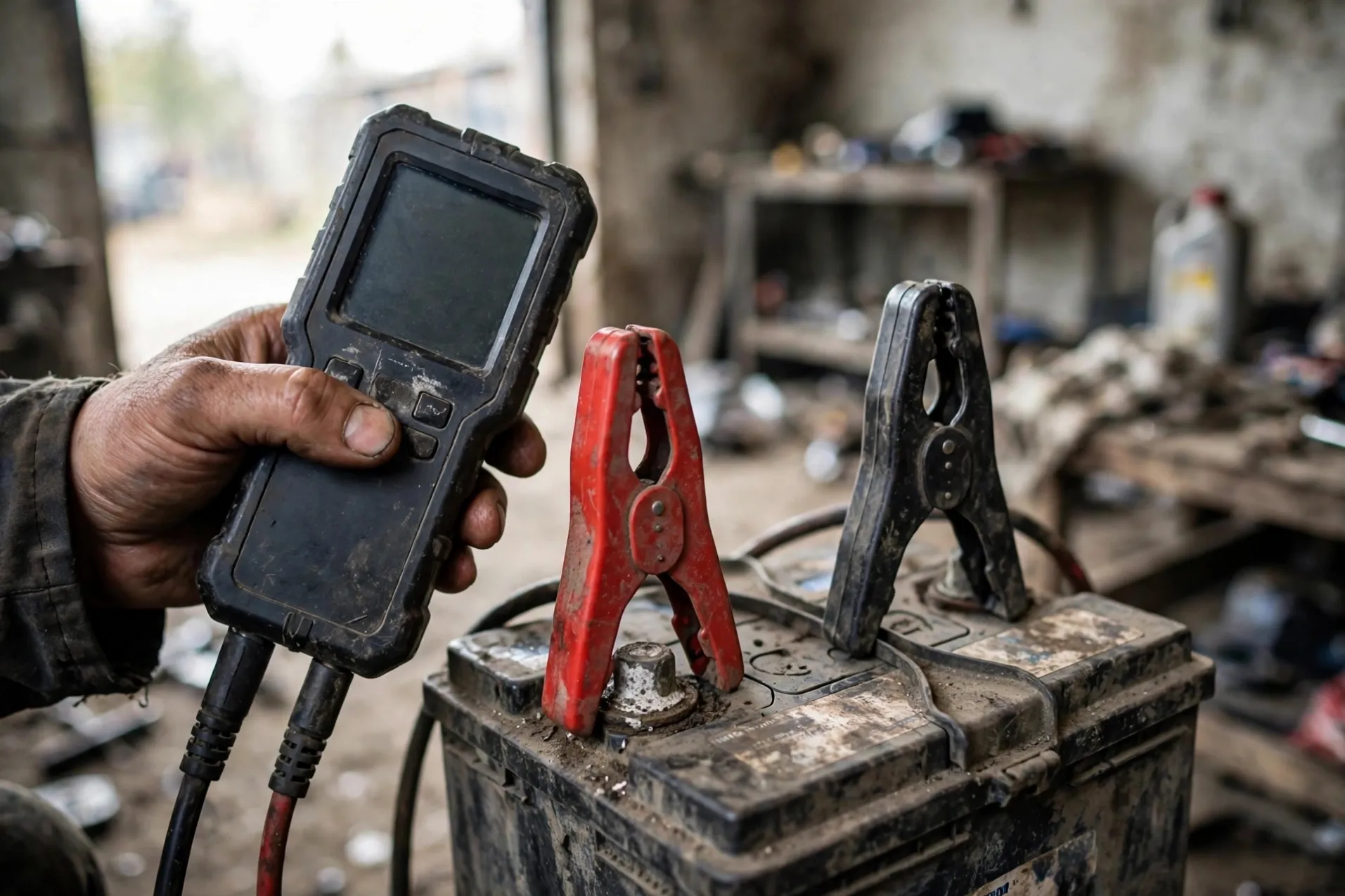
The Short Answer: Test Under Load, Not Just Voltage
If you need one rule for how to choose a battery tester, it is this: a battery showing healthy resting voltage can still fail under real work. Voltage shows the state of charge at rest. It does not show whether the battery can deliver current, hold up under load, or start an engine on a cold morning.
A useful battery tester therefore does more than display volts. It applies a load, measures internal resistance or conductance, or both, and gives a clear pass, charge-and-retest, or replace result. For importers and distributors, that matters commercially: confident, repeatable results mean fewer returns and fewer arguments with end users.
Why Voltage Alone Misleads
A lead-acid battery can read close to its nominal voltage after charging and still have sulfated plates, a weak cell, or high internal resistance. Put it under load and the voltage collapses. The same problem appears in fleet and standby use: a battery kept on a charger looks fine in the workshop and fails when the vehicle, UPS system, or solar installation actually needs it.
A multimeter is still valuable, but it answers a different question: voltage at a moment in time. A dedicated battery tester answers the decision question: is this battery still fit for service? Many complaints about battery testers are not product failures, but cases where the wrong test was used, or where temperature, state of charge, or battery type was ignored.
The Three Test Methods, Compared
Voltage check. Fast and useful as a first screen. It can identify a deeply discharged battery, but it cannot reliably grade a battery that is partly degraded. Use it for triage, not for a final verdict.
Load testing. A load tester applies a known load briefly and watches how far the voltage drops and how quickly it recovers. This comes closest to real use, and is easy to demonstrate beside a vehicle. Its limits are practical: traditional load testers can be bulky, generate heat, and must match the battery type and rating.
Conductance and internal resistance testing. These testers send a small signal through the battery and infer its condition from the response, which correlates with internal resistance. The test is fast, does not heavily discharge the battery, and suits routine fleet or standby screening. Rising internal resistance is often an early warning sign, even before starting performance visibly worsens.
In practice, choose the method that fits the job: load testing for a workshop go or no-go decision, conductance or internal resistance testing for fast screening and trend tracking, and voltage measurement as a supporting check.
Test method | Best for | Main limitation |
|---|---|---|
Voltage check | Quick triage, state of charge | Cannot reliably grade a degraded battery |
Load test | Workshop go / no-go decisions | Bulkier; test must match battery type |
Conductance / internal resistance | Fast fleet and standby screening | Needs correct battery type and rating input |
Key Selection Criteria
Battery types and ratings you actually serve. Start from your market, not a feature list. Do your customers mainly test automotive starting batteries, or also deep-cycle, AGM, gel, or lithium-based batteries? A tester covering only one chemistry will disappoint the rest of your market, while one claiming to cover everything deserves a sample test on each type you sell into. Confirm its rated range covers the batteries your customers test most often.
Clear, repeatable results. A good tester reduces operator judgement. Look for a clear display, consistent readings when the same battery is tested twice, and clamps that make solid contact without constant readjustment. Dirty terminals, loose clamps, and a low state of charge all affect results, so a tester that prompts for battery type and rating, or warns about a poor connection, helps prevent misdiagnosis.
Safety and durability. Battery testing happens around high currents and corrosive terminals, and in industrial settings around large battery banks. Check the safety rating in the supplier's documentation rather than assuming it, and consider daily workshop use: drops, dust, heat, and pulled cables. A tester that fails early damages your brand more than a slightly higher price will.
Ease of use and record-keeping. For fleet and service teams, recording results or comparing a reading with a previous test turns a one-off check into a maintenance record. A simple, consistent result format also helps a technician explain a replacement decision. If your customers need documentation for warranty or service reports, ask how results can be saved or shared before you order.
How the Choice Changes by Application
Automotive workshops need speed and a convincing result at the counter, with clamps that work on cramped terminals. Fleet operators need consistency across many vehicles: spotting a weakening battery before a breakdown is worth more than confirming a failure afterwards. Solar, UPS, and standby users need fast, non-discharging screening for batteries that must work when called upon. Distributors need all of the above, because their customers span these segments — a narrow tester limits your resale market.
Sample Evaluation: Test Before You Commit
Never judge a battery tester from a datasheet alone. With a sample, test a known good battery, a known weak battery, and a discharged battery, and check that the tester separates them clearly; test the same battery three times for consistent results; test in realistic conditions, such as slightly dirty terminals; and check whether a new technician can follow the instructions unaided. Also check the clamps, cables, and case, and whether replacements are available. If a sample fails this routine, a larger order will only multiply the problem.
OEM, ODM, and After-Sales Support
For distributors and own-brand buyers, the product is only part of the purchase. Confirm how OEM and ODM options are handled — logo, packaging, user manual, and barcode labelling — and whether those details stay consistent across repeat orders. Ask about warranty handling, spare clamps and cables, and technical support when a customer disputes a result. Clear service support is usually worth more over several orders than a lower unit price alone.
Questions to Ask Your Supplier
- Which battery types and ratings does this tester cover, and what should we confirm for types outside that range?
- How should results be interpreted for a partly discharged battery, and what retest procedure do you recommend?
- What safety rating and construction standards apply, and can you share the relevant documentation?
- What accessories and spare parts are available, and what is the warranty process for a faulty unit?
- Can you provide OEM or ODM packaging, manual, and labelling options for our market, and what do you need from us to start?
A supplier that answers directly and flags limits honestly gives you material you can pass on to your own customers.
Conclusion
Choosing a battery tester is not about the longest feature list. It is about matching the test method to your customer's decision, confirming coverage of the batteries they actually use, and verifying repeatability with a sample before buying in quantity. Get those three things right, and you sell a tool that prevents breakdowns and arguments alike.
Suggested internal links: battery tester selection guide, clamp meter vs multimeter comparison, and insulation tester selection for industrial maintenance — link to the relevant product category pages on the site.
For product details, samples, and OEM/ODM options, contact us via zydhardware.com — we will be glad to help you choose a battery tester that fits your market.