Sep 8, 2026Buying Guides
How to Choose a Digital Multimeter: A Practical Guide for Professional Buyers
Learn how to compare digital multimeters by safety category, accuracy, functions, display, durability and application before choosing models for professional use or distribution.
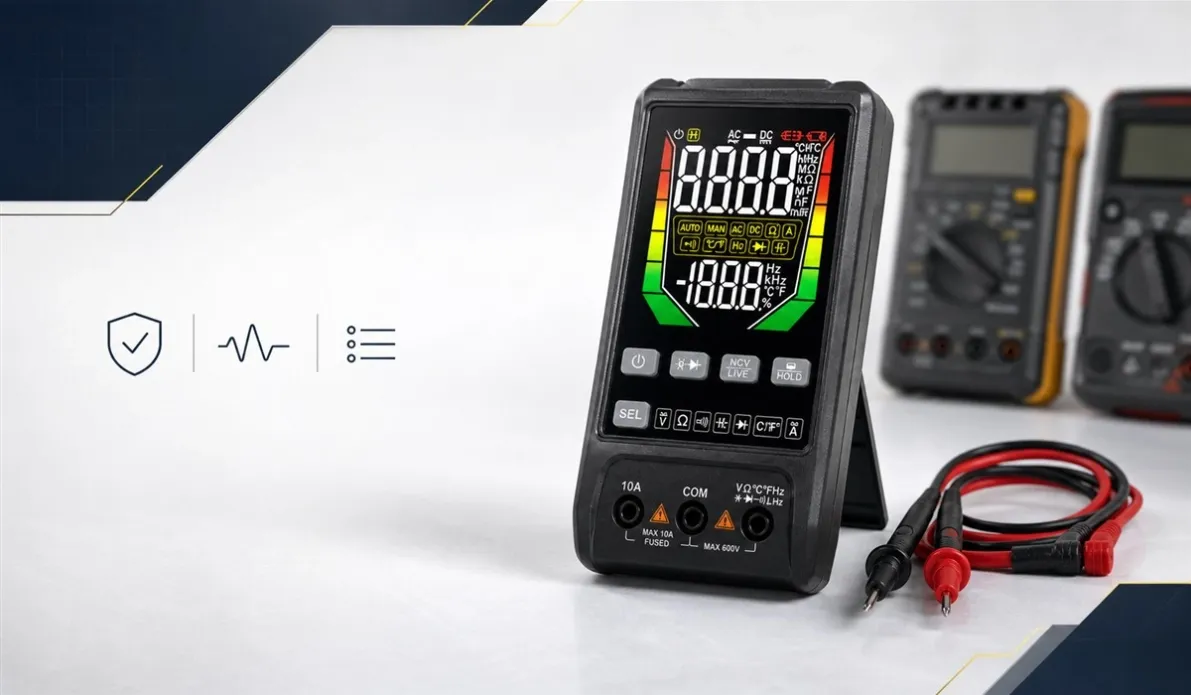
A digital multimeter is one of the most widely used tools in electrical installation, HVAC service, industrial maintenance, automotive diagnostics and electronics repair. However, two meters that look similar may differ significantly in safety, accuracy, measurement range and long-term reliability.
For professional users and distributors, choosing a digital multimeter should not be based only on price or display counts. The right model must match the application, working environment and target market.
What Is a Digital Multimeter?
A digital multimeter, often called a DMM, combines several electrical measurement functions in one portable instrument. Most models measure AC and DC voltage, current and resistance. Depending on the design, a meter may also measure capacitance, frequency, temperature, continuity, diodes or duty cycle.
Smart and professional models may add functions such as auto-ranging, True RMS, low-pass filtering, data recording, Bluetooth communication, non-contact voltage detection and rechargeable batteries.
- Start With the Application
The first question is not “Which meter has the most functions?” It is “Where will the meter be used?”
For residential electrical work, users normally need AC/DC voltage, resistance, continuity and a clear, durable display. HVAC technicians may also require capacitance, temperature and microamp measurements. Automotive technicians often need DC voltage, resistance, frequency, duty cycle and reliable low-current measurement. Industrial maintenance users may need higher safety ratings, True RMS, data recording and stronger input protection.
A basic model can be suitable for training or general troubleshooting, while work on distribution panels, motors, solar systems or industrial equipment requires a more carefully selected instrument.
- Check the Measurement Safety Category
Safety category is one of the most important specifications. Common markings include CAT II, CAT III and CAT IV. These categories describe the type of electrical environment in which the meter is designed to operate and the transient overvoltage it should withstand.
CAT II is generally associated with appliances and equipment connected to ordinary outlets. CAT III is commonly used for fixed installations, distribution panels, feeders and permanently installed equipment. CAT IV applies to the origin of an installation, utility connections and some outdoor conductors.
The category number must always be considered together with the rated voltage. A meter marked CAT III 600 V is not equivalent to CAT III 1000 V. Buyers should also review the test leads, fuses and available compliance documents instead of relying only on printing on the housing.
- Decide Whether True RMS Is Required
Standard averaging meters can provide acceptable results on clean sinusoidal waveforms. Modern electrical systems, however, often contain variable-frequency drives, electronic power supplies, LED drivers and other nonlinear loads.
A True RMS meter is normally the better choice when measuring distorted waveforms. For electricians, HVAC technicians and industrial maintenance teams, True RMS capability can improve measurement confidence in real operating conditions.
- Compare Accuracy, Resolution and Counts
Display count describes how many values the screen can show before the range changes. Common options include 2,000, 4,000, 6,000, 20,000 and higher counts.
A higher count can provide finer resolution, but it does not automatically mean better accuracy. Accuracy is normally stated as a percentage of the reading plus a number of digits. Professional buyers should compare the accuracy specification for the ranges that matter most, rather than comparing only the headline count.
Resolution, stability, update speed and repeatability also affect the practical user experience.
- Select the Right Functions
Useful functions may include:
• Auto-ranging for faster general measurements
• Manual range selection for stable troubleshooting
• Continuity buzzer with a fast response
• Capacitance for HVAC and electronic applications
• Frequency and duty cycle for signal checking
• Temperature measurement with a compatible probe
• NCV detection for preliminary voltage checks
• Data hold, relative mode, minimum/maximum and peak capture
• Low-pass filter for variable-frequency drive measurements
• Data logging or PC software for maintenance records
More functions are not always better. A clear, reliable meter with the correct core functions may be more valuable than a complex model with features the user never needs.
- Examine Input Protection and Construction
Professional meters should have suitable protection against incorrect connections and overloads. Important details can include fuse type, input jack design, PTC or MOV protection, double insulation, flame-resistant housing and reliable test leads.
Physical design also matters. Buyers should check the rotary switch, button feel, display readability, backlight, viewing angle, stand, protective holster and battery compartment. For field service, drop resistance, dust protection and water resistance may be important.
- Review Power Supply and Usability
Traditional replaceable batteries are convenient in many markets, while rechargeable lithium batteries can reduce operating cost for frequent users. If a rechargeable design is selected, consider charging interface, battery runtime, replacement availability and charging safety.
A large display is helpful, but information must remain easy to read. Automatic power-off, low-battery indication and a built-in flashlight can also improve daily use.
- Requirements for Distributors and Private-Label Buyers
Distributors should evaluate more than the instrument itself. Confirm the available packaging, manual languages, barcode labels, logo options, accessories, test leads, temperature probes and carrying cases.
Certification availability should be checked by exact model and target market. Ask for applicable test reports and declarations, and verify that the product, packaging and manual use consistent model numbers.
Before placing a larger order, it is useful to inspect samples for measurement consistency, input protection, selector durability, display quality, accessory quality and packaging accuracy.
A Practical Selection Checklist
Before choosing a model, confirm:
• Target user and main application
• Maximum working voltage and current
• Required safety category and rated voltage
• True RMS requirement
• Accuracy and display count
• Capacitance, frequency, temperature and other functions
• Manual or auto-ranging operation
• Fuse and input protection
• Display and physical durability
• Battery type and runtime
• Required language, packaging and accessories
• Certification requirements for the destination market
• Sample inspection and quality-control process
Final Thoughts
The best digital multimeter is not necessarily the model with the highest count or the longest feature list. It is the meter that provides the right measurement functions, suitable safety protection and consistent performance for its intended application.
Professional buyers should define the application first, compare technical specifications carefully and verify samples before confirming a product range. This approach helps distributors build a more focused catalogue and helps end users select instruments they can use with confidence.