Sep 11, 2026Buying Guides
How to Choose a Digital Multimeter: Professional Buyer’s Guide
Learn how to choose a digital multimeter based on accuracy, True RMS, CAT rating, measurement range, safety, applications and purchasing requirements.
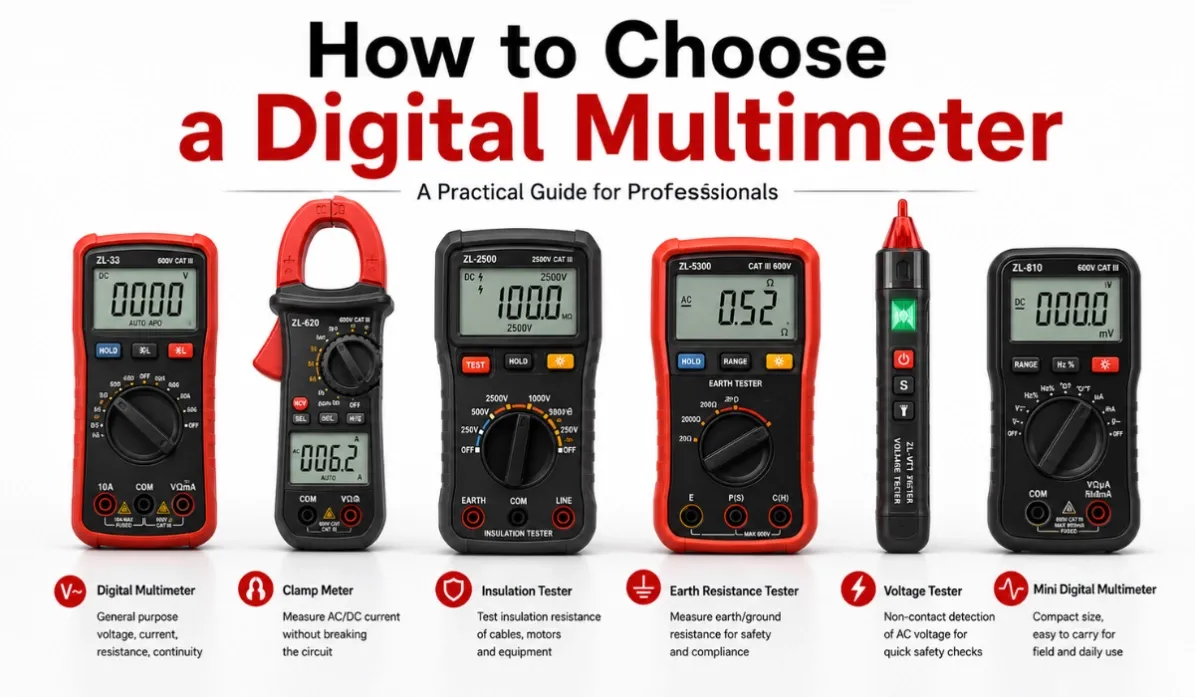
How to Choose a Digital Multimeter for Professional Use
Choosing a digital multimeter is not simply a matter of selecting the model with the longest feature list.
The right instrument depends on what needs to be measured, where it will be used, the required level of accuracy, and the electrical risks present at the measurement point. A multimeter suitable for basic electronics may not be appropriate for industrial distribution systems, HVAC equipment, photovoltaic installations, or automotive diagnostics.
For professional users and purchasing teams, the best approach is to evaluate the application first and the specifications second.
This guide explains the main factors to consider when selecting a digital multimeter for professional use.
What Is a Digital Multimeter?
A digital multimeter, commonly called a DMM, combines several electrical measurement functions in one instrument.
Depending on the model, it may measure:
- AC and DC voltage
- AC and DC current
- Resistance
- Continuity
- Capacitance
- Frequency
- Temperature
- Diode characteristics
- Duty cycle
More advanced models may also offer functions such as minimum and maximum recording, relative measurement, low-pass filtering, data logging, Bluetooth connectivity, or non-contact voltage detection.
However, more functions do not automatically make a meter more suitable. Hioki recommends beginning the selection process by identifying the functions required, followed by safety and operating-environment considerations.
1. Start With the Intended Application
Before comparing specifications, determine where and how the multimeter will be used.
General electrical maintenance
Electricians working in residential or commercial environments commonly need:
- AC and DC voltage
- Resistance
- Continuity
- AC and DC current
- Capacitance
- Frequency
- A suitable CAT safety rating
- Durable test leads
A clear display, fast continuity response and reliable input protection may be more valuable than numerous specialized functions.
Industrial electrical work
Industrial technicians may encounter motor controls, variable-frequency drives, distribution panels and non-linear loads.
They may require:
- True RMS measurement
- A higher measurement-category rating
- Min/Max recording
- Frequency measurement
- Low-pass filtering
- Temperature measurement
- Strong overload protection
HVAC and refrigeration
HVAC technicians often need to measure electrical and environmental parameters during the same service visit.
Useful functions may include:
- AC voltage and current
- Capacitance
- Frequency
- Temperature
- Microamp measurement
- True RMS
- Min/Max recording
A temperature probe and a compact design can be particularly useful for field service.
Electronics and repair
For circuit-board diagnostics and electronic repair, the priorities are often different:
- Higher resolution
- Low-current measurement
- Capacitance
- Frequency
- Diode testing
- Fast continuity
- Stable resistance readings
- Good probe-tip access
A very high CAT rating may be less important in low-energy electronic circuits, but input protection and correct operating procedures still matter.
Automotive diagnostics
Automotive technicians may prioritize:
- DC voltage and current
- Resistance
- Frequency
- Duty cycle
- Temperature
- Min/Max recording
- Stable low-voltage readings
The selected functions should match the types of sensors, charging systems and electrical circuits being tested.
2. Check the Measurement Category and Voltage Rating
Safety should be evaluated before convenience features.
Multimeters are commonly marked with measurement categories such as CAT II, CAT III and CAT IV. These categories relate to the instrument’s ability to withstand transient overvoltages in different parts of an electrical installation.
In general:
- CAT II applies to measurements on circuits directly connected to low-voltage equipment and receptacle-level loads.
- CAT III applies to distribution-level circuits, including fixed installations, distribution panels and many industrial systems.
- CAT IV applies near the origin of the installation, including utility connections, service entrances and electricity meters.
Fluke describes CAT III environments as distribution-level systems and CAT IV environments as locations closer to the utility connection and service entrance.
A label such as “CAT III 600 V” includes both a category and a maximum working voltage. These two parts should always be considered together.
A CAT IV 600 V meter and a CAT III 1000 V meter are not interchangeable descriptions. The appropriate choice depends on the measurement location, expected system voltage and applicable safety requirements.
The test leads and accessories must also be rated appropriately. Using high-category-rated instrumentation with unsuitable probes can undermine the protection of the overall measurement setup.
Never choose a meter solely because it has the highest printed voltage range. Confirm that the stated rating is supported by proper product documentation and applicable test standards.
3. Decide Whether True RMS Is Necessary
One of the most important differences between professional multimeters is the AC measurement method.
An average-responding meter can provide acceptable results on a clean sine wave. However, many modern electrical loads produce distorted waveforms.
Examples include:
- Variable-frequency drives
- Electronic lighting controls
- Computer power supplies
- HVAC control systems
- Inverters
- Switching power supplies
- Other non-linear loads
A True RMS meter calculates the effective value of both sinusoidal and distorted AC waveforms within its specified operating limits. Fluke notes that average-responding meters can produce significant errors when measuring non-sinusoidal signals, while True RMS instruments are intended to provide more reliable readings in these applications.
True RMS should therefore be prioritized when the meter will be used with:
- Motor drives
- Industrial controls
- Modern HVAC systems
- Inverter-based equipment
- Electronic power supplies
- Distorted or uncertain waveforms
For basic checks on clean, stable sine-wave circuits, an average-responding model may be sufficient. For professional distribution and industrial product ranges, True RMS is generally the more versatile choice.
It is also important to check the meter’s bandwidth, crest-factor specification and minimum AC input specification. The words “True RMS” alone do not describe performance under every possible signal condition.
4. Understand Accuracy, Resolution and Counts
These three terms are related, but they do not mean the same thing.
Accuracy
Accuracy indicates how close a measured result is expected to be to the actual value under specified conditions.
A specification may be expressed in a form such as:
±(0.5% of reading + 2 digits)This means the possible error includes both a percentage of the displayed value and a number of least-significant display counts.
When comparing meters, check:
- The specified function
- The selected range
- Operating temperature
- Calibration interval
- Whether the accuracy is stated as percentage of reading or full scale
Resolution
Resolution is the smallest change in the input that the meter can display on a selected range.
A meter can have high resolution but still have modest accuracy. More displayed digits do not automatically mean the reading is closer to the true value.
Keysight distinguishes accuracy as closeness to the true value and resolution as the smallest detectable or displayed change.
Display counts
Display count indicates the largest number the screen can show before switching to another range.
Common handheld meter counts include:
- 2,000 count
- 4,000 count
- 6,000 count
- 10,000 count
- 20,000 count
- 60,000 count
For example, a 6,000-count meter can display values up to approximately 5,999 before changing range.
Higher count can provide better displayed resolution, but the practical value depends on the meter’s underlying accuracy, stability and application.
For general electrical service, a 4,000- or 6,000-count model may be sufficient. Electronics, laboratory work and precision diagnostics may benefit from higher resolution and tighter accuracy specifications.
5. Compare the Required Measurement Ranges
A professional buyer should compare the ranges needed for real applications, rather than selecting the model with the highest number in every category.
Review at least:
- Maximum AC voltage
- Maximum DC voltage
- Maximum AC current
- Maximum DC current
- Resistance range
- Capacitance range
- Frequency range
- Temperature range
Also check the resolution and accuracy within the ranges that will actually be used.
For example, a meter with a very high maximum capacitance range may still be unsuitable if it is slow or inaccurate in the range most frequently used by an HVAC technician.
Similarly, measuring high current directly through a handheld multimeter requires inserting the meter into the circuit. For frequent current measurement, a clamp meter may offer a safer and more convenient solution because it measures current without opening the conductor path.
6. Choose Between Auto-Ranging and Manual-Ranging
An auto-ranging multimeter automatically selects an appropriate measurement range. This can make general troubleshooting faster and reduce the chance of selecting an unsuitable range.
A manual-ranging meter requires the user to select the range.
Auto-ranging advantages
- Easier for general users
- Faster when the expected value is unknown
- Convenient for changing measurement conditions
- Reduces unnecessary range switching
Manual-ranging advantages
- Greater control over display behavior
- Potentially faster when the expected range is known
- Useful when monitoring small changes
- Often available on lower-cost models
Many professional meters provide both automatic and manual range selection. This offers convenience during initial testing and control during more detailed diagnostics.
7. Evaluate the Functions That Support Real Troubleshooting
Additional features should be judged by how often they solve a real problem.
Fast continuity response
A slow continuity buzzer can make cable tracing, switch testing and repetitive production checks frustrating. Response speed and threshold behavior matter in practical use.
Min/Max recording
This function captures the highest and lowest values during a test period. It can help identify intermittent voltage drops, fluctuations and startup behavior.
Relative mode
Relative measurement allows the user to compare a reading against a stored reference. It can also help compensate for test-lead resistance in certain low-resistance measurements.
Frequency and duty cycle
These functions are useful when checking control signals, switching circuits, automotive sensors and some HVAC systems.
Capacitance
Capacitance measurement is especially relevant for HVAC service, motor capacitors and electronic troubleshooting.
Temperature
A compatible thermocouple input can reduce the need to carry a separate thermometer, although users should check the specified temperature range and probe limitations.
Low-pass filter
A low-pass filter can help stabilize voltage readings in certain variable-frequency-drive applications by reducing the influence of high-frequency components.
Data logging and connectivity
Data storage, USB or wireless connectivity may be useful for maintenance records, trend analysis, remote observation and quality-control applications.
These features are valuable only when they support the intended workflow. A purchasing decision should not be based on feature quantity alone.
8. Inspect the Input Protection and Fuses
The internal design of a multimeter is just as important as its display and functions.
Professional models may include:
- High-energy fuses
- Input protection components
- Overload protection
- Protected terminal design
- Clear terminal warnings
- Incorrect-lead-position alerts
Before purchasing, check:
- Whether the current inputs are fused
- Fuse type and replacement availability
- Maximum current duration
- Overload limits
- Terminal layout
- Safety documentation
A low-cost meter with a long function list may not be the best choice for demanding electrical environments if its protection system is unclear.
9. Consider the Display and Physical Design
Field instruments must remain usable in real working conditions.
Important factors include:
- Display size
- Backlight
- Viewing angle
- Bar graph
- Button layout
- Rotary-switch feel
- Glove-friendly operation
- Protective case
- Drop resistance
- Dust and water resistance
- Battery access
- Auto power-off
- Built-in stand
- Magnetic hanging options
An electrician working inside a dim panel has different needs from a repair technician working at a clean bench.
The enclosure should also match the expected environment. For outdoor, construction or industrial use, durability may matter more than compact size.
10. Do Not Overlook the Test Leads
Test leads are part of the measurement system, not a minor accessory.
Check:
- CAT and voltage rating
- Current rating
- Insulation quality
- Probe-tip exposure
- Finger guards
- Cable flexibility
- Connector quality
- Replaceability
- Available clips and accessories
Shorter exposed probe tips can reduce the risk of accidental bridging in crowded electrical panels. Removable caps can allow one lead set to support different measurement environments, provided the applicable safety requirements are followed.
For distributors and private-label buyers, replacement leads and compatible accessories should be considered during product selection, not after the product has launched.
11. Match the Meter to the User
There is no single best multimeter for every professional.
For electricians
Prioritize:
- CAT III or CAT IV rating appropriate to the application
- True RMS
- Fast continuity
- Durable leads
- Strong input protection
- Clear display
- Min/Max recording
For HVAC technicians
Prioritize:
- True RMS
- Capacitance
- Temperature
- Frequency
- Microamp measurement where required
- Compact field design
- Magnetic hanging option
For electronics technicians
Prioritize:
- Higher resolution
- Stable low-voltage measurement
- Low-current ranges
- Diode testing
- Capacitance
- Frequency
- Fast continuity
- Fine probe accessories
For automotive technicians
Prioritize:
- DC voltage and current
- Frequency
- Duty cycle
- Min/Max
- Temperature
- Low-voltage resolution
- Durable leads and clips
For industrial maintenance teams
Prioritize:
- Appropriate CAT rating
- True RMS
- High voltage and current capability
- Low-pass filtering
- Min/Max
- Data logging
- Strong environmental durability
12. What Should Distributors and OEM Buyers Compare?
A distributor should evaluate more than the technical specification sheet.
Important commercial and supply-chain considerations include:
- Target-user positioning
- Entry-level, mid-range and professional price tiers
- Function overlap between models
- Required certifications
- Product consistency
- Calibration and inspection procedures
- Packaging options
- Manual languages
- Logo and private-label options
- Minimum order quantity
- Lead time
- Warranty terms
- Spare test leads and accessories
- After-sales support
- Availability of product images and marketing materials
A product range should be easy for customers to understand. Too many models with nearly identical specifications can create confusion, increase inventory risk and make sales training more difficult.
A practical catalogue may include:
- A basic model for general measurements
- A True RMS model for professional electrical work
- An HVAC-oriented model with capacitance and temperature
- A high-safety industrial model
- A compact or smart model for portable use
The exact mix should be based on the target market rather than copied from a competitor’s catalogue.
Digital Multimeter Selection Checklist
Before making a purchasing decision, confirm the following:
- What will the meter measure?
- Where will it be used?
- What CAT and voltage rating is required?
- Is True RMS necessary?
- What accuracy and resolution are needed?
- Which measurement ranges matter most?
- Are capacitance, temperature or frequency required?
- Does the meter have suitable input protection?
- Are the test leads correctly rated?
- Is the display suitable for the working environment?
- Are product documentation and certifications available?
- Are replacement accessories available?
- Does the model fit the intended price position?
- Is OEM or private-label customization required?
Frequently Asked Questions
Is a True RMS multimeter always necessary?
Not for every application. An average-responding meter may be sufficient for clean sine-wave signals. True RMS is the better choice when testing variable-frequency drives, electronic power supplies, HVAC controls, inverters and other loads that may produce distorted waveforms.
Is a higher display count always better?
No. Higher count improves displayed resolution, but accuracy, stability, input protection and measurement range must also be considered.
What CAT rating should an electrician choose?
The correct rating depends on the location in the electrical installation. Work on distribution panels and fixed installations may require CAT III equipment, while measurements near service entrances and utility connections may require CAT IV equipment. The working voltage must also be checked.
Can a digital multimeter measure current?
Yes, if the model includes an appropriate current input and range. The meter must normally be connected in series with the circuit. For frequent or high-current measurements, a clamp meter may be more convenient.
What is the best multimeter for HVAC technicians?
An HVAC-oriented model commonly includes True RMS, capacitance, temperature, frequency and suitable current-measurement capability. The appropriate CAT rating and working-voltage range should match the equipment being serviced.
What is the difference between accuracy and resolution?
Accuracy describes how close a reading is expected to be to the actual value. Resolution describes the smallest change the meter can display. A meter can show many digits without necessarily providing high accuracy.
Conclusion
The best digital multimeter is not necessarily the model with the most functions or the highest maximum range.
A professional purchasing decision should begin with the application, electrical environment and user requirements. Safety rating, True RMS capability, accuracy, resolution, input protection, test leads and practical usability should then be evaluated together.
For distributors and private-label buyers, product positioning, certification, documentation, customization and long-term supply support are equally important.
A well-selected multimeter provides useful measurements, supports safer working practices and fits clearly into the intended product range.
Looking for Digital Multimeters for Distribution or Private Label?
Explore our range of digital multimeters for electrical maintenance, HVAC service, electronics, automotive diagnostics and industrial applications.
OEM and private-label options may include:
- Logo printing
- Customized packaging
- User manuals
- Function selection
- Accessories
- Product labelling