
Buying Guides
How to Choose a Lux Meter for Lighting Compliance
Choosing a lux meter for workplace lighting checks? Compare range, accuracy, LED measurement and data logging — plus a sample checklist for B2B buyers.
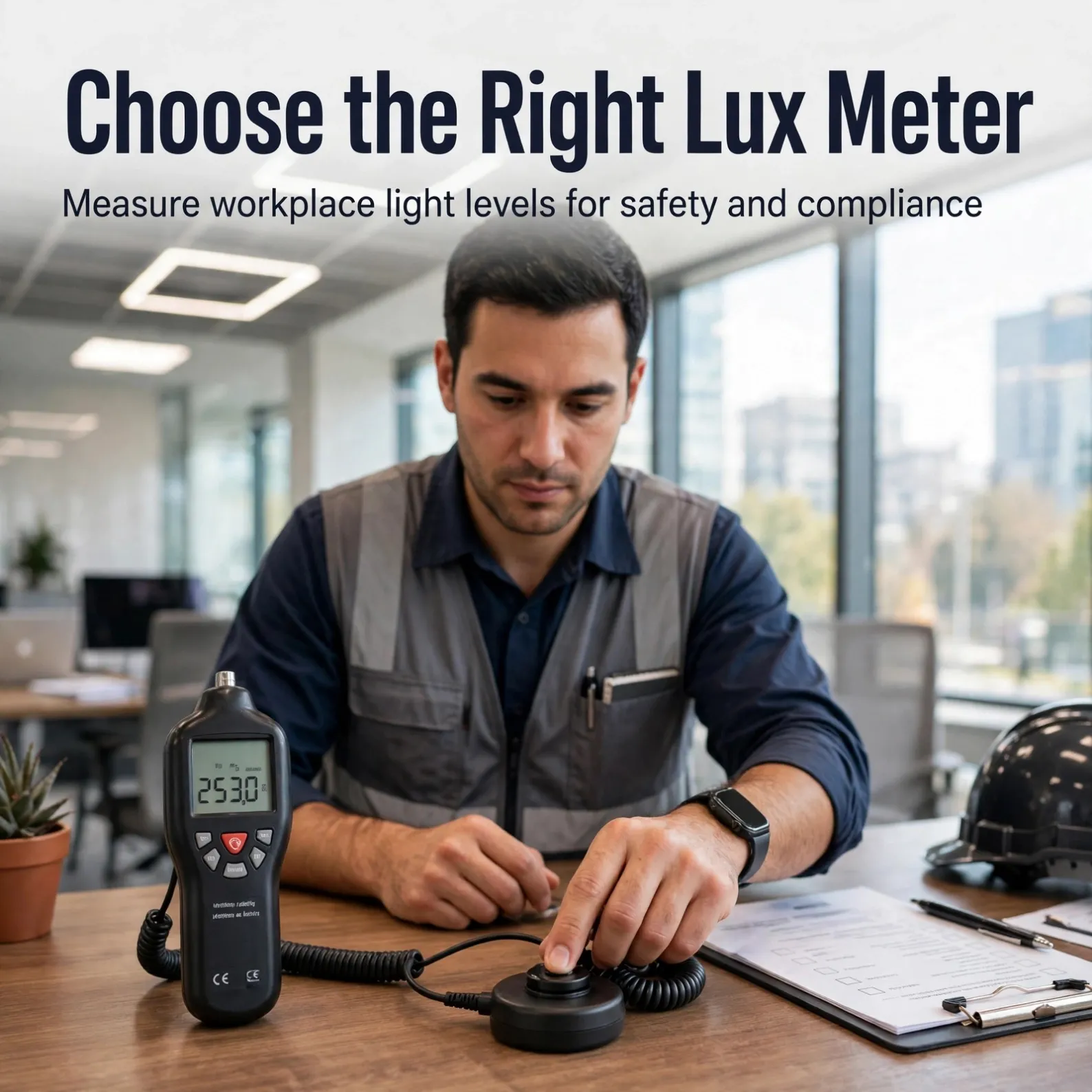
A lux meter earns its keep when a lighting question needs a number: is this warehouse floor bright enough, does this office meet the contracted lighting level, did the LED retrofit deliver the promised light? The right meter comes down to four things: range covering dim corridors and bright daylight, accuracy you can defend in an audit, a sensor that reads modern LED light correctly, and a way to record the result.
What a Lux Meter Actually Measures
A lux meter measures illuminance — light falling on a surface — in lux (lumens per square metre). One foot-candle equals about 10.76 lux, and most meters switch between the two.
Typical readings: a dim corridor 50–100 lux, a warehouse aisle 100–200 lux, an office around 500 lux, an inspection bench 750–1,000 lux. Daylight near a window can exceed 10,000 lux; direct sunlight reaches 100,000 lux. That spread is why range matters: a meter topping out at 20,000 lux cannot verify daylight, while 0.1 lux resolution suits emergency-lighting checks in dark stairwells.
Why Lighting Levels Are a Procurement Decision
For importers and distributors, lux meters sell into a compliance workflow: facility managers audit lighting against standards such as EN 12464-1 or local workplace codes; LED retrofit contractors must prove the new installation meets the specified levels before final payment; safety officers document light levels in risk assessments. In each case the buyer wants a defensible measurement, not a gadget.
A meter that only shows a live reading is fine for a quick check, but an audit needs a record of where and when each reading was taken. Models with memory or data logging turn a walk-around into evidence. And because LED lighting now dominates new installations, a meter designed for old incandescent and fluorescent sources can misread LEDs by a meaningful margin, a real source of disputes after a retrofit.
6 Specifications That Decide Whether the Reading Holds Up
1. Measuring range
Catalogue models in this class typically cover 0.1 to 200,000 lux (0.01 to 20,000 foot-candles): the low end for emergency lighting, the high end for daylight. If your customers only check indoor artificial lighting, 0–100,000 lux is usually enough. Prefer auto-ranging — faster on a walk-around, and it avoids reading the wrong scale.
2. Accuracy
Most handheld models in this class quote around ±4% of reading in the mid-range, widening to ±10% above 10,000 lux. Higher-grade models hold ±2% up to 20,000 lux and ±3% above. For a quick check, ±4% is fine. For an audit or a retrofit acceptance test, where the reading decides whether a contractor gets paid, the tighter class is worth the difference.
3. Sensor quality
The sensor, not the display, is where cheap meters fail. Check cosine correction, so angled light is still measured correctly, and a detachable sensor on a cable, so the operator can hold the sensor flat on the work surface while reading the display. Pocket meters with a fixed sensor are convenient, but for audit work the separate probe is the choice.
4. LED measurement
LED spectra differ from the incandescent and fluorescent sources that classic lux meters were calibrated against, and some meters read LEDs noticeably high or low. A few catalogue models state LED measurement explicitly — one lists "can measure LED" as a feature, another is an LED illuminometer with auto-ranging. If your customers audit LED-lit spaces, ask the supplier directly whether the model is rated for LED sources, and test the sample under LED and fluorescent light at the same brightness.
5. Resolution and sampling speed
Resolution of 0.1 lux (or 1 lux on higher ranges) is standard and enough for workplace checks, and sampling time of about 0.5 seconds is typical. More useful in practice is a data-hold function, so the reading can be frozen while the operator writes it down, and max/min for finding the darkest corner of a room.
6. Data logging
A meter with internal memory — for example 32,000 readings — can record a whole floor's grid and be downloaded later. Some models also measure temperature and humidity alongside light. For a distributor, data logging moves a lux meter from the "nice tool" shelf to the "compliance kit" shelf — and justifies a higher price point.
Which Model Fits Which Job
Buyer / use case | What to prioritise |
|---|---|
Facility audit and compliance checks | 0.1–200,000 lux range, ±2–3% accuracy, detachable sensor, data logging |
LED retrofit verification | LED-rated measurement, auto-ranging, data-hold and max/min |
Warehouse and logistics safety checks | Wide range, rugged housing, long battery life, lux/fc switching |
Quick checks by maintenance teams | Pocket size, low weight (~115 g), auto-zeroing |
Indoor environment surveys | Combined light, temperature and humidity measurement in one device |
How to Evaluate a Sample Before You Order
Never approve a lux meter from a datasheet alone. On the sample, compare it against a second meter under the same light; test it under LED and fluorescent light at equal brightness; check a dim corridor at 50–100 lux for a stable reading; tilt the sensor 30–45 degrees to test cosine correction; and measure near a bright window to confirm it reads into five figures without saturating. If a supplier cannot provide a sample, that is itself useful information.
Common Mistakes Buyers Make
- Buying on maximum range alone. A 200,000 lux rating means little if accuracy above 10,000 lux is poor.
- Assuming all meters read LED correctly. Confirm LED capability with the supplier and test it.
- Measuring at the wrong height. Standards specify the work plane — desk height (0.75–0.85 m) or floor level for walkways.
- Taking one reading per room. Light varies across a space; a grid of points is the minimum.
- Ignoring calibration. Ask how often it should be recalibrated and whether the supplier offers calibration support.
- Forgetting units. A display locked to lux frustrates buyers in foot-candle markets; switching costs little.
OEM and Private-Label Notes
For importers and brand owners, lux meters are a straightforward OEM category: logo printing, custom packaging, a manual in the buyer's language and a barcode are the usual requests. Confirm which are included and which carry a setup cost, and check the manual's measurement instructions match the standards your customers audit against. Ask which specifications are covered by a certificate for your market, and verify them for your model.
Questions to Ask Your Supplier
- What is the range and accuracy in each band?
- Is the model rated for LED light, and how was that verified?
- Does the sensor have cosine correction and is it detachable?
- Does it store readings that can be downloaded?
- For OEM: what logo, packaging, manual and barcode options are available?
The Bottom Line
For workplace lighting compliance, choose by range first, LED capability second and accuracy third — then let data logging decide between models that pass those three tests. A 0.1–200,000 lux range with a detachable, cosine-corrected sensor covers most audit work. Test the sample under LED light, at low light and in daylight before you order.
Related reading on this site: a guide to choosing an industrial multimeter, a comparison of clamp meters vs multimeters, and a guide to choosing a sound level meter for industrial use — useful companions when you are building a complete workplace safety and compliance kit.
Looking for a lux meter for your market? Contact us through zydhardware.com for samples, specifications and OEM options.