
Buying Guides
How to Choose a Manometer for HVAC and Industrial Use
Choosing a manometer for HVAC or industrial pressure checks? Compare differential vs gauge types, range, accuracy and overpressure — plus a sample checklist.
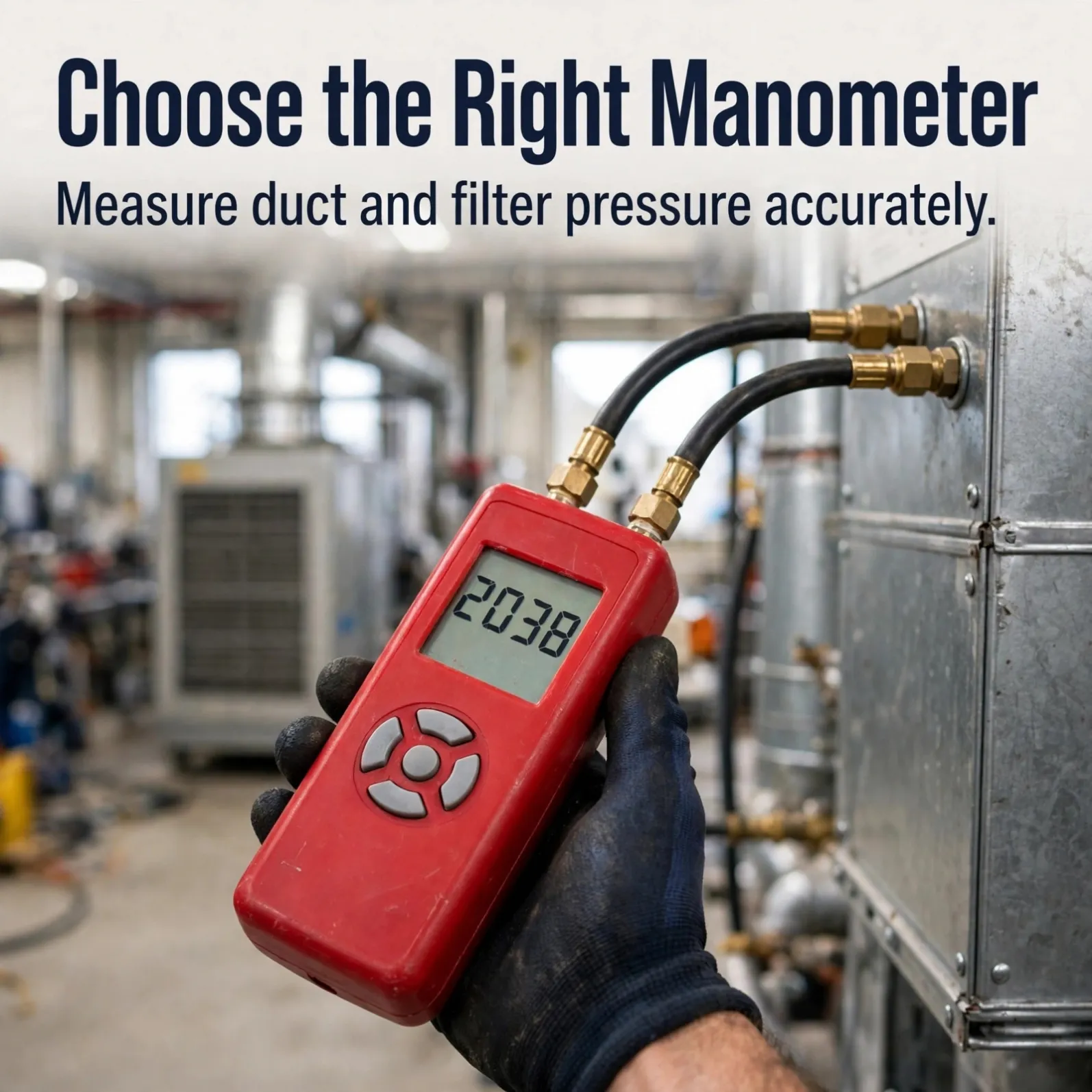
A manometer earns its keep when a pressure question needs a number: duct static pressure on design, a filter loaded enough to change, one cleanroom truly above the next? The right meter comes down to four things: the right type (differential or gauge), a range covering the pressures you meet, accuracy you can trust, and overpressure headroom so one wrong connection does not kill it.
What a Manometer Actually Measures
A manometer measures the pressure of air or gas in ducts, pipes, rooms and equipment. Handheld models fall into two families: a gauge-pressure meter reads pressure against the surrounding atmosphere through one port, while a differential-pressure meter uses two ports and reads the difference between them — the reading that matters for most HVAC and cleanroom work.
Pressure comes in many units: psi and inches of water column (inH2O) in North America, pascals and kilopascals (Pa, kPa) in much of Europe and Asia, millibar (mbar) elsewhere. A meter that switches between units — the TC-168 offers 12 selectable scales and units — avoids conversion errors on site.
Differential vs Gauge: Choose by the Job
| Differential manometer | Gauge manometer |
|---|---|---|
How it works | Two ports; reads the difference between them | One port; reads pressure against atmosphere |
Best for | Duct static pressure, filter pressure drop, room-to-room pressure, fan performance | Supply pressure, line pressure, single-point checks |
Typical reading | Small differences — often only tens or hundreds of pascals | The full pressure at one point |
Limitation | Needs access to both pressure points and two hoses | Cannot show a pressure drop across anything |
Most HVAC buyers need differential first: filter condition, duct static pressure and cleanroom cascades are all differences between two points. A gauge meter fits when the question is simply "what pressure is in this line?" — a gas supply or pneumatic line. A differential meter can cover a gauge job with one port open to air, but check the datasheet first.
Where Buyers Actually Use a Handheld Manometer
- HVAC commissioning and balancing: duct static pressure, total external static pressure across a fan, and pressure drop across filters and coils — the readings that show whether a system delivers its design airflow.
- Filter and building maintenance: a filter's pressure drop rises as it loads, so a regular reading tells you when the drop reaches the limit, not the calendar.
- Cleanrooms and controlled environments: pharma, food and electronics spaces hold one room slightly above the next so air flows the right way through the door — small differences, so the meter needs fine resolution and stable repeatability.
- Gas appliance servicing: supply and burner pressure on boilers and heaters (qualified technicians only). Here range and overpressure margin matter more than fine resolution.
- Industrial and pneumatic checks: line pressure, pressure loss across a component, and pressure decay over time when checking for leaks.
8 Specifications That Decide Whether the Reading Holds Up
1. Measuring range
Match the range to the job, not to the catalogue maximum. Duct and filter work lives at low pressure — the TL-100 (+2 psi, about +13.8 kPa) or TC-168 (±2.999 psi, about ±20.7 kPa). Gas and industrial work needs more: the TL-102 (+10 psi, about +68.9 kPa) or GM510 (±35 kPa). Normal readings should sit mid-range, not near either end.
2. Accuracy
Handheld manometers in this class typically quote around ±0.3% of full scale (FSO) at 25 °C — the figure our TC-168, TL-100, TL-102 and GM510 all carry. Note that "of full scale" is a fixed amount: ±0.3% of a 10 psi range is ±0.03 psi at any reading. A wide-range meter is therefore a poor choice for small pressures — its absolute error can exceed the difference you are trying to measure.
3. Linearity, hysteresis and repeatability
These decide whether the meter repeats: typical figures are linearity/hysteresis around ±0.29% FSO and repeatability around ±0.2% (maximum ±0.5% FSO). If a datasheet hides these, ask — a drifting meter is worse than a slightly less accurate one that repeats.
4. Resolution
Resolution is the smallest change the display can show. For duct and cleanroom work, where the difference that matters may be only a few pascals, check it at the bottom of the range, not just the top — where a weak meter hides a coarse step.
5. Response time
Around 0.5 seconds (GM510) is typical — fast enough to follow a fan starting up or a damper moving. A slow meter smooths away the change you are trying to see, so ask for the figure.
6. Maximum (over-) pressure
This is the pressure the meter survives, not the range it measures. The GM510 measures ±10 kPa but survives 50 kPa; its ±35 kPa version survives 150 kPa. A meter on the wrong line should survive the mistake — ask for the maximum pressure, not just the range, and whether it applies to both ports.
7. Display, data hold and connectors
A large backlit LCD matters in a dim plant room; a dual display (TL-102) shows two readings at once. Data hold (TL-100, GM510) freezes a reading so it can be noted after the probes are pulled away. Check the connection: the TL-100 uses two 1/8-inch (3.18 mm) quick connectors, and the hoses must fit your customers' test ports.
8. Battery, size and durability
A 9 V battery (TC-168, TL-100) or four AAA cells (GM510) are easy to find anywhere. Low-battery warning and auto-off (TL-102) stop a flat battery producing a confident-looking wrong number. At around 180 g and 160 × 70 × 34 mm, the TC-168 is genuinely pocketable — a meter that stays in the van never gets used.
Which Model Fits Which Job
Buyer / use case | What to prioritise |
|---|---|
HVAC commissioning and air balancing | Differential, low range (±2.999 psi class), 12 selectable units, fast response |
Filter monitoring and building maintenance | Differential, fine resolution at low pressure, data hold |
Gas appliance servicing | Higher range (+10 psi class), generous maximum-pressure margin, dual display |
Cleanroom and controlled environments | Differential, repeatability around ±0.2%, Pa/kPa units, data hold |
General industrial and pneumatic checks | ±35 kPa class, overpressure headroom, 0.5 s response |
How to Evaluate a Sample Before Ordering
- Zero check. With both ports open to air, the reading should sit at zero; leave it a few minutes and watch for drift — a wandering zero is the most common fault in a cheap meter.
- Known-pressure check. Compare against a reference gauge or a water column at low pressure; agreement within the quoted accuracy is what to expect.
- Both ports. Apply pressure to each port in turn — a differential meter must read positive one way and negative the other, by the same amount.
- Repeatability. Take the same reading five times; scatter beyond the quoted repeatability means the meter or the connection is at fault — find out which before you buy.
- Hose and connector test. Fit the supplied tubing, tug gently, and check the reading does not wander — a loose connector leaks, and a leak looks exactly like a faulty meter.
Confirm what is in the box: hoses, adaptors, batteries, carrying case. Missing tubing is the most common reason a first order comes back as a complaint, not a repeat order.
Questions to Ask Your Supplier Before You Buy
- Is the meter gauge, differential, or both — and which models cover each?
- What is the range in your customers' units, and what accuracy applies at 25 °C?
- What are the linearity, hysteresis and repeatability figures — not just the headline accuracy?
- What is the maximum pressure the meter survives, on each port?
- What is the response time and the resolution at the bottom of the range?
- Which connectors and hoses are included, and do they fit your customers' ports?
- Is calibration supported, with a certificate or a calibration service for repeat orders?
- For OEM or ODM orders: can the logo, packaging, manual and barcode be customised, and what is the minimum order for a custom version?
A supplier that answers directly, with a datasheet behind each answer, is usually one whose meters behave the same in the field.
The Buying Decision in One Paragraph
Buy the range first and the meter second. For duct pressure, filter drop or room differences, buy a differential meter that puts normal readings mid-range, with accuracy around ±0.3% of full scale and repeatability around ±0.2%. For gas or line pressure, buy the range up and check the maximum-pressure margin first. Either way, insist on a sample that passes the zero, both-ports and repeatability tests — a meter true on the sample will be true on the hundredth unit.
Shenzhen Zhanyueda Technology Co., Ltd. (www.zydhardware.com), founded in 2024, supplies handheld test and measurement instruments for electrical, HVAC, automotive and industrial maintenance, with OEM/ODM service for distributors and private-label buyers.
Related reading on this site: how to choose an anemometer for HVAC airflow; how to choose an infrared thermometer for industrial use; how to choose a gas detector for industrial safety; how to choose a moisture meter.
Want a sample or a quotation? Contact us through www.zydhardware.com with the pressures you need to measure, the units your customers use, and whether you need differential, gauge, or both — and we will recommend a model and a sample for your evaluation.