
Buying Guides
How to Choose a Metal Detector for Industrial Use
Choosing an industrial metal detector? Compare underground detectors, wall scanners and pinpointers by detection depth, discrimination and job — before you buy.
The Short Answer: Choose by the Job, Not by Maximum Depth
A metal detector is only as good as its match to the job. A wall scanner that finds rebar before drilling cannot locate a buried cable, and a deep-search underground detector is the wrong tool for screening visitors at a gate.
Before comparing models, define the job in one sentence: what metal, in what material, at what depth, and how often. That answer decides the type of detector you need; everything else follows from it. The quoted maximum depth is the least reliable number on a datasheet — usually measured under ideal conditions with a large target, and real jobs are rarely ideal.
The Four Types a Buyer Will Meet
1. Wall Scanners (Stud, Rebar and Live-Cable Detectors)
These compact handheld units detect wood and metal studs, steel rebar in concrete, and live AC cables behind plaster, brick or drywall, so a worker can drill or cut without hitting a pipe, cable or reinforcement. Detection depth for rebar is measured in tens of millimetres, not metres. Accuracy depends heavily on the wall material and on calibration against the surface before each scan, so a model that auto-calibrates is worth more on a busy site than one with a longer spec sheet.
2. Underground Metal Detectors
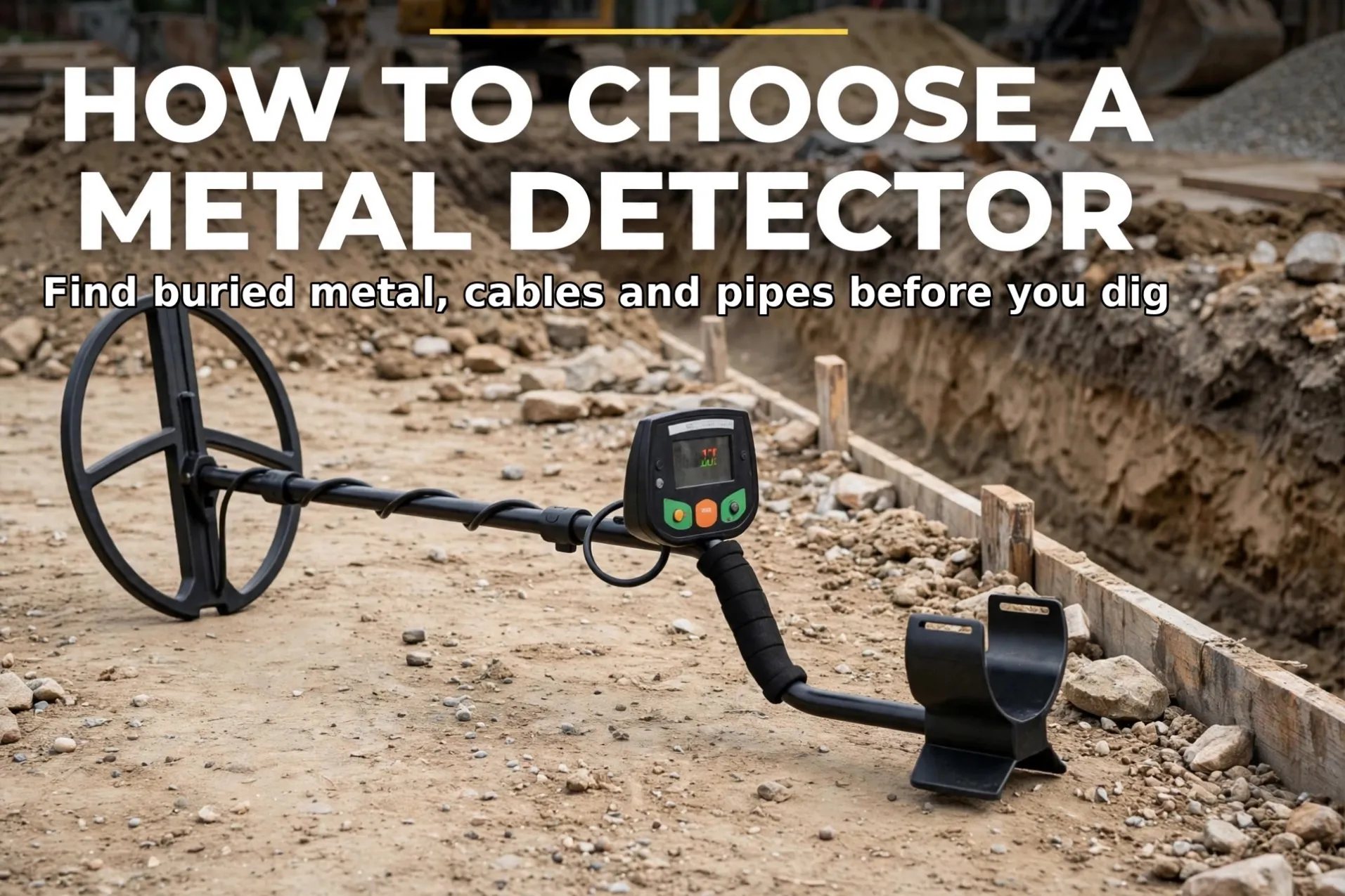
These familiar shaft-and-coil detectors find buried metal: lost tools and parts on industrial sites, buried cables and pipes, and, in surveying, coins, relics and gold. They offer the greatest detection depth, a larger search coil, adjustable sensitivity, and discrimination settings that separate iron from copper, aluminium or silver. Ground balance — the ability to ignore the mineral content of the soil — matters as soon as the ground is not clean sand, and a waterproof coil is essential for wet ground, ditches and shorelines.
3. Pinpointers
A pinpointer is a small probe used after a larger detector has found something, to locate the exact position of a small target in soil, a wall cavity or rubble. It also works for close-range checks in tight spaces where a full-size coil cannot fit. It is a complement, not a replacement, for a full detector.
4. Handheld Security Wands
These screen people and bags at entrances, events and checkpoints, detecting metal objects at very short range with an audio or vibration alert. Sensitivity, battery life and ergonomics matter more here than depth or discrimination: an operator may use one for a full shift.
Type | Typical use | Depth range | Key feature to compare |
|---|---|---|---|
Wall scanner | Rebar, studs, live cable in walls | Tens of millimetres | Accuracy on your wall materials |
Underground detector | Buried metal, cables, surveying | Up to several metres (large targets) | Ground balance and discrimination |
Pinpointer | Exact location in soil or cavities | A few centimetres | Sensitivity and waterproofing |
Security wand | People and bag screening | Contact range | Battery life and ergonomics |
Five Selection Criteria That Actually Decide Performance
1. Detection depth — and how it is measured. Depth depends on target size, target metal, soil or wall material, and coil size. A detector that finds a large iron plate at depth may miss a small copper fitting near the surface, so test with your own typical targets rather than trusting a headline number.
2. Discrimination and target identification. Cheap detectors beep at every metal; better ones distinguish iron from non-ferrous metals and, on some models, show a target ID. On a site full of nails and scrap, discrimination saves hours; on a security gate, it does not matter.
3. Ground balance. Mineralised soil, wet clay and reinforced concrete all produce false signals. Manual or automatic ground balance lets the detector ignore the ground itself and hear only the target. Outdoors on varied soil, this is a must-have.
4. Coil size and shape. A large coil searches deeper and covers ground faster; a small coil separates closely spaced targets and works in tight spaces. Some underground detectors accept interchangeable coils.
5. Durability, battery and handling. A detector used outdoors needs a waterproof coil, a telescopic shaft that locks firmly, and controls that work with gloves. Check battery type, runtime for a full shift, and what the warranty covers.
Common Buying Mistakes
- Buying on maximum depth alone. A headline depth figure rarely reflects your target, your soil or your wall. Accuracy at a realistic depth beats a bigger claim.
- Ignoring false signals. A detector that beeps constantly on mineralised ground or reinforced concrete is unusable, however deep it claims to reach.
- Choosing a hobby model for site work. Hobby detectors are built for occasional use on clean ground. Daily site work needs stronger construction, long runtime and service support.
- Forgetting the wall material. A wall scanner calibrated for drywall behaves differently on brick, tile or thick plaster. Confirm the rated materials before ordering in volume.
How to Evaluate a Sample Before Ordering
Ask for a sample unit and test it on your own jobs, not on a showroom bench. Bury or hide your typical targets — a rebar offcut, a copper pipe section, a small brass fitting — at the depths you actually work with, and check detection and discrimination. Test on your real surfaces — your soil, concrete and wall types — and note false alarms. Run it for a full shift to check battery life, weight, display readability in daylight, and whether the controls work with gloves. Check the accessories too: carry case, spare coil availability, battery type and manual language. A sample that passes is a safer order than any datasheet.
OEM/ODM and After-Sales Points to Confirm
For distributors and private-label buyers, confirm before ordering: logo printing on the unit and packaging, custom packaging design, and user manual in the required languages; barcode and labelling requirements for your market; whether the supplied model matches the sample exactly, including coil, shaft and battery; and warranty terms, spare parts availability, and how the supplier handles a defective unit in the field.
Metal detectors need little routine calibration compared with measurement instruments, but a supplier that answers these questions clearly before the order will answer them after it too.
Questions to Ask Your Supplier
- What target and ground conditions does the quoted detection depth assume?
- Does the model distinguish ferrous from non-ferrous metals, and how is it adjusted?
- Is ground balance automatic, manual, or absent — and which soils is it rated for?
- What is the battery type and realistic runtime per shift, and are spare coils and parts available?
The Bottom Line
Start from the job — wall, ground, or gate — then match the detector type, and only then compare depth, discrimination and durability. A sample tested on your own targets and materials is worth more than any specification table.
Shenzhen Zhanyueda Technology Co., Ltd. (www.zydhardware.com) supplies handheld test and measurement instruments, including metal detectors and wall scanners, and supports OEM/ODM orders with custom branding, packaging and documentation. Contact us through zydhardware.com for a catalogue and a quotation.