
Buying Guides
How to Choose a Sound Level Meter for Industrial Use
Choosing a sound level meter for industrial use? Compare range, accuracy class, weighting, logging and calibration support to get reliable workplace noise data.
The Short Answer: Match the Meter to the Decision
If you only need to know whether a workshop is loud, almost any handheld sound level meter will give you a number. If you need to compare shifts, check a machine after maintenance, document a workplace assessment, or decide whether hearing protection and engineering controls are working, the choice matters much more.
For industrial use, choose a meter with a wide enough range for your noisiest and quietest areas, an accuracy class suited to formal checks, A-weighting for hearing assessment, and a way to record results for comparison over time. A clear display, robust housing, and calibration support matter as much as the headline decibel range.
What the Meter Has to Support
A sound level meter measures sound pressure and reports it in decibels (dB). In industry, that simple job supports several decisions:
- Workplace checks: Is noise in a production area, warehouse, or plant room at a level that needs action?
- Maintenance checks: Has a motor, fan, compressor, or conveyor become louder, suggesting wear or a loose guard?
- Boundary checks: What level reaches a neighbouring office or site fence?
- Before-and-after comparisons: Did an enclosure, silencer, or new machine actually reduce noise?
A quick spot check can tolerate a simpler meter. A repeated assessment needs better repeatability, logging, and calibration.
6 Criteria That Decide Whether the Data Is Usable
1. Measurement Range
Check both ends, not only the maximum. A meter that starts too high may miss quiet offices, while one that tops out too low will overload near presses or engine test areas. Confirm it covers your loudest and quietest places with margin on both sides.
2. Accuracy Class
Meters are grouped by accuracy class, with higher classes offering tighter tolerances. Confirm with the supplier which class a model belongs to and under which standard it is rated. For informal walk-throughs, a general-purpose class may be enough. For workplace assessments or results that may be questioned later, a higher class gives the result more standing.
3. Frequency and Time Weighting
Workplace assessment normally uses A-weighting, which approximates how the ear perceives sound. C-weighting is sometimes used for peak or low-frequency content. For time weighting, fast response follows rapid changes, while slow response gives a more stable reading in fluctuating noise. A meter offering both, plus maximum and minimum capture, describes steady and intermittent noise more honestly than one momentary figure.
4. Data Logging and Output
Handwritten readings are easy to lose or dispute. For repeated monitoring, look for internal memory with time stamps and a practical export route for reports, as specified by the supplier. Useful functions include maximum, minimum, and average or equivalent continuous level. Logging does not improve accuracy, but it makes results auditable.
5. Durability and Working Environment
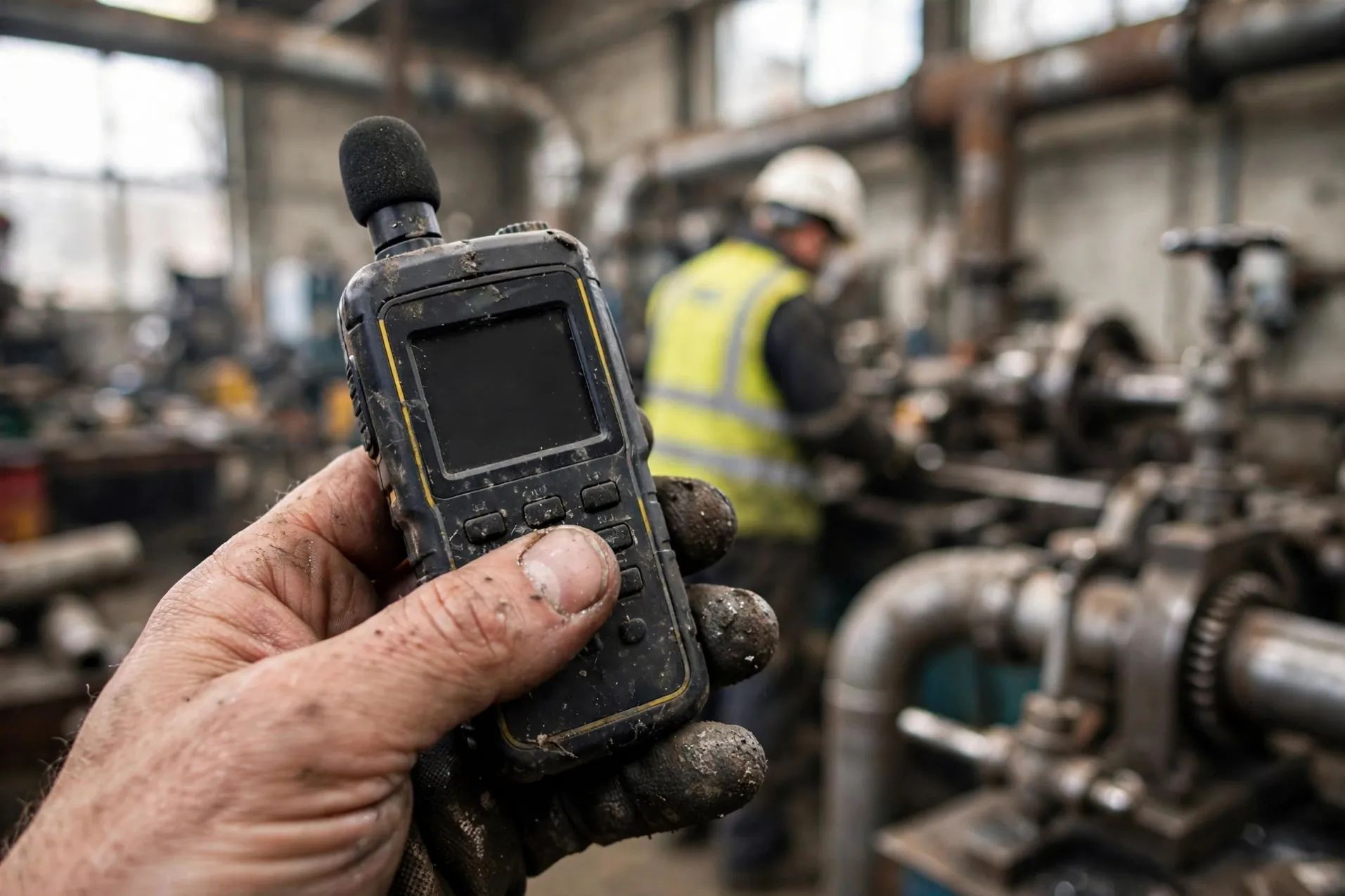
Industrial meters are dropped, carried between buildings, and used in dusty workshops, often with gloves. Consider housing robustness, button size, display readability, battery life, and whether a windscreen is supplied for outdoor work. A tripod mount helps for fixed-point surveys. Judge usability in your real conditions, not only in a quiet test room.
6. Ease of Use
A confusing menu produces inconsistent results across operators. Prioritise a clear display, simple range selection, obvious overload indication, and a short learning curve. Any pre-use check should be straightforward and documented.
Different Workplaces, Different Priorities
Workplace | What matters most | Common pitfall |
|---|---|---|
Manufacturing floor | Wide range, logging, durability | Reporting one loud moment as a shift average |
Construction and outdoor sites | Windscreen, robust housing, battery life | Wind noise inflating the reading |
HVAC and facility maintenance | Quiet-end resolution, portability | A meter that cannot resolve quieter plant rooms |
Site boundary and offices | Time-stamped logging, fixed position | Moving position between surveys |
Buyers covering several areas should favour versatility — logging, a wide range, and both fast and slow response.
Sample Evaluation: Test It Where You Will Use It
Before committing to a quantity, evaluate a sample in real conditions:
- Repeat the same point three times. Return to the same position, height, and distance from the source. Similar results suggest good repeatability.
- Check both ends of the range. Test a quiet office and the noisiest machine area, and confirm there is no overload warning.
- Try logging and export. Record a short survey and confirm the file works in your reporting format.
- Test handling. Operate it with gloves, read it in workshop lighting, and check battery change or charging in the field.
- Ask about calibration. Confirm what calibration or verification support the supplier offers, how often a check is recommended, and what the recalibration route looks like. A meter without a practical calibration route is a short-term purchase.
Note position and machine state for each test; they explain many later differences.
Common Mistakes
- Measuring too close to a reflective wall or the operator's body.
- Holding the meter inconsistently, so angle and distance become uncontrolled variables.
- Reporting a single instantaneous reading as if it were a shift average.
- Ignoring wind, background noise, and machine load when comparing results.
- Skipping a pre-survey check, so drift or a low battery is found only afterwards.
- Buying on maximum decibels alone, while accuracy class, logging, and calibration support go unchecked.
Most of these are method problems, not meter problems.
OEM/ODM and Supplier Questions
For distributors, private-label buyers, and multi-site users, the product is only part of the decision. Before ordering, ask:
- What accuracy class and standard does this model meet, and what is its full range?
- Which weightings, time responses, and logging functions are included, and how are results exported?
- What is supplied in the box, including windscreen, case, and batteries or charger?
- How is a pre-use check or calibration carried out, and what after-sales and repair support is available?
- Can OEM/ODM requirements for logo, packaging, manual, and barcode be met, and what approval steps are needed?
Confirm OEM/ODM capability early if private labelling is planned. A supplier who answers concretely, and flags where a model is unsuited, is usually safer than one who answers every question with a lower price.
Conclusion: Buy Repeatability, Not Just a Number
A sound level meter earns its place when different operators, on different days, can produce comparable results and explain how they got them. Range, accuracy class, weighting, logging, durability, and calibration support together decide that repeatability. Start from the decisions the readings must support, test a sample where you will use it, and confirm support before volume.
For related industrial measurement categories, see also guides on multimeter selection, clamp meter versus multimeter comparisons, and insulation tester selection for industrial use.
To discuss sound level meters for your workplace, distributor range, or private-label project, or to request a sample evaluation, visit zydhardware.com and send an inquiry.