
How to Choose a Voltage Tester & Socket Tester
Buying a voltage tester or socket tester? Compare NCV pens, two-pole testers and socket testers by range, safety rating and use case — plus a buyer checklist.
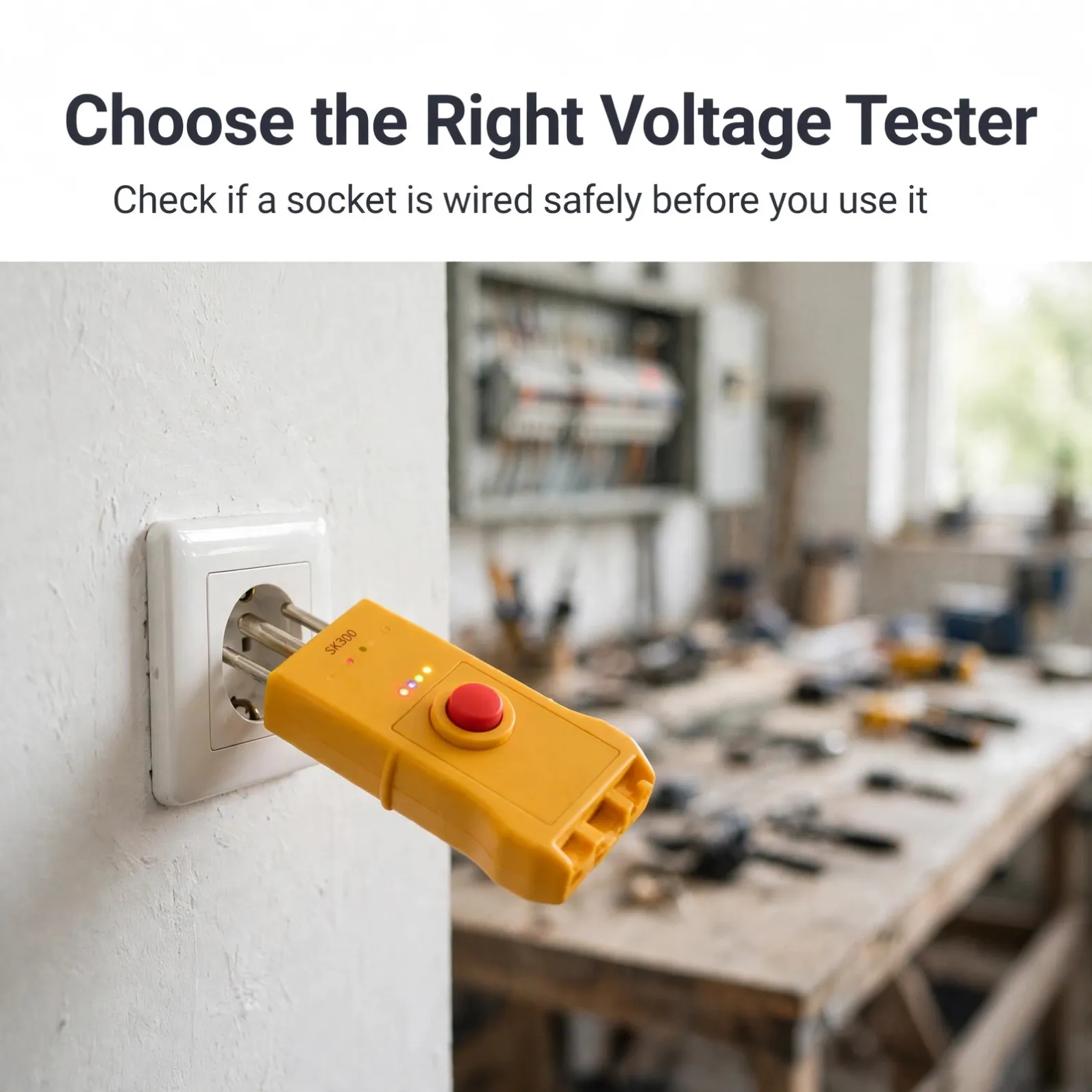
The short answer: match the tester to the job
A voltage tester tells you whether a circuit is live before you touch it. A socket tester tells you whether a wall outlet is wired correctly. They look similar and cost little — which is why buyers get them wrong. The most common mistake is buying one pen-style tester and expecting it to do every job: prove absence of voltage, verify a socket, and check an RCD. Decide first what the tool must prove, then check range and safety rating.
What a voltage tester actually does
Electricians use it as the first step in lockout/tagout: before opening a panel or touching a conductor, they confirm the circuit is dead. It is a safety tool first and a diagnostic tool second.
- Non-contact voltage (NCV) pen testers detect voltage through insulation without touching a live conductor. Sweep near a cable or socket and the pen lights up and beeps — best for quick live/dead screening.
- Two-pole (contact) voltage testers use two probes to measure voltage directly between two points. They give a real reading rather than a yes/no indication — the right tool for proving a circuit dead before work starts.
- Socket testers (receptacle testers) plug into a wall outlet and use indicator lights to show correct wiring, reversed live/neutral, missing earth, and other common faults. Some include an RCD/GFCI test button.
Suppliers also sell combination tools — a pen tester with a built-in flashlight, or a socket tester with RCD test — but a combination only helps if each function is genuinely usable.
NCV pen, two-pole tester, or socket tester?
Most electrical contractors need at least two of the three.
| Tester type | What it proves | Typical range | Best for | Limitation |
|---|---|---|---|---|
| NCV pen tester | Voltage present nearby | 12–1000 V AC | Fast live/dead screening | No numeric reading; fooled by phantom voltage |
| Two-pole voltage tester | Real voltage between two points | 12–690 V AC/DC | Proving dead before work | Needs contact; slower |
| Socket tester | Outlet wiring correct or faulty | Mains voltage (110–125 V or 220–250 V) | Pre-handover socket checks | Only tests the socket it is plugged into |
If your buyers are electricians, a two-pole tester is the core tool and an NCV pen is the companion. For building inspectors or facility managers, the socket tester is often the volume product — simple, visual, and needing no training to interpret.
Key selection criteria
1. Voltage range and sensitivity
Check the detection range against the mains voltage in the target market: a 220–250 V tester may not detect 110–125 V reliably, and vice versa. Some NCV pens offer dual sensitivity — high for finding live cables, low to avoid false alarms.
2. Safety rating: CAT rating and test standard
Look for a CAT rating (such as CAT III 600 V or CAT IV 600 V) that matches the environment — distribution boards need a higher category than a wall socket. Also confirm the applicable safety standard, such as EN 61243-3 for two-pole testers. If the supplier cannot name the standard the product was tested to, treat that as a warning sign.
3. How the result is shown
In a noisy plant room a beeper alone is easy to miss; in bright sunlight a small LED can be hard to see. Good testers combine light and sound, and better two-pole testers add a numeric or bar-graph display. For socket testers, the wiring-fault table should be printed on the tester body itself.
4. Build quality, battery and self-test
These tools live in tool bags, get dropped, and are used with gloves. Check the housing (rugged plastic, secure battery cover), the probe tips (shrouded, finger guards), and the operating temperature range. Most run on small batteries, so a self-test or low-battery indicator is worth paying for: a dead battery that looks like a dead circuit is a genuine safety risk. Ask whether batteries are included.
Common mistakes buyers make
- Using an NCV pen as the only proof of dead. An NCV pen is a screening tool. Before hands-on work, prove the circuit dead with a contact tester, and check the tester itself on a known live source before and after.
- Ignoring phantom voltage. Long cable runs next to live conductors can induce a small voltage that makes an NCV pen beep on a circuit that is actually switched off. A two-pole tester with a low-impedance mode avoids this trap.
- Buying the wrong mains version. Socket testers are region-specific: plug shape, voltage, and wiring conventions differ by country. Confirm the plug type and voltage for each destination market.
- Choosing on price alone. A voltage tester is a low-cost item, but the cost of a wrong reading is an accident. Count returns, warranty handling, and reputation in the total cost.
How to evaluate a sample
Before a bulk order, test a sample the way your end users will:
- Live-dead check: test on a known live socket, then a known dead circuit, then a live source again. It must respond correctly every time.
- Sensitivity test: hold the NCV pen near a live cable, then near a cable in the same trunking that is switched off. Note any false positives.
- Socket tester check: use it on correctly wired, reversed, and unearthed test sockets. The light pattern must match the printed table exactly.
- RCD test: if the socket tester has an RCD test button, confirm it trips a 30 mA RCD.
- Drop and handling: drop it from bench height onto a hard floor, check the battery cover stays shut, and try it with work gloves on.
- Documentation: check that the manual is in the language of the target market. Record the sample test in writing — it becomes the acceptance standard for the bulk shipment.
OEM/ODM and private-label notes
Voltage and socket testers suit private label well: the housing can carry a distributor's logo, and the packaging, manual, barcode and certification marks can be matched to the destination market. When discussing OEM/ODM, confirm the logo method (printing or moulding), packaging options, manual languages, and which certification marks apply to each market.
Questions to ask your supplier
- What is the exact detection/voltage range, and is sensitivity adjustable?
- What CAT rating and safety standard does this model comply with, and can you share the test report?
- Is this model built for 110–125 V, 220–250 V, or dual voltage — and which plug type?
- Are batteries included, and is there a low-battery indicator?
- Does the socket tester include RCD/GFCI trip testing, and at what trip current?
- What is the warranty period, and how are faulty units handled?
The bottom line
Buy the tester for the proof your users need: an NCV pen for fast screening, a two-pole tester for proving dead, and a socket tester for wiring checks. Verify the range and safety rating for the actual market, test a sample against real faults, and agree the acceptance standard before ordering in volume.
About the supplier: Shenzhen Zhanyueda Technology Co., Ltd. (www.zydhardware.com), founded in 2024, manufactures handheld test and measurement instruments and supports OEM/ODM orders. If you are sourcing voltage testers or socket testers for your market, contact the team at zydhardware.com to request a catalogue and a sample.