
Buying Guides
How to Choose an Anemometer for HVAC Airflow
Choosing an anemometer for HVAC work? Compare vane and hot-wire types, air velocity range, CFM air volume and data logging — plus sample checks for B2B buyers.
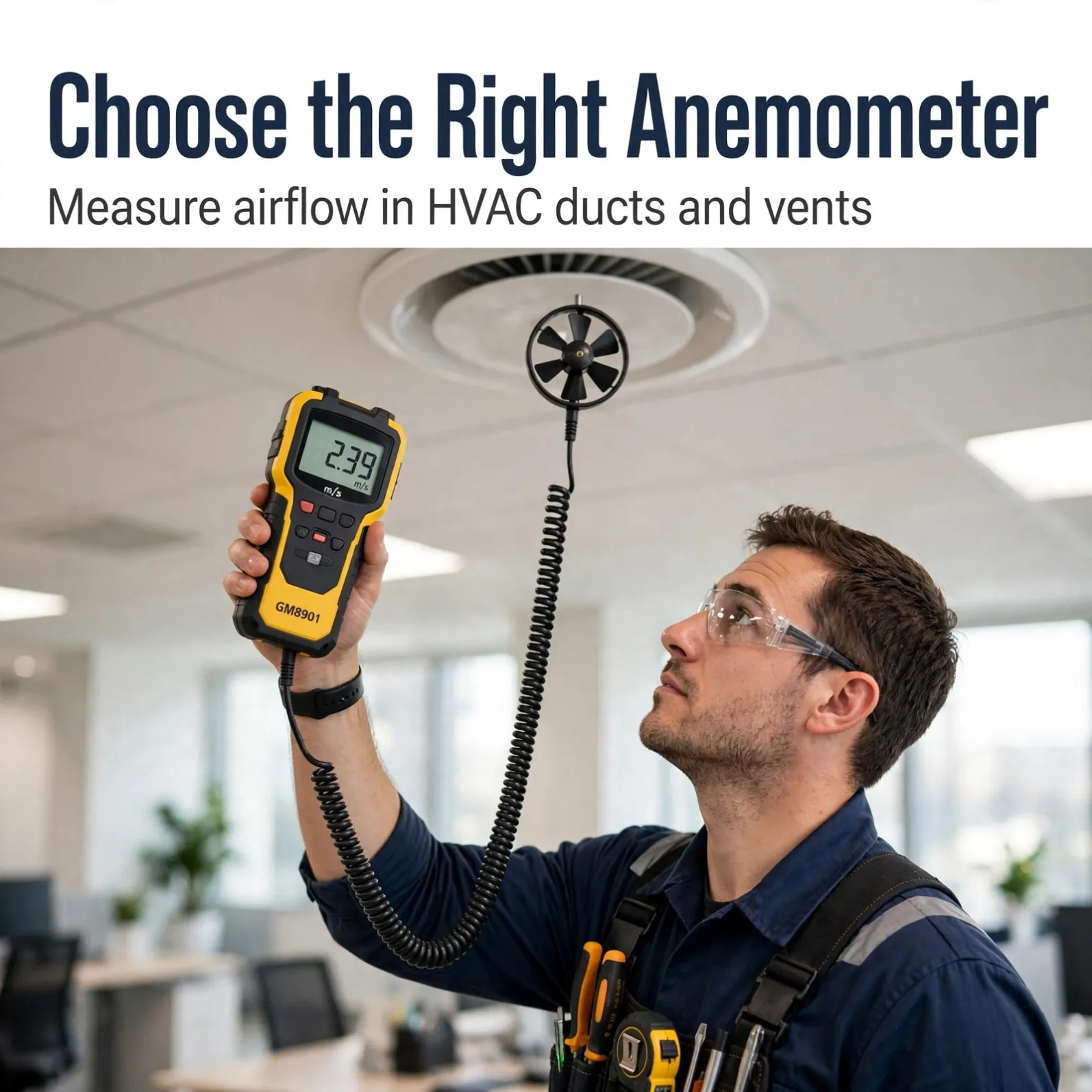
An anemometer turns a guess about airflow into a number you can act on — enough air at this diffuser, too little at that one, a duct that needs balancing. The right choice comes down to four things: the sensor type, enough velocity range, air volume (CFM) readout if you balance systems, and a display and build that work in plant rooms.
What an Anemometer Actually Measures
An anemometer measures how fast air moves, usually in metres per second (m/s), feet per minute (ft/min), kilometres per hour (km/h) or miles per hour (mph). Most handheld models also measure air temperature, and many add humidity. Higher-end models calculate air volume in cubic feet per minute (CFM) or cubic metres per minute/hour (CMM/CMS).
Velocity alone is rarely enough for HVAC work: a diffuser at 2 m/s tells you little until you know the grille area and the resulting volume. Models with a built-in air volume function are popular for commissioning and balancing — enter the area once and the meter converts velocity to volume. If your team only checks whether air is moving, a pocket model is enough; if you balance systems or write reports, you need volume, data hold and data logging.
Vane, Hot-Wire or Pitot: Pick the Sensor First
Vane anemometers are the HVAC workhorse. A small fan — typically a 70 mm-ish impeller — spins in the airflow and the meter converts its speed into a velocity reading. They are rugged, easy to use, and read well at the moderate velocities found at grilles, diffusers and duct openings. Many have a separate sensor head on a cable, so you can hold the display at eye level while the vane sits in the airstream.
Hot-wire anemometers measure how quickly a heated wire cools in the airstream. They are more sensitive at very low velocities — the gentle air movement in a room, or the face velocity of a fume hood — where a vane barely turns. The trade-off is fragility: the sensor is delicate and less forgiving of dust and rough handling.
Pitot tubes measure the pressure difference between moving and still air and convert it to velocity. They handle high velocities and hot air that would damage other sensors, and they are the traditional tool for duct traverse measurements — but they need a separate differential pressure reading and a careful technique, so they suit specialist duct work.
5 Specifications That Decide Whether It Works on the Job
1. Velocity range
Catalogue vane models typically cover 0–30 m/s, with extended models reaching 0–45 m/s. A 0–30 m/s model handles almost all indoor HVAC work: grilles, diffusers and duct openings usually sit well below 15 m/s. The 0–45 m/s class suits industrial ventilation and wind measurement. Also check low-end sensitivity: a meter that cannot register below 0.3 m/s will miss gentle flows.
2. Accuracy
Typical catalogue accuracy for air speed in this class is around ±5% of reading — adequate for balancing and commissioning, where the goal is to compare outlets with each other and against design values. Ask the supplier how accuracy was verified, and compare a sample against a reference meter at several velocities, not just one.
3. Air volume (CFM)
If your customers balance systems, air volume matters more than raw velocity. Look for models that calculate CFM/CMM directly from the measured velocity and a duct or grille area you enter — some catalogue models cover 0–9999 CFM. A model without a volume function forces hand calculation at every grille.
4. Temperature and humidity
Most HVAC anemometers measure air temperature as well as velocity, typically from around −10 °C to 45 °C or wider, and some add humidity (0–99% RH) plus dew point and wind chill. Check the ranges against your customers' environments: a range that stops at 45 °C is fine for occupied spaces, not for hot plant rooms.
5. Data hold, memory and build
The reading you need is often at a ceiling diffuser. Data hold freezes the reading on screen; max/min/average functions capture a traverse without repeated trips up a ladder. Some models store 24 groups of readings, and others add USB or RS-232 output to a PC, with Bluetooth as an option on some models. Vane anemometers come as compact pocket models (some as light as about 50 g) or full-size handhelds with a separate vane head — the latter are better for duct and diffuser work.
Which Model Fits Which Job
Job | What to choose |
|---|---|
HVAC commissioning and balancing | Vane model, 0–30 m/s, with CFM air volume, max/min/average and data hold |
Cleanroom and indoor air quality | Hot-wire or low-velocity vane model with humidity and good low-end sensitivity |
Industrial ventilation and wind measurement | Vane model with 0–45 m/s range, or a multi-function model with wind chill |
How to Evaluate a Sample Before You Order
Never approve an anemometer from a datasheet alone. Compare readings against a reference meter at low, medium and high velocities; measure a grille of known area and check the meter's CFM figure against a hand calculation; and use it one-handed on a ladder to check the display is readable with gloves. If a supplier cannot provide a sample for this kind of test, that is itself useful information.
Common Mistakes Buyers Make
- Buying on maximum range alone. A 45 m/s rating means little if the meter cannot read the 0.3 m/s flows that matter for comfort checks.
- Ignoring air volume. A velocity-only meter forces hand calculation at every grille. For balancing work, CFM readout saves the most time.
- Forgetting units. A display locked to m/s will frustrate buyers in markets that work in ft/min. Models that switch between m/s, ft/min, km/h, mph and knots sell into more markets.
OEM and Private-Label Notes
For importers and brand owners, anemometers are a straightforward OEM category: logo printing on the housing, custom packaging, a manual in the buyer's language and a barcode for retail are the usual requests. Confirm which of these are included and which carry a tooling or setup cost, and check that the manual matches the exact model you order.
Questions to Ask Your Supplier
- What is the velocity range, and what is the minimum readable velocity?
- What accuracy is quoted, and over what part of the range does it hold?
- Does the model calculate air volume in CFM/CMM, and can duct or grille area be stored?
- Which units can the display show?
- Can you supply a sample for velocity and volume testing before we place a volume order?
- For OEM orders: what logo, packaging, manual-language and barcode options are available?
The Bottom Line
Choose an anemometer by sensor type first — a vane model for most jobs, hot-wire for low airspeeds, pitot for specialist duct work — then by velocity range, air volume capability and readability in the field. A 0–30 m/s vane model with CFM readout covers most commissioning and balancing; the 0–45 m/s class serves industrial and outdoor work. Test the sample on a real grille before you order.
Related reading on this site: a guide to choosing an industrial multimeter, a guide to choosing an infrared thermometer, and a guide to choosing a sound level meter for industrial use — useful companions when you are building a complete HVAC and facility-maintenance kit.
Looking for an anemometer for your market? Contact us through zydhardware.com for samples, specifications and OEM options.