
Buying Guides
How to Choose a Handheld Oscilloscope for Field Service
How to choose a handheld oscilloscope for field service: bandwidth, channels, sample rate, battery life, display readability and sample checks before you buy.
The Short Answer
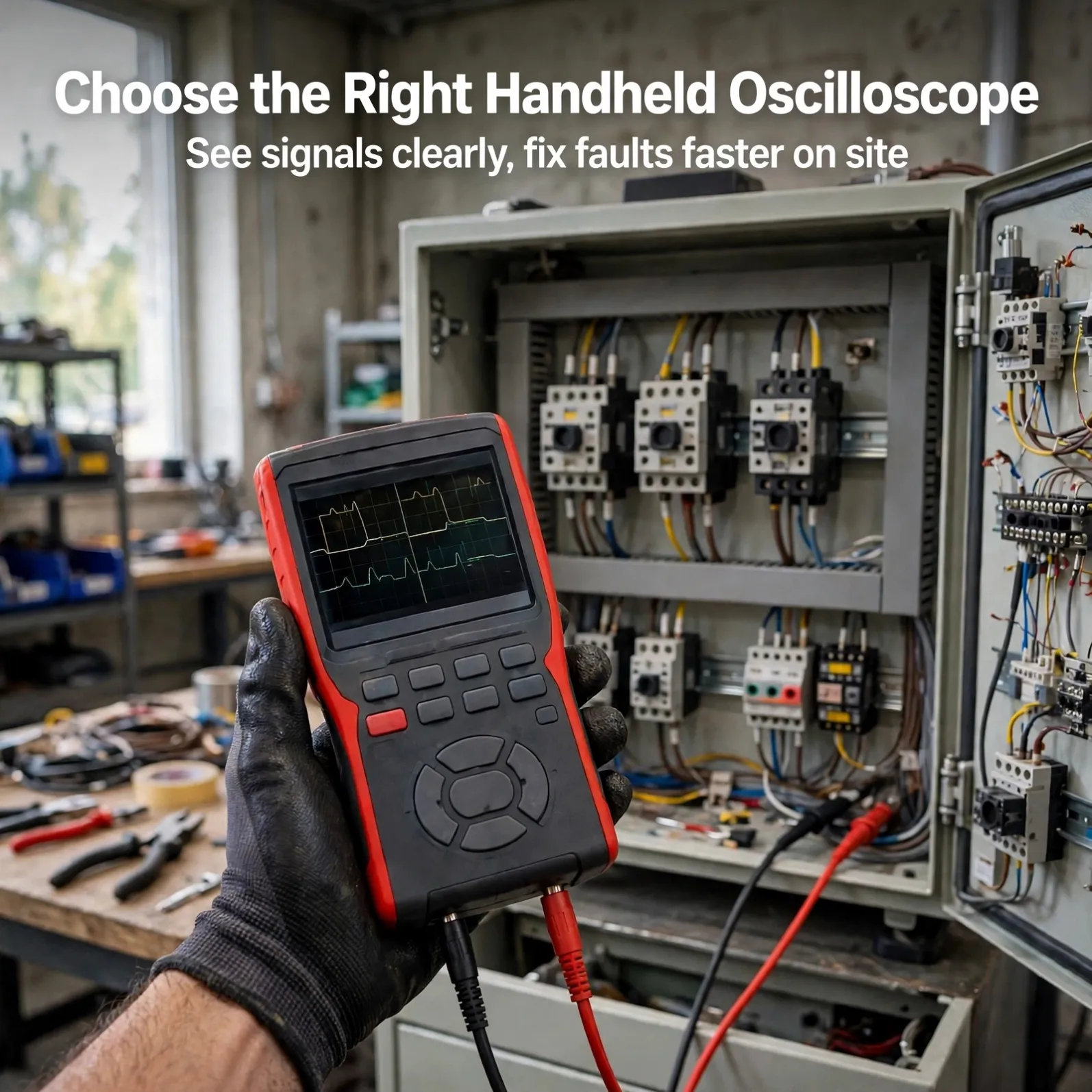
Choose a handheld oscilloscope by the signals you actually need to see, not by the biggest number on the datasheet. A bench scope belongs in a lab; field engineers work on rooftops, in control cabinets, and inside vehicles, often with one hand free and no power outlet nearby. For most field service work — checking control signals, sensor outputs, motor drives, and communication lines — a dual-channel handheld scope with 40–50 MHz bandwidth and a built-in multimeter covers the job. A single-channel scope-meter is enough for simple go/no-go checks on slow signals, while a storage scope with waveform capture earns its place when faults are intermittent and only appear for a fraction of a second. Once the type matches the work, compare sample rate, display readability in daylight, battery life, and ruggedness — then test a sample on a real job before ordering in volume.
The Three Main Types
1. Single-Channel Scope-Meters
A scope-meter combines a basic oscilloscope with a digital multimeter in one handheld unit. A typical entry-level example from our catalogue, the ZT-702S, offers 10 MHz bandwidth in a single channel with a 9,999-count display, powered by a single 18650 battery. This type suits simple signal checks: confirming a sensor output is present or a power supply ripple is within limits. It is light and easy to learn — but one channel means you cannot compare two signals side by side.
2. Dual-Channel 3-in-1 Handheld Scopes
The workhorse of field service. These units add a second channel plus multimeter and waveform-generator functions. The HDS242, for example, is a 40 MHz two-channel unit combining oscilloscope, multimeter, and waveform generator, charged over USB-C from two 2200 mAh 18650 cells. The ZT-703S is a dual-channel 3-in-1 unit with 50 MHz bandwidth and a 200M/280 MSa/s sampling rate. Two channels let you compare an input against an output — a drive command against a motor response, or a sensor signal against its reference — which is how most real faults are isolated.
3. Handheld Storage Oscilloscopes
A storage scope captures a waveform and holds it on screen, or saves it for later review. The ET521S, for example, is a 50 MHz handheld storage oscilloscope with a 320 × 240 colour LCD and a built-in DDS signal generator covering 10 Hz to 156 kHz. The storage function matters most for intermittent faults: a glitch that appears once an hour cannot be diagnosed on a scope that only shows the live signal.
Type | Best for | Channels | Typical bandwidth |
|---|---|---|---|
Single-channel scope-meter | Simple signal checks, go/no-go tests | 1 | Around 10 MHz |
Dual-channel 3-in-1 handheld scope | Comparing signals, drive and control work | 2 | 40–50 MHz |
Handheld storage oscilloscope | Intermittent faults, waveform documentation | 1–2 | 40–50 MHz |
Key Specifications to Compare
Bandwidth. Bandwidth decides which signals you can measure honestly. As a rule of thumb, the scope's bandwidth should be at least five times the highest frequency you need to measure, because its response rolls off near its rated limit. For sensor signals, 4–20 mA loops, and most control work, 10–50 MHz is ample. For fast switching edges in motor drives, ask the supplier for the actual rise-time figure rather than the headline bandwidth.
Sample rate. Sample rate decides how faithfully a fast waveform is drawn. A 200M/280 MSa/s real-time sampling rate, as on the ZT-703S, captures enough points per cycle to show the true shape of a signal rather than a smoothed guess. If the sample rate is too low, the display can show a waveform that looks plausible but is wrong.
Channels and inputs. One channel answers "is this signal present?" Two channels answer "how does this signal relate to that one?" If your team troubleshoots drives, PLCs, or feedback loops, two channels pay for themselves quickly.
Display. Field scopes are read in sunlight, in dim cabinets, and through safety glasses. A colour LCD with a clear waveform and a large numeric readout is worth more than extra features buried in menus. Try it outdoors before you buy.
Battery life, charging, and durability. A scope that dies halfway through a job costs a return visit. Check the battery type (18650 cells are common and replaceable), the rated operating time, and the charging method. USB-C charging, as on the HDS242, means the scope can be topped up from a laptop or a power bank on site. Field instruments also get dropped and knocked against cabinet doors, so ask about drop resistance and the housing material.
Safety rating. Confirm the measurement category rating for the voltages your team works near, in writing, for the exact model you order. Do not assume a rating from a similar-looking model.
Included accessories. Probes, test leads, a carry case, and a manual are part of the purchase, not extras. Ask what is in the box and what spares cost.
Choosing by Application
- Electrical maintenance: a dual-channel 3-in-1 scope covers most work — drive outputs, control signals, and sensor wiring — and the multimeter function handles routine voltage and continuity checks on the same visit.
- Automotive diagnostics: a handheld scope is ideal for sensor waveforms — crank, cam, oxygen, and throttle signals — where the technician moves between vehicles and needs battery power and a compact unit.
- Industrial controls and PLCs: two channels are close to essential, for comparing a command signal with the actuator response or a 4–20 mA loop input with its output.
- Solar and power electronics: checking inverter switching waveforms and DC ripple needs enough bandwidth to see fast edges honestly, plus a storage function for intermittent events.
Common Mistakes When Buying
The most common error is buying bandwidth you will never use while ignoring the sample rate, battery life, and display you will use every day. Others include choosing a single-channel unit for work that needs signal comparison and assuming any handheld scope is safe on mains circuits without checking the category rating for the exact model.
How to Evaluate a Sample Before Ordering
Ask for one sample unit and put it through a real job before committing to a batch. Feed it a known signal and check the reading against a reference instrument; compare two channels on the same signal and check they agree; capture an intermittent event and confirm the stored waveform is readable; use it in sunlight and with gloves on.
OEM/ODM and After-Sales Support
For distributors and private-label buyers, the instrument is only half the purchase. Confirm whether the supplier offers OEM/ODM options such as your logo, custom packaging, a manual in your language, and barcodes — and confirm calibration support, spare probes, and warranty handling before you place a volume order.
Questions to Ask Your Supplier
- What bandwidth and sample rate does this model offer, and at what voltage range?
- How many channels does it have, and does it include multimeter and signal-generator functions?
- What display size and resolution does it use, and is it readable in daylight?
- What battery type, operating time, and charging method does it use?
- What measurement category rating does this exact model carry?
- What probes, leads, and case are included, and what do spares cost?
- What calibration support is provided, and what OEM/ODM options are available?
Internal Linking Suggestions
- How to choose an industrial multimeter (anchor: "industrial multimeter")
- Clamp meter vs multimeter comparison (anchor: "clamp meter vs multimeter")
- How to choose diagnostic tools for PLC control panel troubleshooting (anchor: "PLC control panel troubleshooting tools")
Get a Quote
The right handheld oscilloscope turns a guessing visit into a diagnosis your customer can see on screen. If you are sourcing portable oscilloscopes for distribution or your own brand, contact us through zydhardware.com for specifications, samples, and OEM/ODM options.