
Buying Guides
How to Choose a Laser Distance Meter for Site Measurement
Choosing a laser distance meter for construction? Compare range, ±1.5 mm accuracy, IP rating and Pythagoras functions — plus sample checks for B2B buyers.
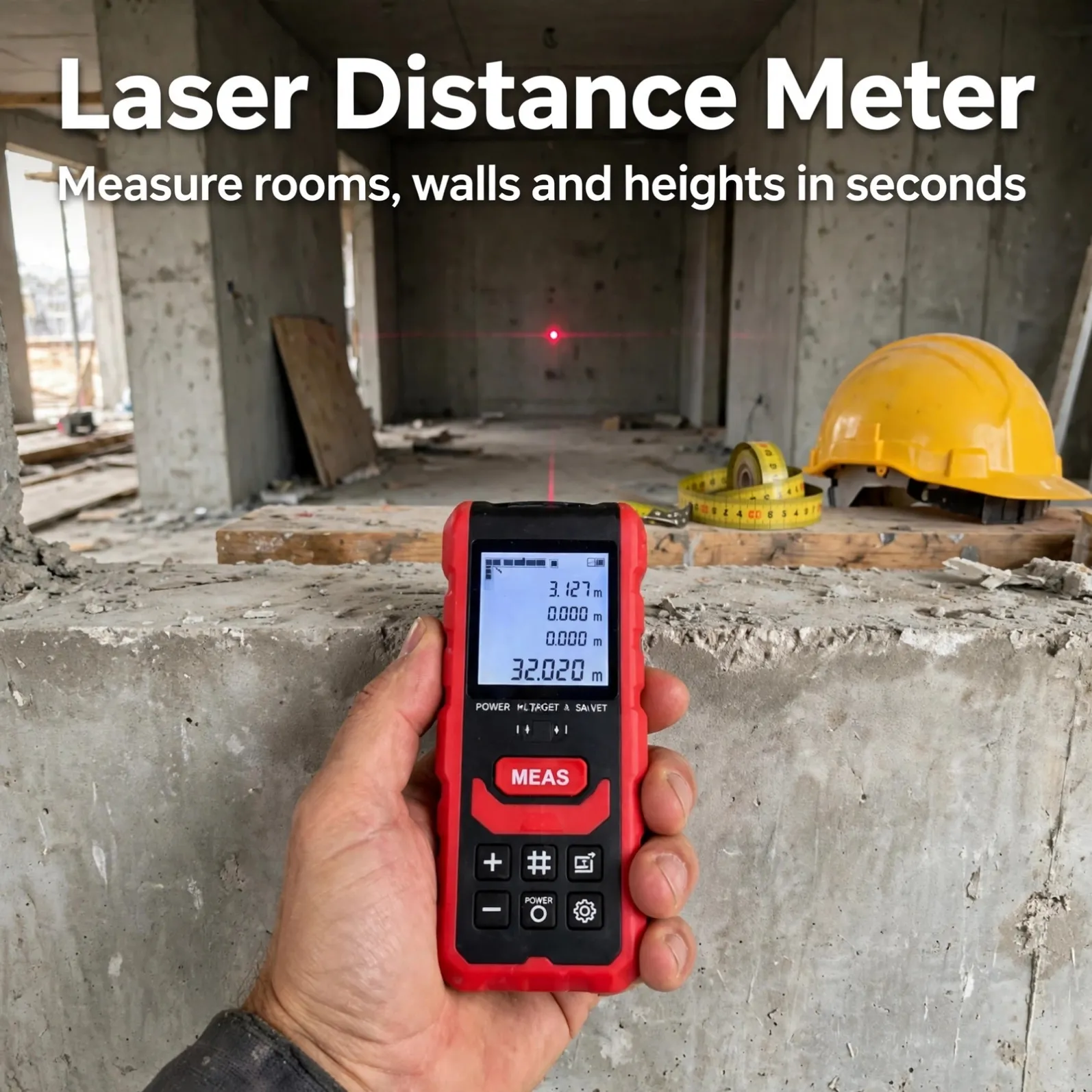
A laser distance meter earns its place on a construction site when it measures faster and more reliably than a tape — one person, one press, a reading in seconds. But not every model suits site work. The right choice comes down to four things: enough range for your longest shot, accuracy that holds up at that range, a display you can read in daylight, and a body that survives dust, drops and rain. Get those right and the extra functions — area, volume, Pythagoras — become genuinely useful instead of decoration.
What a Laser Distance Meter Actually Does
A laser distance meter fires a Class II laser pulse at a target — a wall, a floor, a column — and calculates the distance from the time the light takes to return. Most handheld models measure in 0.2–3 seconds and show the result on an LCD, often alongside two or three previous readings.
Compared with a tape measure, the advantages are practical, not theoretical: one person can measure a 40 m room alone, there is no sag over long spans, and area and volume come from two or three shots instead of a calculator and a notepad. The trade-off is that a laser needs a visible target. Dark, glossy or very distant surfaces can return a weak signal, and bright sunlight can make the laser dot hard to see. That is why range and display quality matter more than the number of functions on the box.
5 Specifications That Decide Whether It Works on Site
1. Measuring range — buy for your longest shot, not your average one
Catalogue models in this class typically cover 40 m, 60 m, 80 m or 100 m. A 40 m model is enough for interior fit-out and residential rooms. For warehouses, facades and open-plan commercial space, choose 60 m or 80 m. The 100 m class suits large sites and outdoor work, but remember that usable range shrinks in bright sunlight and on dark targets — a model rated at 80 m indoors may struggle at 60 m against a dark wall in full sun. If your longest regular measurement is close to a model's rated maximum, step up one range class.
2. Accuracy — ±1.5 mm is the benchmark for this class
Most handheld construction models quote accuracy of ±1.5 mm (about ±0.06 in). That is fine for layout, quantity take-off and installation work. What matters in practice is whether accuracy holds across the whole range, not just at 10 m. When you evaluate a sample, test it at 1 m, at half its rated range and near its maximum, against a steel tape or a known reference distance. A reading that drifts with distance points to a weak laser or a poor sensor, not to user error.
3. Display and readability outdoors
A backlit display that shows several readings at once saves repeated trips to the same spot. Look for a clear LCD — some models use a 1.6-inch display — with large digits that stay readable at arm's length. In bright conditions the limiting factor is often not the screen but the laser dot itself: a red Class II laser (typically 635 nm, under 1 mW) is standard and safe for this use, but it can be hard to spot beyond 20–30 m in direct sun. If outdoor work dominates, consider models with a brighter dot, a target plate, or a viewfinder-style aid, and always confirm outdoor performance with a sample rather than trusting the datasheet alone.
4. Durability — dust, splash and drops
Site tools get dropped, rained on and left in dusty vans. An IP54 rating — dust-protected and splash-proof — is a sensible minimum for site use, and some models in this class carry it. Check the housing too: a rubberised grip, recessed lens and a solid battery door matter more than a slim profile. Operating temperature is typically 0–40 °C; if you work in colder winters or hot summers, confirm the rated range with the supplier before ordering in volume.
5. Battery and power
Models vary: some use two AAA batteries, others a rechargeable lithium battery (for example 850 mAh). Rechargeable units cost less to run over a year of daily use and avoid the "dead batteries on site" problem, but they need a charging routine and a spare plan. AAA models are easier to keep running anywhere in the world — a real advantage for distributors selling into markets where the same charger plug is not standard. Either way, auto power-off after about 30 seconds of inactivity is a useful feature that protects battery life.
Functions Worth Paying For — and Ones You Can Skip
Function | What it does | Who needs it |
|---|---|---|
Area and volume | Calculates floor area or room volume from two or three measurements | Estimators, fit-out teams, flooring and painting contractors |
Pythagoras (indirect height) | Measures height from two angled shots when the top is out of reach | Facade, ceiling and roofing work |
Addition / subtraction | Adds or subtracts measurements on the device | Anyone totalling wall lengths or deducting openings |
Continuous measurement | Live distance readout while you walk the laser along a wall | Finding the shortest distance or checking a level line |
Unit switching (m / in / ft) | Changes measurement units on the device | Exporters and teams working across metric and imperial markets |
Memory storage | Recalls recent readings | Surveyors and anyone documenting measurements on site |
For a distributor, unit switching deserves special attention: a model that only reads in metres will frustrate buyers in imperial markets, while m/in/ft switching costs little and widens the addressable market. Memory and Bluetooth-style data transfer are genuinely useful for surveyors, but for most construction buyers they are nice to have rather than essential — do not let them push the price up at the expense of range or durability.
Which Model Fits Which Job
- Interior fit-out and residential work: a 40 m model with area and volume functions is usually enough, and a compact, light body matters when it lives in a tool belt all day.
- General construction and commercial sites: a 60–80 m model with IP54 protection, Pythagoras and a backlit display covers most jobs, indoors and out.
- Warehouses, facades and large sites: an 80–100 m model with a bright laser dot and continuous measurement, tested outdoors before you commit.
- Golf and long-range outdoor ranging: note that specialist rangefinder models exist for this (for example 150 m golf rangefinders with magnification) — they are a different product from a construction distance meter, so do not substitute one for the other.
How to Evaluate a Sample Before You Order
Never approve a distance meter from a datasheet alone. Run this short checklist on the sample:
- Accuracy test: measure a known distance — a 5 m steel tape run and a 20 m corridor — and compare. Repeat at the model's maximum rated range.
- Sunlight test: take the same outdoor measurement at midday. If you cannot see the dot or the reading jumps, the model is not fit for outdoor work.
- Target test: measure against a dark wall, a glass surface and a rough concrete face. Note which targets give unstable readings.
- Function test: try the Pythagoras height function on a real wall and check the result against a tape measurement.
- Drop and dust check: handle it the way a site worker would — a short drop onto concrete from waist height should not crack the housing or knock the laser out of alignment.
- Battery check: run it through a full working day of typical use and note how long it lasts.
Record the results with photos and the test distances. If a supplier cannot provide a sample for this kind of test, that is itself useful information.
Common Mistakes Buyers Make
- Buying on maximum range alone. A 100 m rating means little if the laser dot is invisible at 40 m in sunlight or the accuracy degrades past 50 m.
- Ignoring the target surface. Dark, reflective and very rough surfaces all reduce reliability. Ask the supplier which target conditions the model is rated for.
- Forgetting units and language. A display locked to metres, or a manual only in one language, can make an otherwise good product hard to sell in a new market.
- Skipping the outdoor test. Most returns and complaints come from outdoor performance that was never checked before ordering.
- Confusing a rangefinder with a distance meter. Golf and hunting rangefinders measure long distances to a small target; construction distance meters measure rooms, areas and heights. They are different tools for different buyers.
OEM and Private-Label Notes
For importers and brand owners, laser distance meters are a straightforward OEM category: logo printing on the housing, custom packaging, a manual in the buyer's language and a barcode for retail are the usual requests. Confirm with the supplier which of these are included and which carry a tooling or setup cost, and check that the manual's measurement instructions match the functions of the exact model you order — a manual written for a different range class causes more support calls than any hardware fault. As with any instrument, ask which specifications are covered by a certificate for your market, and verify them for your model rather than assuming they transfer from a similar one.
Questions to Ask Your Supplier
- What is the rated range, and under what light and target conditions was it tested?
- What is the accuracy across the full range, not just at short distance?
- What IP rating does the housing carry, and what drop testing has it passed?
- Which units can the display show — metres only, or m/in/ft?
- Does the model include area, volume and Pythagoras functions, or are they on a higher model?
- What battery does it use, and what is the expected battery life in normal site use?
- Can you supply a sample for outdoor and long-range testing before we place a volume order?
- For OEM orders: what logo, packaging, manual-language and barcode options are available, and what are the setup requirements?
A supplier who answers these directly, with test conditions rather than slogans, is usually a supplier whose product will survive contact with a real site.
The Bottom Line
For construction and site measurement, choose a laser distance meter by range first, accuracy second and durability third — then let functions like Pythagoras and area calculation decide between models that pass those three tests. A 40 m model serves interiors, 60–80 m covers most construction work, and 80–100 m is the pick for large and outdoor sites. Test the sample in sunlight, on dark targets and at full range before you order, and the meter will repay you in faster surveys and fewer return visits.
Related reading on this site: a guide to choosing an industrial multimeter, a comparison of clamp meters vs multimeters, and a guide to choosing a handheld oscilloscope for field service — useful companions when you are building a complete site-measurement kit.
Looking for a laser distance meter for your market? Contact us through zydhardware.com for samples, specifications and OEM options.