
Buying Guides
How to Choose a Tachometer for Motor & Machine Checks
Choosing a tachometer for motor checks? Compare contact vs non-contact RPM measurement, range, accuracy and sampling — plus a B2B sample checklist for buyers.
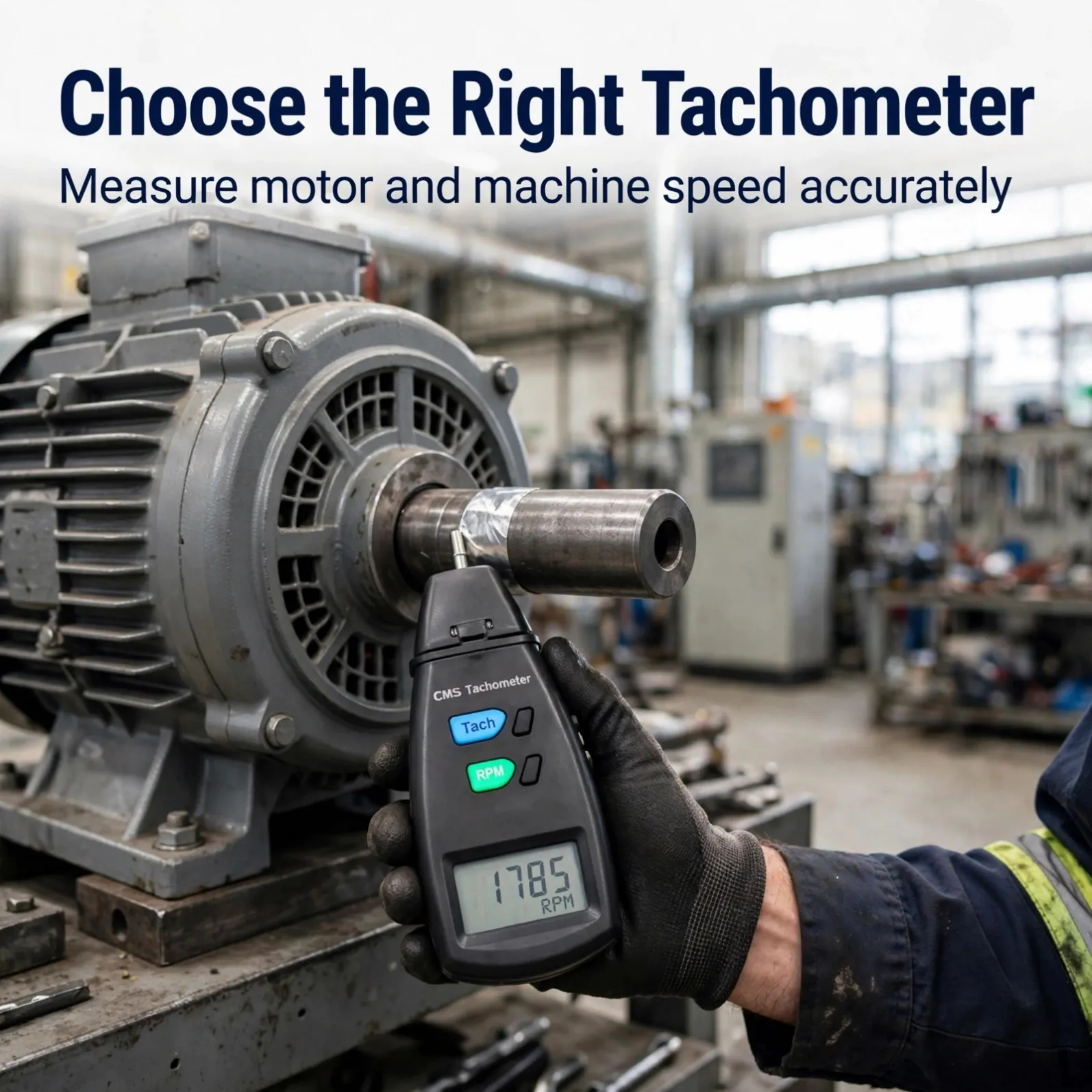
A tachometer earns its keep when a speed question needs a number: is this motor actually running at its rated RPM, is the fan slowing down under load, is the conveyor at its set speed? The right meter comes down to four things: a method that fits the machine, a range covering slow and fast shafts, accuracy you can trust, and a reading you can capture safely without stopping the line.
What a Tachometer Actually Measures
A tachometer measures rotational speed in revolutions per minute (RPM). Contact models touch the shaft with a small cone or wheel adaptor; non-contact (photo or laser) models aim a light beam at a reflective mark on the shaft and count the reflections. Many handheld models do both and also read surface speed in metres per minute — useful for belts, rollers and conveyor surfaces.
Typical speeds show why range matters: a large fan may turn at 900 RPM, a standard four-pole motor at around 1,500 RPM, a two-pole motor near 3,000 RPM, and a small spindle at tens of thousands of RPM. A meter topping out at 19,999 RPM covers most motors and fans; a high-speed spindle needs the non-contact range reaching 99,999 RPM.
Contact vs Non-Contact: Choose by the Machine, Not by Habit
| Contact tachometer | Non-contact (photo / laser) tachometer |
|---|---|---|
How it works | Cone or wheel adaptor touches the rotating shaft or surface | Light beam reads a reflective mark on the shaft |
Typical range | 0.5–19,999 RPM | 2.5–99,999 RPM |
Best for | Low-speed shafts, surface speed of belts and rollers, small motors you can reach safely | High-speed shafts, hot or moving parts, anything unsafe to touch |
Limitation | Needs access to the shaft end while it runs | Needs a reflective mark on the shaft and a clear line of sight |
Extra readings | Surface speed in m/min or ft/min | Max / min / last value memory |
A combined model covers both jobs in one tool, which is why most maintenance kits carry one. If your customers only check accessible motors and belts, a contact model is enough. If they work on running lines, fans behind guards or high-speed spindles, non-contact is the requirement — not a luxury.
7 Specifications That Decide Whether the Reading Holds Up
1. Measuring range
Check both ends. Contact range of 0.5–19,999 RPM covers slow fans and standard motors; non-contact range of 2.5–99,999 RPM covers high-speed spindles and turbines. Ask what the fastest machine on site runs at — above 20,000 RPM, only a non-contact model will do. Auto-ranging is standard in this class and avoids reading the wrong scale.
2. Accuracy
Handheld tachometers in this class typically quote ±(0.05% of reading + 1 digit). On a 1,500 RPM motor that is roughly ±2 RPM — tight enough for maintenance records and acceptance checks. Be wary of any meter that quotes accuracy without stating the range, and test the sample against a known speed before ordering in volume.
3. Resolution
Resolution of 0.1 RPM below 1,000 RPM and 1 RPM above it is typical. Fine resolution matters most at low speed, where a 1 RPM step on a 60 RPM shaft is a large relative error. For most motor work, 0.1 RPM below 1,000 RPM is the right bar.
4. Sampling time
Sampling time of 0.5–0.8 seconds is typical. A fast sample matters when speed is drifting — a slow meter can miss a dip under load. For acceptance testing, take several readings and watch the max/min memory rather than trusting one number.
5. Measuring distance (non-contact)
Laser models typically read a reflective mark from 50–500 mm away — the distance that decides whether a technician can measure a guarded fan or a hot shaft without getting close. Ask for the effective distance in the datasheet and test it with the supplier's reflective tape; a mark that falls off at speed is a common field failure.
6. Memory and display
Max, min and last-value memory turns one reading into a short record: the highest speed at start-up, the lowest under load, the last reading before the meter was put away. A large five-digit LCD with a backlight is worth having on a dim plant floor; a display character height around 18 mm stays readable at arm's length.
7. Power, size and durability
Four AA batteries or a single 9 V battery are typical, with a meter weight around 130–145 g and a body near 130 × 70 × 29 mm — genuinely pocketable. Check the battery type customers can buy locally, and whether the meter ships with reflective tape and contact adaptors (cone, wheel and funnel tips) — without them, the kit is incomplete.
Which Model Fits Which Job
Buyer / use case | What to prioritise |
|---|---|
Motor and pump maintenance teams | Combined contact + non-contact, 0.5–99,999 RPM, max/min memory |
HVAC and fan servicing | Non-contact laser, 50–500 mm measuring distance, surface speed in m/min |
Production-line and conveyor checks | Contact wheel adaptor for belt speed, fast sampling, large display |
Automotive workshops | Non-contact for engine pulleys and fans, high top-end range |
Predictive maintenance programmes | Accuracy of ±(0.05% + 1 digit), memory functions, repeatable readings |
How to Evaluate a Sample Before Ordering
A tachometer is a simple instrument, so a sample test is quick and decisive:
- Known-speed test. Measure a motor at no load and compare with the speed printed on its nameplate. A reading within a few RPM is what to expect.
- Low-speed check. Test on a slow fan near the bottom of the range — this is where weak meters wobble.
- Distance test. For a laser model, read the mark from the far end of its 50–500 mm distance in normal plant lighting — bright sunlight or a dusty lens can shorten it.
- Contact adaptor test. Fit each adaptor, press it to a running shaft, and check the reading is stable and the adaptor does not slip or overheat.
- Repeatability. Take the same reading five times. If the numbers scatter by more than a few RPM, find out whether the meter or the mark is at fault before you buy.
Also confirm what is in the box: reflective tape, contact adaptors, batteries and a carrying case. Missing tape or adaptors are the most common reason a first order comes back as a complaint rather than a repeat order.
Questions to Ask Your Supplier Before You Buy
- What is the contact range and the non-contact range, and what accuracy applies to each?
- What is the effective measuring distance for the laser, and is reflective tape included?
- Which contact adaptors are included — cone, wheel, funnel — and are spares available?
- Does the meter store max, min and last value, and is the display readable in low light?
- What battery type does it use, and what is the expected battery life?
- Is calibration supported, and can the supplier provide a calibration certificate or a calibration service for repeat orders?
- For OEM or ODM orders: can the logo, packaging, manual and barcode be customised, and what is the minimum order for a custom version?
A supplier that answers these directly, with a datasheet behind each answer, is usually one whose meters behave the same in the field. Vague answers now tend to become vague support later.
The Buying Decision in One Paragraph
Buy the measurement method first and the meter second. If the machines your customers check are accessible, slow and safe to touch, a contact tachometer covers the job; if they are fast, guarded, hot or running, non-contact is mandatory. Either way, insist on range covering your fastest machine, accuracy of around ±(0.05% + 1 digit), 0.1 RPM resolution at low speed, and a sample that passes the known-speed, distance and repeatability tests. A tachometer that reads true on the sample will read true on the hundredth unit — the difference between a tool your customers trust and one they stop using.
Shenzhen Zhanyueda Technology Co., Ltd. (www.zydhardware.com), founded in 2024, supplies handheld test and measurement instruments for electrical, HVAC, automotive and industrial maintenance, with OEM/ODM service for distributors and private-label buyers.
Related reading on this site: how to choose an industrial multimeter; clamp meter vs multimeter; how to choose a handheld oscilloscope; how to choose diagnostic tools for PLC and control panel troubleshooting.
Want a sample or a quotation? Contact us through www.zydhardware.com with the machines you need to measure, the speed range involved, and whether you need contact, non-contact, or both — and we will recommend a model and a sample for your evaluation.