
Buying Guides
How to Choose a Temperature and Humidity Meter
Compare range, accuracy, response time and data logging before buying a temperature and humidity meter — a guide for HVAC, cold chain and warehouse buyers.
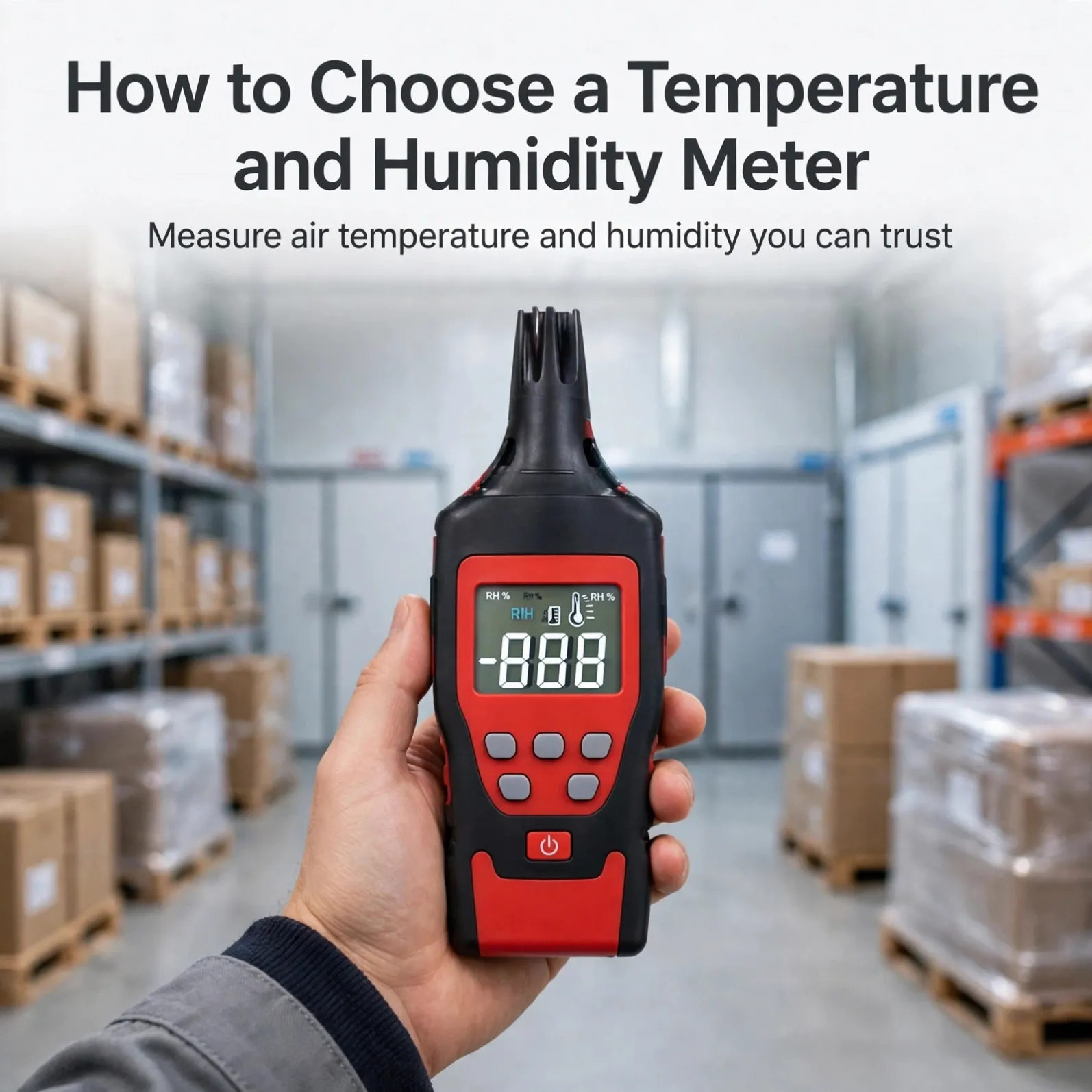
The short answer: match the meter to the air you actually measure
A temperature and humidity meter — also called a thermo-hygrometer — measures the two numbers that decide whether a room, a cold store, or a duct is doing its job: air temperature and relative humidity.
Start from the job, not the datasheet. A commissioning engineer checking a new air-handling unit needs a fast handheld probe. A warehouse manager proving a cold chain stayed within limits needs logging and a calibration certificate. A facilities team watching a server room needs a fixed monitor with an alarm. Pick the form factor first, then compare accuracy and range.
Handheld, wall-mount, or data logger: three different tools
Handheld thermo-hygrometers are the field instrument. A probe at the top of the unit samples the air where you hold it, and a dual display shows temperature and humidity side by side. They suit commissioning, spot checks, and troubleshooting — walking a warehouse aisle, checking supply-air temperature at a diffuser, or verifying a greenhouse zone. A typical handheld unit in this class measures roughly −20 °C to 60 °C with ±0.5 °C accuracy and runs on AAA batteries.
Wall-mount room thermometers sit in one place and show the conditions at that spot. They suit offices, clean rooms, storage rooms, and anywhere staff need a glanceable reading. Expect a narrower range — commonly −10 °C to +50 °C and 10–99% RH — with humidity accuracy around ±3–5% RH. They are cheap and permanent, but they only tell you about one location.
Data loggers record temperature and humidity over hours, days, or weeks. They are the right choice whenever you need proof: a cold-chain shipment, a pharmaceutical store, or a food warehouse under audit. When comparing loggers, ask about memory capacity, battery life, how data is exported, and whether the unit carries a calibration certificate traceable to a national standard.
The five selection criteria that decide the purchase
1. Measurement range — cover your worst case, not your average
List the extremes the meter will see. A cold store runs near 0 °C or below; a greenhouse in summer can exceed 40 °C; a server-room check rarely leaves 15–35 °C. Humidity ranges matter just as much: a dry winter office may sit at 20% RH, a tropical warehouse at 90% RH. A meter that cannot reach your extremes will not just read inaccurately — it may display an error exactly when you need a number.
2. Accuracy and resolution — know what the number is worth
Temperature accuracy of ±0.5 °C is a solid benchmark for a handheld field meter; ±1 °C is acceptable for a fixed room display. For humidity, ±3% RH is good, ±5% RH is common on budget units, and anything worse than that is only useful as a rough indicator. Resolution — 0.1 °C and 0.1% RH — tells you how finely the display steps, not how right it is. Do not confuse the two: a meter can display 0.1 °C steps and still be 2 °C off.
3. Response time and sensor placement
Humidity sensors are slower than temperature sensors. A good handheld meter settles within a minute or two in still air; a technician who reads it after ten seconds records a meaningless number. Check the sensor position too: a probe at the top of the unit, away from the hand and the battery compartment, reads the air rather than the warmth of your grip. If you measure inside ducts, confirm the probe length reaches the air stream and that the unit can hold a reading while you pull it out.
4. Display, hold, and min/max
In daily use, the display decides whether the meter gets used. A large dual display that shows temperature and humidity together saves a button press on every reading. A hold function freezes the reading so you can write it down; min/max recording shows the extremes since switch-on, which is useful when checking a room that swings overnight. Backlight matters more than buyers expect — cold stores and plant rooms are rarely well lit.
5. Data logging and calibration support
If the reading will ever be shown to a customer, an auditor, or an insurer, logging and calibration move from nice-to-have to essential. Ask three questions before ordering: can the meter store readings with timestamps, can the data be exported to a computer, and can the supplier provide a calibration certificate? A supplier who can calibrate before shipment — and re-calibrate on a schedule — is worth more than a slightly cheaper unit that arrives uncalibrated.
Where each type earns its keep
Application | Best fit | What to check |
|---|---|---|
HVAC commissioning | Handheld probe meter | Fast response, hold function, duct probe reach |
Cold chain and food storage | Data logger | Logging interval, alarm limits, calibration certificate |
Warehouse and archive | Wall-mount plus handheld | One fixed display per zone, one handheld for spot checks |
Greenhouse and agriculture | Handheld or logger | Humidity accuracy at high RH, water resistance |
Server room and clean room | Fixed monitor with alarm | Alarm thresholds, continuous display, stable accuracy |
Sample evaluation: test it in your own air
Ask for one sample and run it against a reference you trust. Put the sample and a calibrated reference meter side by side for an hour and compare readings at the same moment — rooms drift. Move the sample from a cool store to a warm office and time how long the humidity reading takes to settle. If you buy loggers, download a full day of data and confirm the export format opens in your own spreadsheet. If the sample reads differently from the reference by more than its stated accuracy, or if the humidity reading wanders for half an hour, pause the order and ask the supplier why.
OEM/ODM and supplier questions
If you sell under your own brand, temperature and humidity meters are straightforward OEM products: your logo on the housing, your packaging, your manual, and your barcode. Confirm the details before the first order — logo placement and printing method, packaging artwork, manual language, and the barcode format your market requires.
Before you place the order, ask the supplier: what is the temperature and humidity accuracy across the full range, not just at 25 °C? How long does the sensor take to settle after a step change? Is a calibration certificate available, and what does re-calibration cost? What is the battery life in continuous use, and are batteries included? And what is the warranty if a sensor drifts within the first year?
Related reading
- Infrared thermometer buying guide — for surface temperature checks that pair with air measurements
- Moisture meter buying guide — for moisture inside materials, not in the air
- Anemometer buying guide — for airflow checks that complete an HVAC commissioning kit
Looking for a temperature and humidity meter for your market? Contact us at zydhardware.com for specifications, samples, and OEM options — we supply handheld and fixed instruments to distributors and brand owners worldwide.