Sep 11, 2026Buying Guides
How to Compare Multimeter Specifications: A 10-Step Buyer’s Guide
Two digital multimeters can look almost identical on a specification sheet. Both may offer 6000 counts, True RMS, NCV, capacitance, and similar voltage ranges. Yet they may be designed for very dif
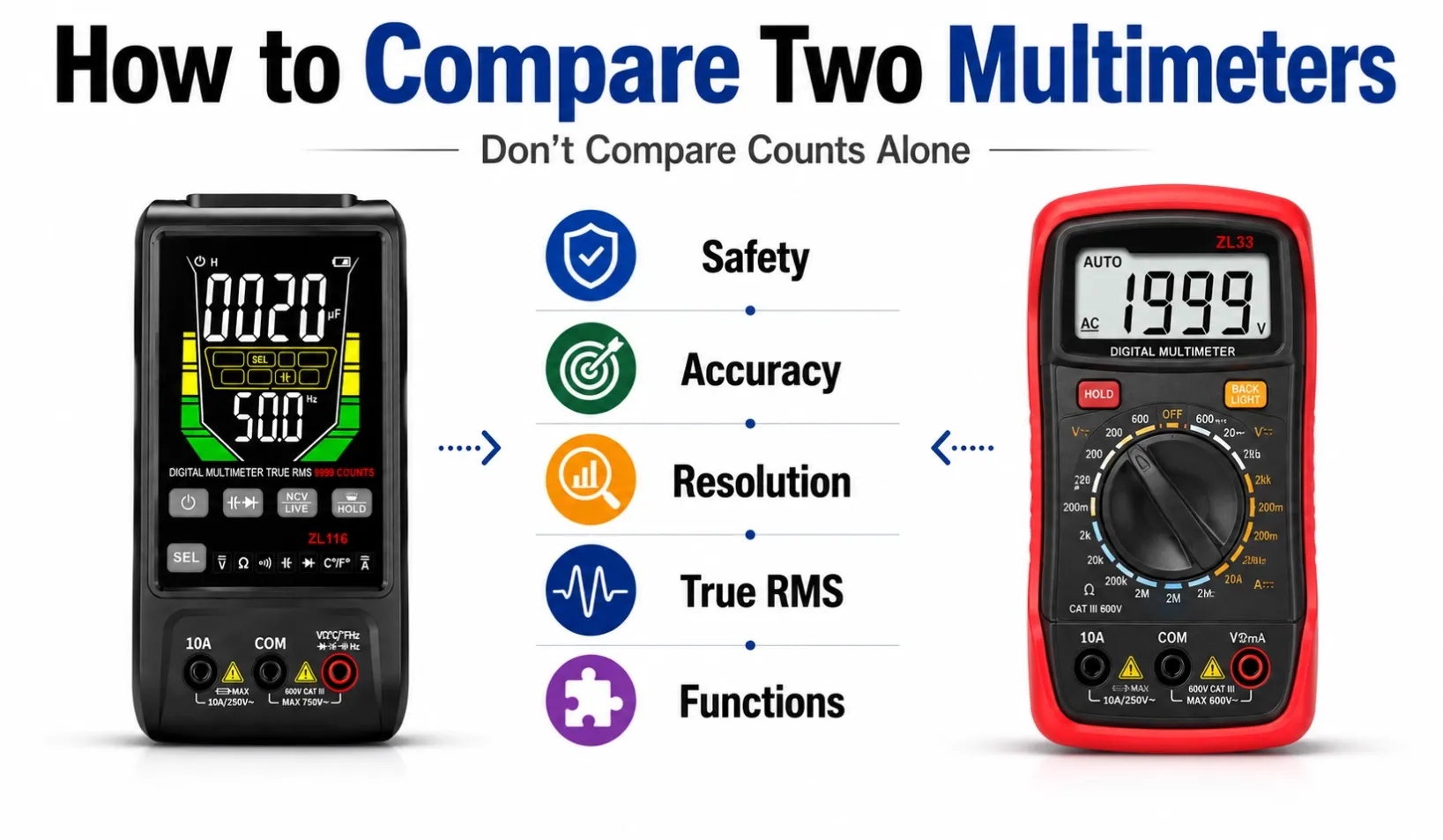
How to Compare Multimeter Specifications: A 10-Step Buyer’s Guide
Two digital multimeters can look almost identical on a specification sheet.
Both may offer 6000 counts, True RMS, NCV, capacitance, and similar voltage ranges. Yet they may be designed for very different users and applications.
One may be suitable for professional electrical or HVAC maintenance, while another may be better positioned for electronics troubleshooting.
For distributors, wholesalers, and private-label buyers, this creates an important sourcing question:
How do you compare two multimeters when both specification sheets look good?
The answer is not to compare one headline number.
A multimeter should be evaluated as a complete measurement system.
Here is a practical 10-step framework.
Step 1: Define the Application First
Before comparing counts, accuracy, or functions, ask:
Who is the end user?
Different users have different priorities.
Electricians may prioritize:
- Appropriate CAT rating
- True RMS
- Input protection
- Fast continuity
HVAC technicians may need:
- Capacitance
- Temperature
- AC current
- Frequency
- Microamp measurement for certain applications
Electronics technicians may place greater importance on:
- Higher resolution
- Low-voltage ranges
- Low-current measurement
- Frequency and duty cycle
Industrial maintenance technicians may require:
- True RMS
- Min/Max
- Reliable input protection
- Durable construction
- Stable readings
So the first question should never be:
Which meter has more counts?
It should be:
Which meter better matches the intended application?
Step 2: Compare Safety Before Extra Features
For professional electrical applications, safety deserves attention before additional functions or display resolution.
Compare:
- Measurement category
- Rated voltage
- Input protection
- Fuse protection
- Test-lead rating
- Applicable safety documentation
For example:
CAT III 600 V
and:
CAT IV 600 V
do not describe the same measurement environment.
A higher CAT category is not simply a quality ranking. The appropriate rating depends on where the instrument will be used.
For B2B sourcing, buyers should also avoid evaluating safety from the front-panel marking alone.
Supporting documentation and product construction matter.
Step 3: Compare Useful Range, Not Just Maximum Range
Large maximum values look impressive on packaging.
1000 V. 100 MΩ. 100 mF.
But a larger maximum range only creates value when the customer actually needs it.
Suppose:
Meter A: 600 V maximum
Meter B: 1000 V maximum
Meter B has the larger number.
But if the intended customer primarily performs measurements well below 600 V, other differences such as accuracy, safety, functions, and usability may be more important.
Compare the ranges customers will actually use—not only the maximum values on the datasheet.
Step 4: Compare Accuracy Correctly
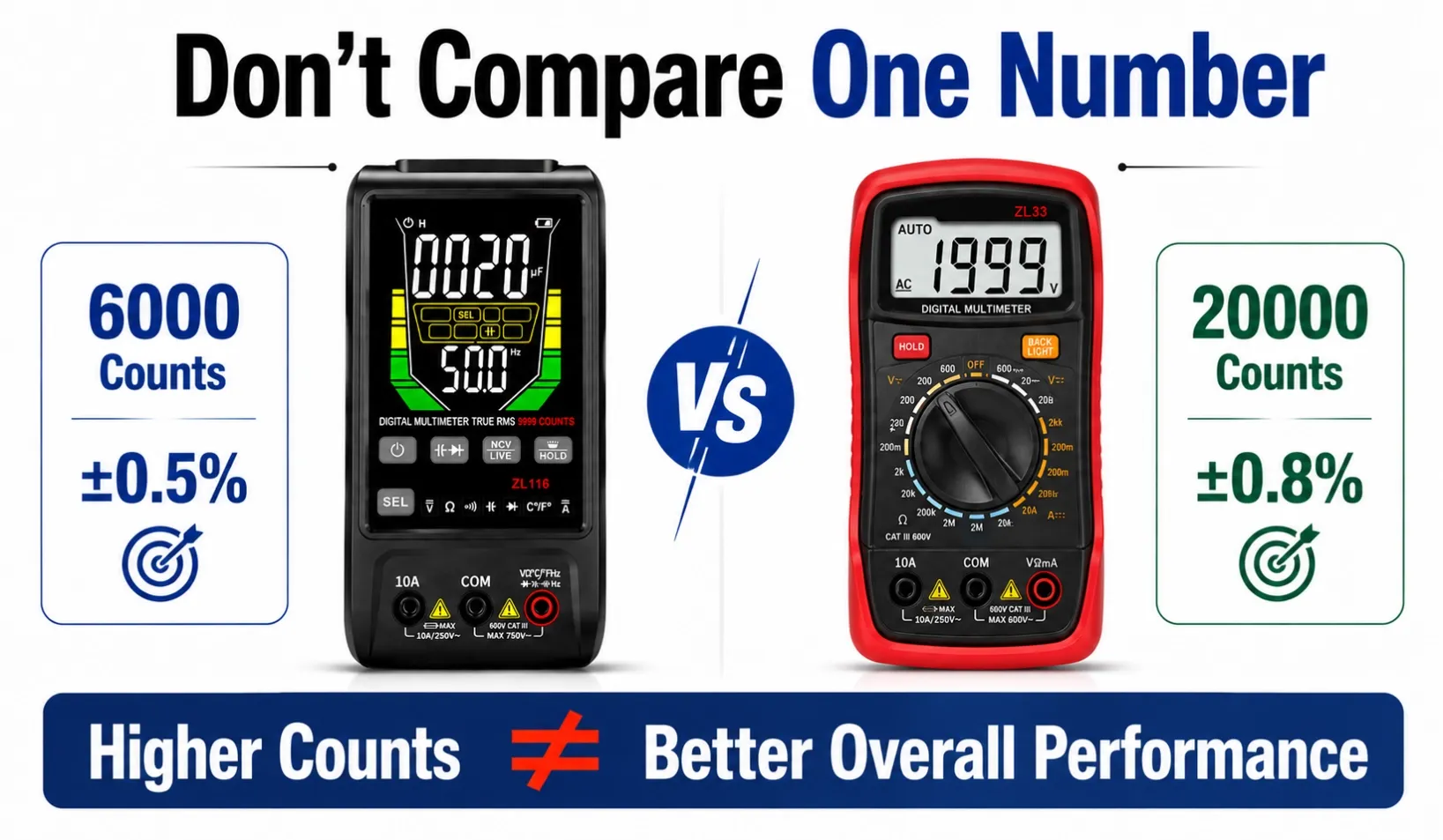
Do not compare:
0.5% vs 0.8%
without reading the rest of the specification.
Digital multimeter accuracy is commonly expressed in a form such as:
±(% of reading + counts)
For example:
±(0.5% + 2 counts)
Professional buyers should compare:
- The same measurement function
- Comparable ranges
- Percentage of reading
- Additional counts
- Applicable frequency range for AC
- Specified operating conditions
A meter's best headline accuracy does not describe its performance across every function and range.
Step 5: Compare Resolution and Counts
Counts help describe the amount of detail a digital multimeter can display.
For example:
Meter A: 6000 counts
Meter B: 20000 counts
Meter B offers greater potential display resolution on comparable ranges.
But:
Resolution ≠ Accuracy
A higher-count meter does not automatically provide a measurement closer to the true value.
For many professional field applications, a well-designed 6000-count meter can provide sufficient resolution.
Higher counts become more valuable when the application genuinely requires technicians to observe smaller changes.
Compare:
Counts + Range + Resolution + Accuracy
together.
Step 6: Determine Whether True RMS Matters
True RMS is particularly important when measuring AC signals that are not clean sine waves.
These can occur in systems involving:
- Variable-frequency drives
- Electronic controls
- Inverters
- Switching power supplies
- Certain HVAC equipment
For these applications, True RMS capability may be much more meaningful than simply increasing display counts.
However, not every user needs the same measurement capability.
Once again:
Application determines specification.
Step 7: Avoid the Feature Trap
More functions do not automatically make a better multimeter.
Consider features such as:
- LoZ
- Min/Max
- Peak
- Inrush measurement
- Temperature
- Capacitance
- NCV
- Bluetooth
- Data logging
Their value depends on the target user.
Bluetooth, for example, may add little value to a basic field meter but can be useful when remote monitoring or data recording is required.
Instead of asking:
How many functions does this meter have?
ask:
Which functions solve problems for the intended customer?
Step 8: Evaluate Usability
This is where specification sheets often tell only part of the story.
Two meters with similar specifications may feel very different in daily use.
Sample evaluation can reveal differences in:
Continuity response
Does the buzzer respond quickly and consistently?
Autoranging speed
How quickly does the meter settle on an appropriate range?
Reading stability
Does the display remain usable during measurement?
Display readability
Can the screen be read clearly in typical working conditions?
Rotary switch and buttons
Are the controls practical for repeated field use?
Test leads
Are the probes and cables suitable for the intended application?
These factors may not produce impressive headline specifications, but they can strongly affect the end-user experience.
Step 9: Compare the Complete Product Package
For a distributor, the meter itself is only part of the product.
Also evaluate:
- Test leads
- Thermocouple where applicable
- Alligator clips
- Carrying case
- Batteries or rechargeable system
- User manual
- Packaging
For private-label buyers, additional questions may include:
- Can the logo be customized?
- Can the housing or color be customized?
- Can packaging be localized?
- Can manuals be adapted for the target market?
- What accessories can be bundled?
A technically good meter with poor accessories or packaging can still create a weak product offer.
Step 10: Evaluate the Supplier Behind the Specification
For B2B purchasing, specifications are only one part of the decision.
A distributor may need the same product for repeated orders rather than a single purchase.
Consider:
- Product consistency
- Available technical documentation
- Sample support
- OEM/private-label capability
- Packaging customization
- Lead time
- Warranty and after-sales support
- Product availability over time
This is an important difference between buying a multimeter and building a multimeter product line.
Example: Comparing Two Multimeters
Consider these two hypothetical products:
Specification | Meter A | Meter B |
|---|---|---|
Counts | 6000 | 20000 |
DC Voltage Accuracy | ±(0.5% + 2 counts) | ±(0.05% + 3 counts) |
True RMS | Yes | Yes |
Temperature | Yes | No |
Low Current | Standard | μA capability |
Main Strength | Field functions | Higher resolution |
Potential Application | Electrical / HVAC | Electronics / technical work |
Which one is better?
Neither—until you define the customer.
For an HVAC distributor, Meter A's temperature measurement and field-oriented functions may create more value.
For electronics or engineering applications, Meter B's tighter accuracy and higher resolution may be more useful.
This is why professional multimeter comparison should always begin with application.
The 10-Step Multimeter Buyer Checklist
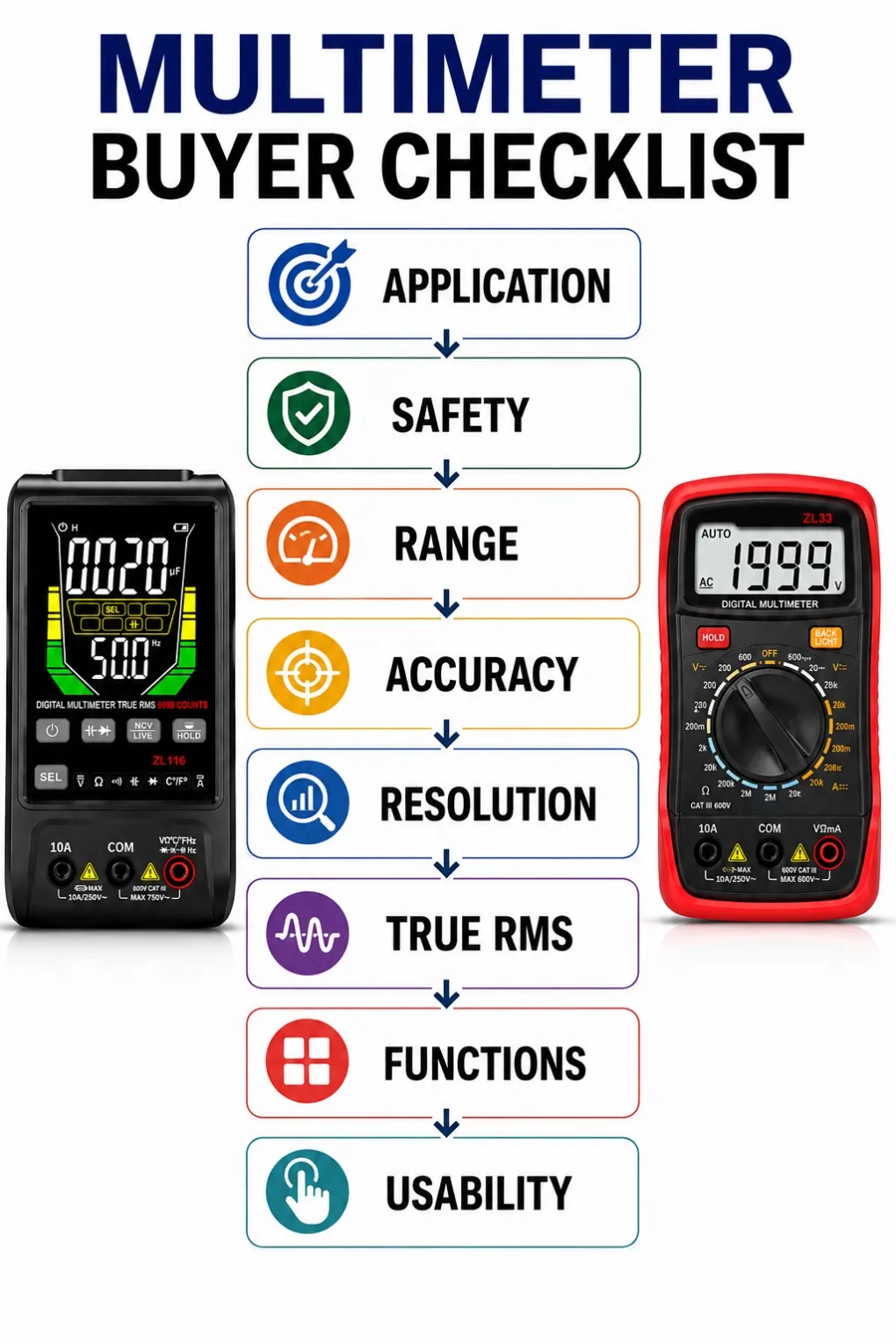
When comparing two DMM specification sheets, use this order:
1. APPLICATION
↓
2. SAFETY
↓
3. RANGE
↓
4. ACCURACY
↓
5. RESOLUTION
↓
6. TRUE RMS
↓
7. FUNCTIONS
↓
8. USABILITY
↓
9. ACCESSORIES
↓
10. SUPPLIER SUPPORT
This prevents one of the most common sourcing mistakes:
Choosing the meter with the biggest numbers instead of the meter that best fits the customer.
Final Takeaway
When comparing two multimeters, do not ask only:
Which has more counts?
Which measures the highest voltage?
Which has more functions?
Instead, compare the complete product:
Application + Safety + Range + Accuracy + Resolution + True RMS + Functions + Usability
The best multimeter is not necessarily the one with the longest specification sheet.
It is the one whose specifications best match the intended user.
Comparing an Existing Multimeter With an Alternative?
If you are a distributor, wholesaler, or private-label buyer, you can send us the model number or specification sheet of the multimeter you currently source.
We can help compare the key specifications and identify available alternatives based on your target application, required functions, positioning, and OEM/private-label requirements.