
Buying Guides
How to Tell If a Multimeter's CAT Rating Is Real
A printed CAT III 600V label is not proof of safety. Check the lab mark, fuse, and test report to verify a multimeter CAT rating before you buy or import.
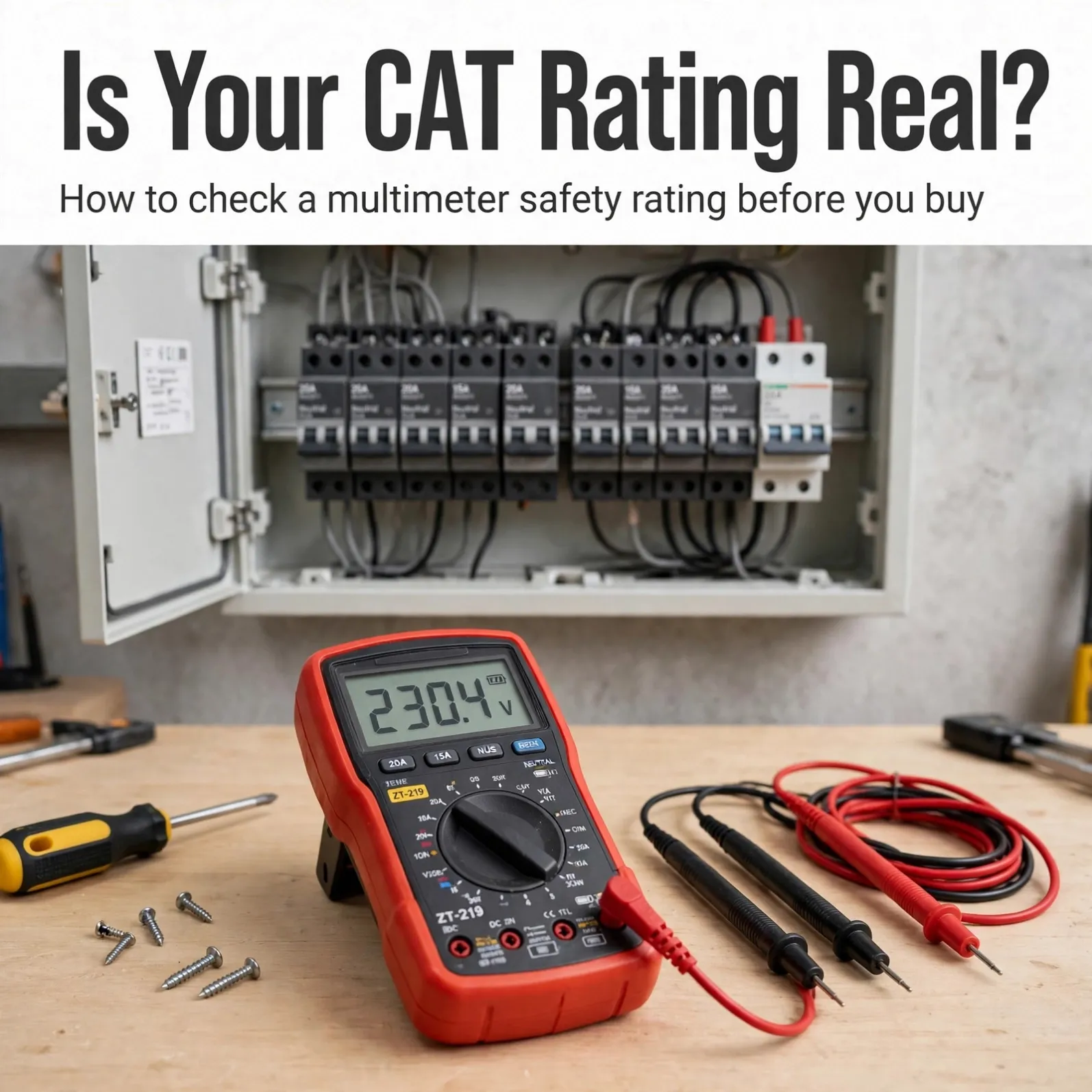
How to Tell If a Multimeter's CAT Rating Is Real
A meter printed with "CAT III 600V" looks safe. That print alone proves nothing. A CAT rating is only trustworthy when an independent laboratory has tested that exact model to the IEC 61010 standard — and you can verify the test. Meters have been recalled because the fuse inside could not handle the rating on the case, and teardowns have found CAT-marked meters with no input protection. Before you buy, import, or brand a multimeter, check it the way a safety engineer would: lab mark, full rating, paperwork.
What a CAT Rating Actually Measures
CAT — measurement category — is defined in IEC 61010. It describes how much transient energy a meter can survive at a given point in the electrical system, not how accurately it measures. Spikes are damped as they travel through wiring, so danger is highest at the service entrance and lowest at a wall outlet:
Category | Where it applies | Examples |
|---|---|---|
CAT IV | Origin of the installation | Service entrance, utility meter |
CAT III | Building distribution | Panels, switchgear, fixed wiring |
CAT II | Receptacle loads | Appliances, portable tools, outlets |
CAT I | Protected circuits | Low-energy electronics |
Read the two numbers together. A CAT III 600V meter must survive a 6,000V impulse through a 2-ohm source; CAT IV 600V, 8,000V; CAT II 600V, only 4,000V through a 12-ohm source. The trap: a CAT II 1000V meter sounds stronger than a CAT III 600V meter, but the CAT III meter faces a harsher test. Never use a lower-category meter where a higher one is required.
Why a Printed Label Is Not Proof
The IEC writes the standard but does not enforce it. In many markets a manufacturer can print a CAT rating on its own declaration, untested. Fluke's safety guidance is plain: a maker can self-certify CAT II or CAT III without verification; the only reliable check is the mark and listing number of an independent lab such as UL, CSA, or TÜV.
Recalls show what happens when the label outruns the design. Fluke recalled its AM-500 and AM-510 meters because a CAT III 600V meter had a fuse with too low a breaking capacity — an arc-flash risk above 400V. Klein recalled CL110, CL210, and CL310 clamp meters in 2016 — a loose fastener could make a live circuit read as zero — and about 1.69 million NCVT-1 testers in 2021 after a sticking button silenced the alarm. Fluke recalled TL221, TL222, and TL224 test leads in 2004 after connection faults caused wrong readings.
Teardowns tell the same story: EEVblog engineers have found CAT-marked meters with ordinary glass fuses instead of high-rupture-capacity (HRC) fuses, and no varistor on the input. A glass fuse can shatter or sustain an arc; an HRC fuse interrupts fault current safely. The case marking cannot tell you which is inside.
Six Checks Before You Buy or Import
1. Look for an independent lab mark and a listing number. A UL, CSA, or TÜV mark should appear on the meter itself, with a listing or file number — then verify it in the lab's public database. A mark with no verifiable listing is a warning sign.
2. Read the full rating near the input jacks. A genuine rating reads as a pair — "CAT III 600V" or "CAT III 1000V / CAT IV 600V". A meter showing only "600V", or "CAT III" with no voltage, carries an incomplete rating you cannot trust. Our 2025 catalogue lists the SR-510A at CAT III 1000V and CAT IV 600V.
3. Check the fuse. Open the fuse compartment and read the marking: the fuse must be an HRC type rated for the meter's full CAT voltage and current. If the manual gives no fuse specification, or a plain glass fuse sits in a meter claiming CAT III, treat the rating as unverified.
4. Watch the wording. "Tested to IEC 61010" means a test happened; "designed to meet IEC 61010" means only that the designer intended to meet it. That word "designed" is a common tell of a self-declared rating. The CE mark is the same: a manufacturer's declaration, not an independent safety test.
5. Judge the build. Recessed, shrouded jacks, firm lead connections, and a solid case fit a meter built to survive a transient. A meter claiming CAT IV that feels light, shows exposed metal at the jacks, or ships with thin unmarked leads probably never passed the test its label claims.
6. Ask for the test report for that exact model. A certificate for a different model, a different rating, or a "series" does not cover the meter you are buying. If the supplier cannot produce it, do not accept the rating.
What to Ask Your Supplier: A Buyer's Checklist
For distributors buying in volume, the CAT rating is a liability question as much as a specification: a meter that fails under a transient can injure the user and expose the importer.
Check | What to verify | Red flag |
|---|---|---|
Lab mark | UL, CSA, or TÜV mark with listing number on the meter | Mark only on the box or website |
Full rating | Category and voltage printed together near the jacks | Voltage or category shown alone |
Fuse | HRC fuse rated for the full CAT voltage, stated in the manual | Glass fuse, or no fuse specification |
Wording | "Tested to" or "certified to" IEC 61010 | "Designed to meet" the standard |
Documentation | Test report naming the exact model and rating | Report for a different model, or none |
Leads | Test leads rated to the same CAT and voltage as the meter | Unmarked leads, or leads rated lower |
Calibration support | Calibration service and certificate available | No calibration path for the model |
Confirm the rating fits your customers' work: most facility maintenance sits in CAT III; service-entrance work needs CAT IV. Buying CAT II meters for panel work to save money is a false economy — the rating covers the whole chain: a CAT III meter with CAT II leads is a CAT II system.
Before a volume order, test the sample as a safety check: verify the lab listing, confirm the fuse, measure a known source, check the leads. For own-brand orders, put the exact CAT rating, lab mark, and fuse specification in the order sheet and confirm the factory test report covers that model. Shenzhen Zhanyueda supports OEM and ODM production, including logo, packaging, manual, and barcode customisation.
The Bottom Line
A CAT rating is a test result, not a label. Read category and voltage together, check the lab mark, fuse, and leads, distrust "designed to meet," and ask for the test report for the exact model. A supplier who answers all six checks quickly is worth working with; one who cannot is telling you something.
Need multimeters with verified safety ratings? Contact us at zydhardware.com for the catalogue, sample terms, and OEM/ODM options.
Related categories: digital multimeters, clamp meters, insulation resistance testers.