
What Test Instruments Should Every HVAC Distributor Consider Stocking?
Build an HVAC test instrument range around service calls, measurement requirements, compatible probes and support—not simply more models.
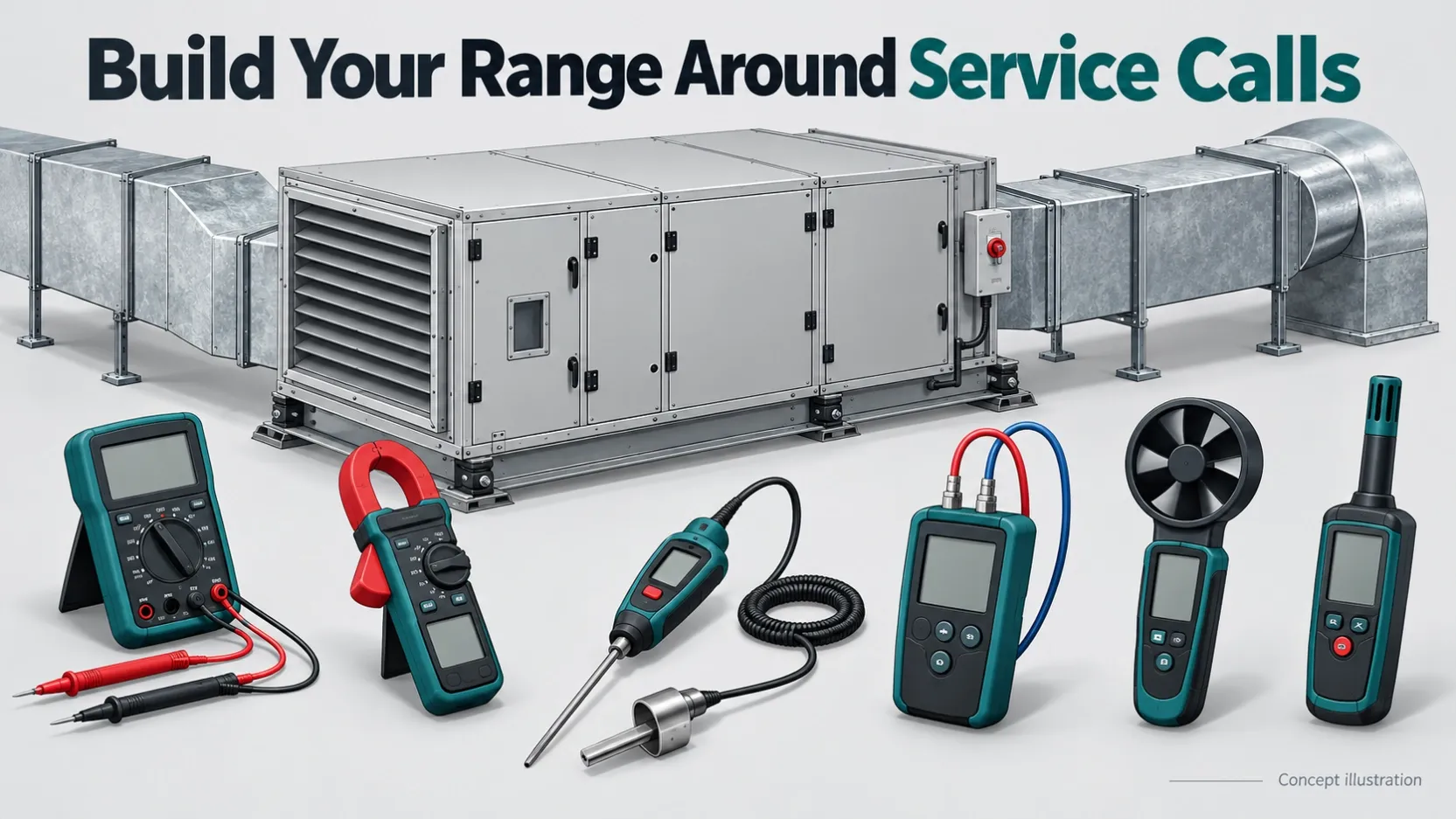
A strong HVAC product range should reflect the service calls technicians actually face. Start with the measurements customers need to make, then select instruments, probes and support that help them complete those jobs. A longer model list is not automatically better coverage.
For a distributor, the useful question is not simply, “Do we stock an anemometer?” It is, “Can our customer take the airflow measurement their job requires with the equipment we supply?”
Start With Service Calls, Not Category Names
Review recent enquiries, orders, returns and technical questions. Separate residential servicing, commercial ventilation and refrigeration maintenance. Record each task, its measurement requirements and any gap in your offer. Your own records should determine which capabilities deserve regular stock and which belong on a specialist quotation list.
The following framework is not a universal diagnostic sequence or a complete HVAC service kit.
Match the Instrument to the Diagnostic Question
| Task | Category to evaluate | Selection boundary |
|---|---|---|
| Electrical diagnostics | Multimeter and clamp meter | Verify required functions, current type, range and safety suitability for the exact model. |
| Temperature checks | Contact thermometer and suitable probes; IR thermometer for surfaces | Air, pipe contact and infrared surface measurements are different jobs. |
| Pressure checks | Manometer or differential pressure instrument | Match pressure limits, permitted media and connections to the application. |
| Airflow checks | Anemometer with appropriate probe or other airflow tools | One local velocity reading does not establish total airflow. |
| Humidity and comfort | Thermo-hygrometer | Temperature and relative humidity are not a complete indoor-air-quality assessment. |
| Preventive inspection | Thermal camera | A thermal pattern guides investigation; it does not prove the root cause. |
Electrical Diagnostics: Sell the Required Functions
Do not treat every multimeter or clamp meter as interchangeable. A request for current measurement still requires clarification of current type, expected level and measurement method. Build comparisons around documented model capabilities.
Safety suitability is a requirement at every price level. Instruments, leads and accessories must suit the application. A lower price must not mean recommending equipment outside its rating. Electrical testing should follow equipment instructions and be performed by appropriately qualified personnel.
Temperature: Choose the Probe Before the Bundle
An air-temperature check, a pipe-contact reading and a surface scan require different measurement arrangements. Confirm probe type, connection and intended use before offering a kit.
Infrared thermometers determine surface temperature. A technician needing air temperature needs a suitable air-temperature measurement arrangement, not an IR reading aimed into a vent. Contact and infrared functions may coexist in one instrument, but remain different methods. See the Fluke 561 manual for a manufacturer example of this distinction.
For a distributor, a documented compatible probe may close a more useful gap than another thermometer body.
Pressure and Airflow: Avoid Selling the Wrong Measurement
Differential pressure instruments can support filter checks; some configurations also support flow measurements with suitable accessories. This does not make every manometer suitable for every pressure task. The Testo 420 application information illustrates application-dependent instrument and accessory selection, not a capability claim for ZYD products.
Keep ventilation pressure work distinct from refrigerant-circuit work. Verify permitted media, pressure limits and connections; do not substitute a ventilation manometer for a refrigerant pressure instrument.
Ask whether customers need velocity at one location or volume flow through an opening. Volume-flow determination depends on the measurement method, relevant cross-sectional information and representative sampling. A flow display does not make a single-point reading representative. See Testo air-velocity measurement guidance.
Humidity and Thermal Inspection: Explain the Limits
A thermo-hygrometer addresses temperature and relative humidity. Do not present these readings as evidence about pollutants the instrument does not measure. Broader indoor-environment work requires appropriate sensors and methods; multifunction instruments also depend on which probes are fitted. Testo 440 dP measurement options provide an example.
For thermal cameras, evaluate inspection and reporting needs rather than image appearance alone. Reflective surfaces can produce misleading apparent temperatures. A suspicious pattern should lead to investigation, not automatic part replacement. See Fluke guidance on reflective surfaces.
Build Tiers Around Job Requirements
Entry-level, mid-range and professional labels only help when the differences are clear.
- Core task coverage: a defined routine measurement, with the required function, range, accuracy specification, safety suitability and accessories.
- Workflow upgrade: a documented benefit for repeat users, such as relevant recording functions or probe flexibility.
- Specialist work: an application or reporting requirement not covered by the core range, with verified accessory and support arrangements.
Three tiers are not necessary in every category. Two genuinely different options may be easier to explain than several nearly identical models. Not every customer needs the highest-priced instrument.
Use This Worksheet Before Adding a Model
- Which specific customer task does it address?
- How often does that task appear in your enquiries or orders, and over what period?
- What quantity, conditions and reporting requirements must be covered?
- Can the current offer complete the job, including probes and accessories?
- Is the gap a missing function, unclear choice, unavailable accessory or support issue?
- Would a new model, better bundle, compatibility guide or sales training solve it best?
Consider a hypothetical example: you sell several thermometers, but cannot identify or replace a pipe probe customers need. Another thermometer may not solve the problem. A verified probe option and clear compatibility guide might.
Refrigeration-focused or heating-focused customers may need specialist equipment beyond this framework. Use the same task-first review rather than treating this as an exhaustive stocking list.
Make the Range Explainable and Supportable
Before launching a model, ask a salesperson to explain which job it suits, which job it does not suit, which accessories are needed and why a customer would choose it over the next option.
Then establish the after-sale arrangements: replacement probes and leads, the correct manual, and any documented service, calibration and warranty terms for that exact product. Do not promise support that has not been established.
Common Distributor Questions
Should we stock every category?
Not automatically. Let customer tasks and documented demand guide regular stock; keep less frequent specialist requirements on a quotation list.
Is adding models the best way to grow the range?
Only when a new model closes a meaningful gap. Accessory availability, clear comparisons and better guidance may solve the problem more directly.
What information should we send with an enquiry?
Describe customer service tasks, target market, required measurement functions and estimated quantities. Include probe, accessory and reporting needs so suitability can be reviewed.
The best HVAC product range is built around service calls. Help customers choose a suitable measurement setup, understand its limits and keep using it effectively. These task details also provide ZYD with a more useful enquiry starting point than a request for a general tool catalogue.