Sep 11, 2026Buying Guides
Multimeter Accuracy vs Resolution: What Should Buyers Compare?
When comparing digital multimeters, buyers often focus on specifications such as: 6000 counts. 20000 counts. 0.5% accuracy. 0.1 mV resolution.
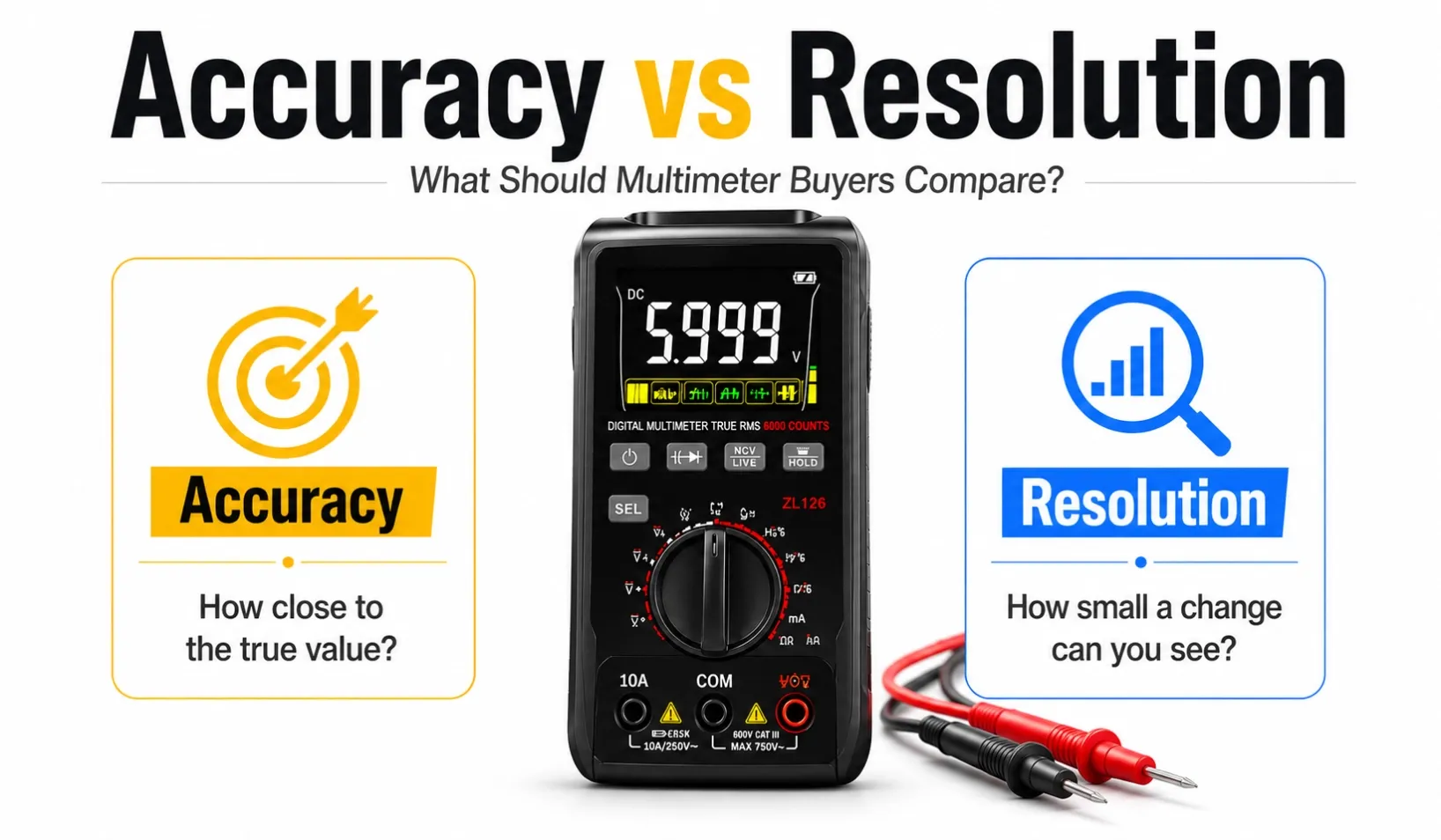
When comparing digital multimeters, buyers often focus on specifications such as:
6000 counts. 20000 counts. 0.5% accuracy. 0.1 mV resolution.
The problem is that these numbers describe different aspects of measurement performance.
A multimeter can have high resolution but relatively modest accuracy. Another meter can display fewer digits while providing better accuracy for the measurement that actually matters.
The key difference is:
Resolution tells you how small a change the meter can display. Accuracy tells you how close the measurement is to the true value.
For electricians, HVAC technicians, industrial maintenance teams, and distributors selecting professional multimeters, understanding both is more useful than simply choosing the meter with the largest display count.
What Is Multimeter Accuracy?
Accuracy describes how close a measured value is expected to be to the actual value under specified conditions.
Digital multimeter accuracy is commonly expressed in a form such as:
±(% of reading + counts)
For example:
±(0.5% of reading + 2 counts)
The first part represents an error related to the measured value.
The second part represents additional uncertainty based on the least significant displayed digit.
Suppose a meter measures:
10.000 V
with an accuracy specification of:
±(0.5% + 2 counts)
If the resolution on that range is 0.001 V:
0.5% of 10.000 V = 0.050 V
and:
2 counts × 0.001 V = 0.002 V
So the total specified uncertainty would be approximately:
±0.052 V
under the conditions stated by the manufacturer.
That means displaying more decimal places does not necessarily mean you know the voltage to all of those decimal places.
What Is Multimeter Resolution?
Resolution is the smallest change in a measured quantity that the multimeter can distinguish and display on a particular range.
For example:
A meter with:
6.000 V range → 0.001 V resolution
can display changes of:
0.001 V
So it might show:
5.121 V → 5.122 V
A different range might provide:
60.00 V range → 0.01 V resolution
The same meter now displays changes in steps of:
0.01 V
This illustrates an important point:
Resolution depends on both the meter and the selected measurement range.
It is not simply the number of digits visible on the screen.
Accuracy vs Resolution: A Simple Example
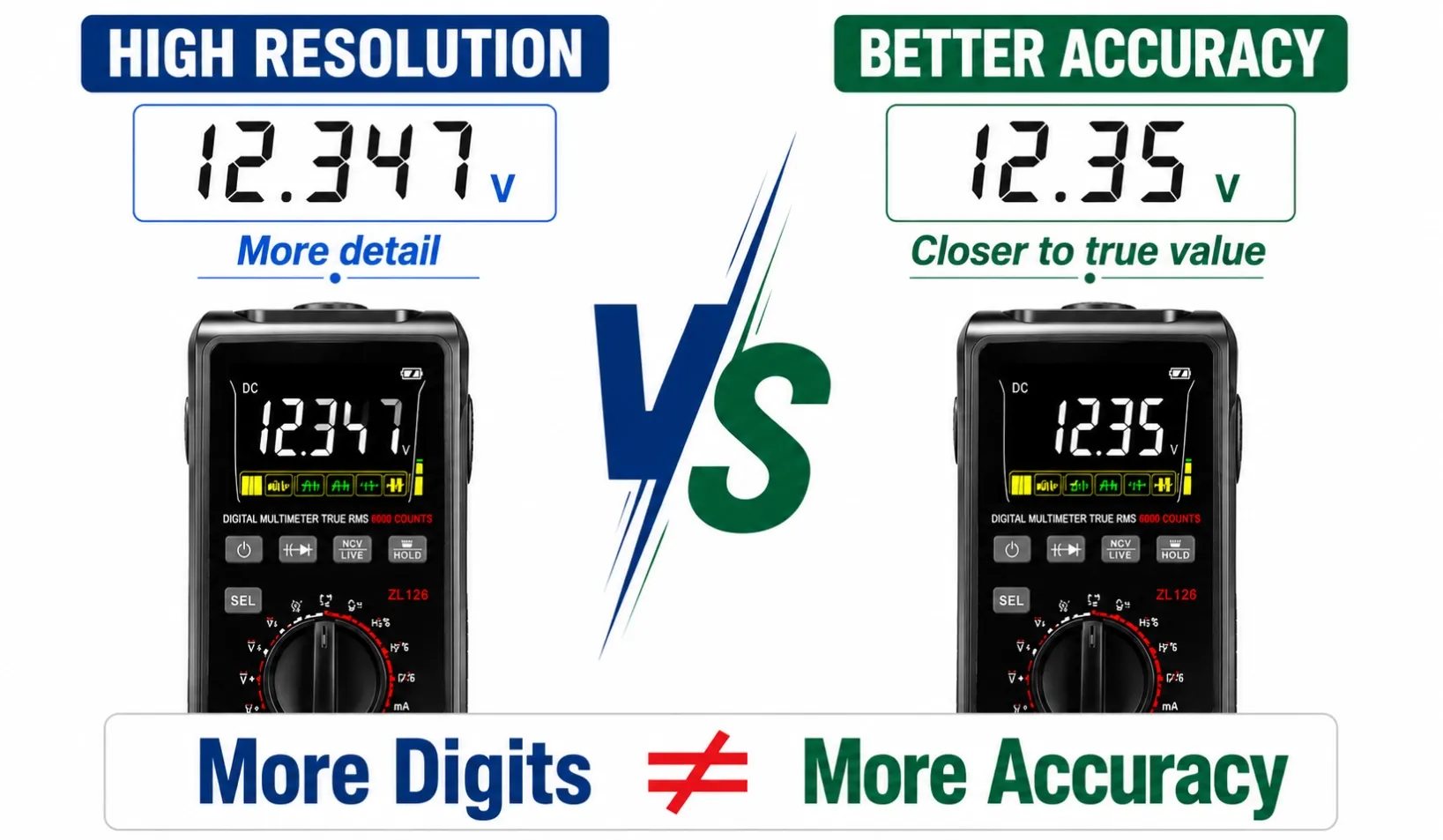
Imagine two digital multimeters measuring the same voltage source.
Meter A
Reading: 12.347 V
Resolution: 0.001 V
Accuracy: ±1.0%
Meter B
Reading: 12.35 V
Resolution: 0.01 V
Accuracy: ±0.3%
Meter A displays more decimal places.
It therefore has higher displayed resolution.
But Meter B has the tighter stated accuracy specification.
So which one is better?
That depends on the application.
If you need to observe very small changes, Meter A's additional resolution may be useful.
If you need the measured value to be closer to the actual value, Meter B's better accuracy may matter more.
This is why:
More digits ≠ more accuracy.
Where Do Counts Fit In?
This connects directly to multimeter counts.
Counts are one way of describing display resolution.
For example:
Display | Approx. Maximum Reading |
|---|---|
2000 counts | 1999 |
4000 counts | 3999 |
6000 counts | 5999 |
20000 counts | 19999 |
A higher-count meter can generally provide finer displayed resolution over part of its measurement range.
But count alone does not tell you:
- Measurement accuracy
- Stability
- Noise
- Input protection
- Safety category
- Measurement speed
- True RMS capability
That is why comparing two meters only by saying:
“20000 counts is better than 6000 counts.”
can be misleading.
Resolution vs Accuracy vs Precision
There is another term that often creates confusion:
Precision.
These three concepts should not be used interchangeably.
Resolution
How small a difference can the meter display?
Accuracy
How close is the measurement to the true value?
Precision
How consistently can the instrument reproduce similar results under the same conditions?
Imagine repeatedly measuring a stable voltage source.
A meter that repeatedly shows nearly the same value may demonstrate good repeatability or precision.
But if that repeated value is consistently away from the reference value, it can be:
Precise, but not sufficiently accurate.
For product comparison, therefore:
Resolution ≠ Accuracy ≠ Precision
although all three contribute to measurement quality.
Does Higher Resolution Matter in Real Applications?
Sometimes enormously.
Sometimes hardly at all.
It depends on what the technician is measuring.
General Electrical Work
Suppose an electrician wants to determine whether a nominal mains supply is present and reasonably normal.
The difference between displaying:
230.1 V
and:
230.12 V
may add little practical value to the troubleshooting decision.
Other factors may matter more:
- Safety category
- Input protection
- True RMS
- Reliability
- Continuity response
- Test-lead quality
HVAC Troubleshooting
HVAC technicians may need:
- Voltage
- Current
- Capacitance
- Temperature
- Frequency
Useful resolution matters, but measurement functions and field usability may matter just as much.
Electronics Repair
Higher resolution can become more valuable when technicians are investigating:
- Low-voltage circuits
- Sensor outputs
- Small resistance changes
- Electronic components
- Power-supply behavior
Small changes may actually carry diagnostic information.
Industrial Maintenance
Industrial users may need a balance of:
- Accuracy
- Resolution
- True RMS
- Safety
- Durability
- Measurement speed
Again, the highest-resolution meter is not automatically the best field instrument.
Why Range Matters Too
Accuracy and resolution should not be compared without looking at the measurement range.
Consider a 6000-count meter.
It might have:
Range | Resolution |
|---|---|
600.0 mV | 0.1 mV |
6.000 V | 0.001 V |
60.00 V | 0.01 V |
600.0 V | 0.1 V |
The same meter therefore provides different absolute resolution depending on the selected range.
This is one reason autoranging is useful: the meter can select a suitable range for the measured value.
However, professional buyers should still inspect the specification table rather than looking only at the headline count.
How Should Buyers Read an Accuracy Specification?
This is where many product comparisons go wrong.
Suppose two meters are advertised as:
Meter A: ±0.5%
Meter B: ±0.8%
It is tempting to conclude immediately that Meter A is better.
But first ask:
0.5% of what?
You need to compare:
- Measurement function
- Measurement range
- % of reading
- Additional counts/digits
- Frequency range for AC measurements
- Operating conditions
- Calibration period where specified
For example, an AC voltage specification may change depending on signal frequency.
A meter might perform differently at:
50/60 Hz
than at:
500 Hz or 1 kHz.
So distributors comparing professional instruments should look at the actual specification table—not only the best accuracy number printed on the front page.
A Practical Buyer Comparison
Suppose you are choosing between two professional handheld multimeters.
Meter A
- 6000 counts
- DC voltage accuracy: ±0.5% + 2 counts
- True RMS
- Suitable safety rating
- Fast continuity
- Temperature and capacitance
Meter B
- 20000 counts
- DC voltage accuracy: ±0.8% + 5 counts
- No True RMS
- Similar voltage range
- Basic measurement functions
Which should you stock?
There is no universal answer.
For professional electricians or HVAC technicians, Meter A may provide the better overall feature mix.
For an electronics user who specifically values higher displayed resolution, Meter B may still have an advantage in certain measurements.
The correct decision depends on the target user.
What Should Professional Buyers Compare?
For distributors and private-label buyers, I recommend comparing multimeters in this order.
1. Application
Start with:
Who will use this meter and what will they measure?
Do not start with count.
2. Safety
For electrical field applications, check:
- CAT rating
- Rated voltage
- Input protection
- Fuse protection
- Test-lead rating
- Relevant documentation
A more accurate meter is not automatically a safer meter.
3. Measurement Range
Does the instrument cover the voltage, current, resistance, capacitance, temperature, or frequency ranges the user needs?
4. Accuracy
Compare accuracy for the functions and ranges that actually matter.
Do not compare only the manufacturer's best headline accuracy.
5. Resolution
Determine whether the application benefits from seeing smaller changes.
6. True RMS
For distorted AC waveforms and many modern electrical loads, True RMS capability can be more valuable than additional display counts.
7. Measurement Speed and Stability
A high-resolution display is less useful if readings are excessively slow or unstable.
Keysight notes that measurement speed and resolution can involve trade-offs in DMM design. Keysight United States
8. Usability
Professional users also care about:
- Display readability
- Backlight
- Continuity speed
- Probe quality
- Battery life
- Ergonomics
- Auto-ranging behavior
These factors do not look impressive in a headline specification, but they strongly affect everyday use.
Accuracy or Resolution: Which Matters More?
Neither one is universally more important.
The answer depends on the measurement task.
Application | Accuracy Priority | Resolution Priority |
|---|---|---|
Basic electrical checks | Moderate | Moderate |
Professional electrical maintenance | High | Moderate |
HVAC troubleshooting | High | Moderate |
Automotive diagnostics | High | Moderate–High |
Electronics repair | High | High |
Industrial maintenance | High | Moderate–High |
Laboratory / R&D | Very High | Very High |
This is a general application guide rather than a universal specification requirement.
The important lesson is:
Buy the measurement performance the application needs—not the largest number on the datasheet.
What Should Distributors Put in Their Product Range?
Instead of stocking several meters differentiated only by counts, create clear application-based levels.
Entry-Level Multimeter
Focus on:
- Basic measurement functions
- Appropriate safety
- Competitive price
- Simple operation
Professional Field Multimeter
Focus on:
- Better accuracy
- Useful resolution
- True RMS
- Strong safety design
- Fast continuity
- Application-relevant functions
Advanced Technical Multimeter
Focus on:
- Higher resolution
- Tighter accuracy
- More advanced functions
- Data features where required
- Electronics / engineering applications
This makes it much easier for sales teams and end-users to understand why one model costs more than another.
Quick Buying Checklist
Before choosing a digital multimeter, compare:
- What is the target application?
- What ranges are required?
- What is the accuracy on those ranges?
- What is the resolution?
- How many counts does the meter provide?
- Is True RMS needed?
- What CAT rating is appropriate?
- How are the inputs protected?
- How quickly does the meter respond?
- Which additional functions does the user actually need?
If two meters have different counts but you have not compared these points, you do not yet have enough information to say which one is better.
Frequently Asked Questions
Is resolution the same as accuracy on a multimeter?
No. Resolution describes the smallest change the meter can display, while accuracy describes how close the measurement is expected to be to the true value.
Does more counts mean better accuracy?
No. Higher counts generally provide greater potential display resolution, but accuracy is specified separately.
Can a multimeter be high-resolution but inaccurate?
Yes. A meter may display many digits while still having a relatively wide accuracy specification.
What does ±(0.5% + 2 counts) mean?
It means the measurement uncertainty includes 0.5% of the reading plus an additional uncertainty equivalent to two least-significant display counts on the selected range.
Is 20000 counts better than 6000 counts?
Not necessarily. It provides more potential display resolution, but application, accuracy, safety, True RMS capability, measurement speed, and other specifications should also be compared.
What matters most when buying a professional multimeter?
Start with the application and safety requirements, then compare range, accuracy, resolution, True RMS capability, measurement functions, protection, and usability.
Final Takeaway
When comparing digital multimeters, remember:
Resolution tells you how much detail you can see.
Accuracy tells you how much confidence you can place in the measured value relative to the true value.
And:
Counts help describe resolution—but they do not determine accuracy.
For professional buyers, the best multimeter is therefore not necessarily the one with the most counts or decimal places.
It is the one whose:
Safety + Range + Accuracy + Resolution + Functions
best match the intended application.
Related Reading
What Does 6000 Counts Mean on a Multimeter?
Understand how display counts affect resolution and why more counts do not automatically mean better measurement performance.
How to Choose a Digital Multimeter for Professional Use
Compare the specifications and functions that matter when selecting DMMs for professional electrical, HVAC, and industrial applications.