Non-Contact Voltage Tester Sensitivity: A Distributor’s Guide to False Alarms and Batch QC
Learn how to compare NCV tester sensitivity, false alarms, safety documentation and batch consistency before a distributor or private-label order.
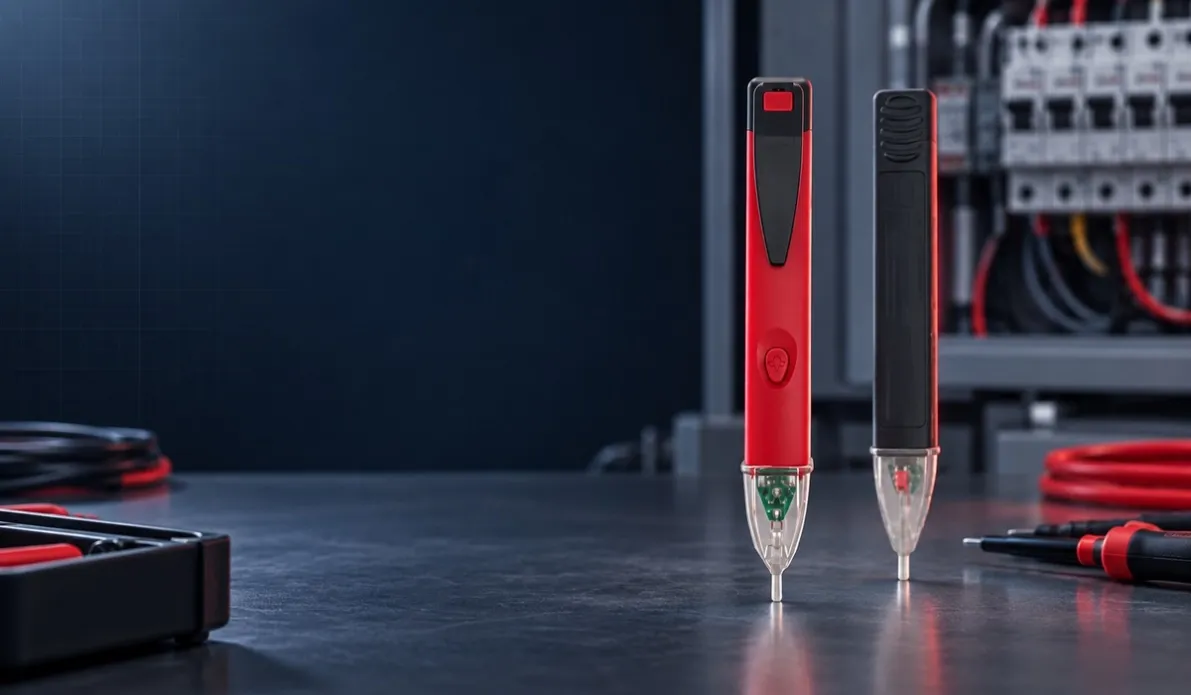
A non-contact voltage tester looks simple: bring the sensing tip near an insulated conductor and watch or listen for an alert. For distributors, however, the commercial risk sits inside that simple interaction. A tester that is too sensitive can alarm around adjacent conductors and induced fields. A tester that is not sensitive enough can miss an energized cable behind thick insulation. If performance changes from batch to batch, returns rise quickly and users lose confidence in the brand.
This guide explains how importers, electrical wholesalers, MRO distributors, and private-label buyers should evaluate non-contact voltage tester sensitivity, false alarms, repeatability, safety documentation, and incoming quality control. It also explains why an NCV tester is a screening tool for voltage presence—not a substitute for a suitably rated contact instrument when a qualified person must verify an electrically safe condition.
What Does a Non-Contact Voltage Tester Actually Detect?
Most pen-style NCV testers sense the alternating electric field around an energized conductor. The user does not need to touch bare metal. The field couples through the probe tip and the user’s body, then the tester converts the signal into an audible, visual, or vibrating alert.
That operating principle explains both the convenience and the limitations. The tester is influenced by voltage, frequency, distance, insulation thickness, cable shielding, nearby conductors, the user’s coupling to ground, battery condition, and the sensor’s internal threshold. It usually does not provide a quantitative voltage measurement. Therefore, “accuracy” and “resolution” are not the most useful comparison terms for a basic NCV pen. Buyers should focus on detection threshold, repeatability, detection distance, alert behavior, and performance under defined conditions.
An NCV result should be treated as one piece of evidence. OSHA guidance emphasizes the use of appropriate test equipment to verify de-energization, and electrical safety practice commonly requires a properly rated contact test at the exposed conductors or circuit parts. A non-contact pen can support preliminary screening and troubleshooting, but it should not be marketed as proof that a circuit is safe to touch.
Why the Lower Detection Threshold Matters More Than the Maximum Voltage
Many product listings lead with “1000 V,” but the lower end of the stated range often tells buyers more about the intended application. A tester starting around 90 V AC may be suited to common mains branch circuits. A model starting at 60 V AC offers a different sensitivity target. Models intended for lower-voltage control circuits may use a lower threshold or a separate high-sensitivity mode.
A lower threshold is not automatically better. Greater sensitivity can help find a conductor behind thicker insulation or trace an energized cable, but it can also increase nuisance alarms from adjacent wires, capacitive coupling, and induced voltage. The correct question is not “Which tester detects the lowest voltage?” It is “Which threshold and alert behavior fit the buyer’s actual circuit environment?”
| Selection factor | Why it matters | Procurement question |
|---|---|---|
| Stated AC range | Defines the manufacturer’s intended detection window under specified conditions | What voltage, frequency, insulation, and distance were used to verify both endpoints? |
| Single or multiple sensitivity modes | Changes the balance between reach and nuisance alarms | Is the threshold fixed, automatically adjusted, or user selectable? |
| Detection distance | Affects tracing and conductor identification | What is the typical and allowed distance at representative voltages? |
| Repeatability | Determines whether units behave consistently in a carton and across production lots | What pass window is used in final inspection? |
| Alert design | Controls readability in bright, dark, or noisy work areas | Are light and sound distinct, and is there a low-battery indication? |
False Positives: When the Tester Alerts but the Target Is Not Energized
A false positive does not always mean the tester is defective. It can result from the surrounding electrical environment or from a test method that does not isolate the target conductor.
Adjacent energized conductors
In a crowded panel, cable tray, or multi-core cable, the electric field from one live conductor can couple into a neighboring conductor. A highly sensitive tester may alert on the neighboring wire even when that wire is disconnected. Distributors should test conductor discrimination, not only basic activation.
Induced and capacitively coupled voltage
Long parallel cable runs can develop a detectable field through capacitive coupling. The NCV pen may correctly sense an electric field without proving that the conductor can deliver useful current. This is one reason field technicians often follow an NCV check with a suitable contact tester.
Static charge and electrical noise
Static electricity, fluorescent lighting, variable-frequency drives, and other sources of electromagnetic noise can trigger unstable behavior in poorly filtered designs. A good sample evaluation should include realistic interference conditions rather than a single demonstration beside an exposed mains wire.
False Negatives: When an Energized Conductor Is Missed
False negatives deserve special attention because the user may interpret silence as safety. Common causes include depleted batteries, a minimum threshold above the actual circuit voltage, shielded or armored cable, metal enclosures, thick insulation, excessive distance, an unfavorable probe angle, or weak coupling between the user and ground.
The sensing principle also matters when buyers serve automotive or battery markets. A conventional capacitive NCV pen is primarily an AC-field detector; it should not be assumed to detect 12 V or 24 V DC merely because those values appear in a customer’s application. Product pages, packaging, and manuals must state AC/DC capability accurately.
A robust manual should tell the user to check the tester on a known live source before and after the intended test, confirm battery status, stay within the rated application, and use the appropriate follow-up method. These instructions are part of product quality, not optional marketing copy.
Voltage Range Is Not a Safety Category
A 60–1000 V detection range describes a functional range; it does not by itself establish CAT II, CAT III, or CAT IV protection. Measurement category relates to the transient environment and energy available at the point of use. A printed category mark should be supported by model-matched design evidence and test documentation.
For every sample, ask the supplier to identify the exact model, rated environment, applicable standard, issuing laboratory, report number, and report date. Check that the housing, PCB, probe geometry, plastics, markings, and manual match the tested configuration. A generic certificate, a report for a similar model, or a logo in a sales image is not enough.
If you need a refresher on the practical limits of this tool type, see ZYD’s guide to non-contact voltage testers versus multimeters.
Seven Specifications B2B Buyers Should Put in the RFQ
1. Detection range and test conditions
Request the nominal AC range together with frequency, conductor type, insulation thickness, probe orientation, test distance, ambient temperature, humidity, and battery voltage. A range without conditions is difficult to verify or enforce.
2. Sensitivity architecture
State whether you need a fixed threshold, dual range, graded bar indication, or automatic sensitivity. If there are modes, define the default power-on mode and the visual or audible indication that distinguishes them.
3. Detection-distance window
Specify a minimum and maximum activation distance for defined test fixtures. An excessively wide distance can reduce conductor selectivity, while a very short distance can make the tester unreliable through thick insulation.
4. Alert sequence and visibility
Document startup self-check behavior, standby indication, live-voltage alert, low-battery warning, audible level, LED color, and auto-power-off logic. Buyers serving noisy plants may prioritize a strong visible alert; buyers serving dim mechanical rooms may need an integrated light.
5. Environmental and mechanical requirements
Define the operating temperature and humidity, storage conditions, drop test, clip retention, battery-door durability, button-cycle life, and any ingress-protection target. Require evidence for every rating you plan to print.
6. Model-matched safety and compliance documents
Ask for the applicable safety report, declaration, material compliance files, labeling artwork, and traceability records for the exact construction. Confirm market-specific requirements before using CE, UKCA, ETL, UL, FCC, RoHS, or other marks. Do not transfer a certification claim from another product in the supplier’s catalog.
7. Battery and packaging controls
Agree on battery type, installed or separate shipment, shelf-life expectations, leakage inspection, polarity marking, and transport packaging. Weak or inconsistent batteries can look like a sensor defect during receiving inspection.
A Practical 12-Point Incoming QC Checklist
- Identity check: Match model, color, labels, barcode, manual revision, and carton markings to the approved sample.
- Visual inspection: Look for cracked tips, loose clips, housing gaps, sharp molding flash, and poor battery contacts.
- Power-on self-check: Verify the specified light and sound sequence on every sampled unit.
- Known-live check: Confirm activation on a controlled insulated AC conductor within the stated range.
- Known-dead check: Confirm the unit remains silent at a matched de-energized fixture.
- Lower-threshold check: Test at the agreed voltage near the lower end of the declared range.
- Upper-range functional check: Use a controlled setup appropriate to the model and qualified test personnel.
- Distance repeatability: Record activation distance over several approaches rather than a single pass.
- Adjacent-conductor discrimination: Test a dead conductor beside an energized conductor at a defined spacing.
- Orientation check: Approach the test point from the tip and allowed side angles to identify unstable units.
- Battery-state check: Verify low-battery behavior and confirm performance does not become ambiguous before shutdown.
- Documentation check: Confirm warnings, rated range, intended use, battery instructions, and limitations match the product.
Use a documented fixture, stable source, consistent conductor and insulation, and trained personnel. Do not improvise with exposed live terminals during warehouse inspection. The fixture should allow the same distance and orientation to be reproduced from lot to lot.
How to Measure Batch Consistency
A pass/fail alert alone can hide meaningful variation. Record the activation distance for each sampled unit at two or three defined voltages, then compare the average, spread, and outliers with the approved golden sample. Track startup behavior, alert latency, sound output, and battery current as additional process indicators.
For a private-label program, keep a signed golden sample and a controlled specification revision. Require supplier notification before changing the sensor, PCB, firmware, plastics, buzzer, LEDs, battery contact, or critical component source. A cosmetic substitution can affect field coupling; an electronic substitution can shift the threshold. Both can change customer experience even when the catalog range stays the same.
| Batch control | Minimum evidence to retain | Buyer risk reduced |
|---|---|---|
| Golden-sample comparison | Photos, serial/lot ID, sealed reference unit, revision record | Unapproved appearance or performance drift |
| Functional fixture test | Source voltage, frequency, conductor, insulation, distance, results | Inconsistent detection threshold |
| False-alarm challenge | Adjacent conductor spacing and energized/dead states | Nuisance returns and poor wire discrimination |
| Document audit | Model-matched reports, declarations, artwork, manual revision | Unsupported compliance claims |
| Lot traceability | Production date, line, component lot, inspector, shipment lot | Slow containment when a defect appears |
Evaluating the ZYD VT120 for a Distribution Program
The ZYD VT120 non-contact voltage tester is listed for 60–1000 V AC screening, with battery power and an LED indication. That makes it a candidate for distributors serving electrical maintenance, home inspection, and general tool channels.
Before approving any volume order, confirm the exact frequency range, alert sequence, detection-distance limits, low-battery behavior, environmental ratings, safety-category documentation, and packaging configuration for the production version you will receive. Treat the online description as the start of technical alignment, not a substitute for the approved specification and sample test.
Buyers building a broader electrical-testing line can review ZYD’s test and measurement product catalog to compare complementary multimeters, socket testers, clamp meters, and insulation testers.
OEM and Private-Label Questions to Resolve Before Tooling
- Will the housing, sensor, PCB, firmware, and buzzer remain identical to the approved sample?
- Which claims and certification marks may legally appear on the private-label version?
- Can the supplier provide lot coding on the product and retail packaging?
- Who controls translated warnings and which manual revision is authoritative?
- What AQL levels apply to critical, major, and minor defects?
- How will sensitivity drift, false alarms, and battery failures be handled during warranty analysis?
- What change-notification period applies before materials or components are substituted?
These questions protect more than compliance. They also reduce inconsistent reviews, channel returns, and the cost of replacing inventory after a silent design change.
Frequently Asked Questions
Can an NCV tester prove that a wire is de-energized?
No. It can indicate the presence of an AC electric field under suitable conditions, but no alert does not prove zero voltage. Follow the applicable safe isolation procedure and use appropriately rated test equipment.
Is a 12 V threshold always better than a 60 V or 90 V threshold?
No. A lower threshold can improve sensitivity for some AC control circuits, but it can also increase nuisance alerts and reduce conductor selectivity. Match the threshold to the actual application.
Why does the tester alert on a dead wire?
The wire may be near an energized conductor and picking up an induced or capacitively coupled field. Static charge or electrical noise can also cause an alert. Use a controlled follow-up test.
Why might an NCV pen miss a live cable?
Shielding, metal conduit, thick insulation, low voltage, excessive distance, poor user coupling, probe orientation, or a weak battery can reduce the detectable field.
Does a 1000 V maximum range mean CAT III or CAT IV?
No. Functional voltage range and measurement category are different specifications. Require model-matched evidence for any CAT claim.
What is the best incoming test for distributors?
Use a repeatable insulated-conductor fixture with known live and dead states, defined voltages, fixed spacing, and recorded activation distance. Compare each lot with the approved reference sample.
Build an NCV Tester Program Around Repeatable Evidence
For a distributor, the strongest NCV tester offer is not the one with the longest feature list. It is the one with a clearly defined range, consistent sensitivity, understandable alerts, model-matched documentation, stable production, and warnings that prevent misuse.
ZYD supports instrument distributors, electrical wholesalers, importers, and OEM/private-label brands with sample evaluation, mixed-SKU sourcing, packaging, manuals, and production alignment. Contact ZYD with your target market, voltage range, certification needs, packaging language, annual quantity, and incoming-QC requirements to discuss an appropriate configuration.