
Buying Guides
PLC Control Panel Troubleshooting: Choosing the Right Tool
PLC fault? Choose the tool by fault type, not habit. Compare multimeters, loop calibrators, clamp meters and insulation testers — ranges and sample checks.
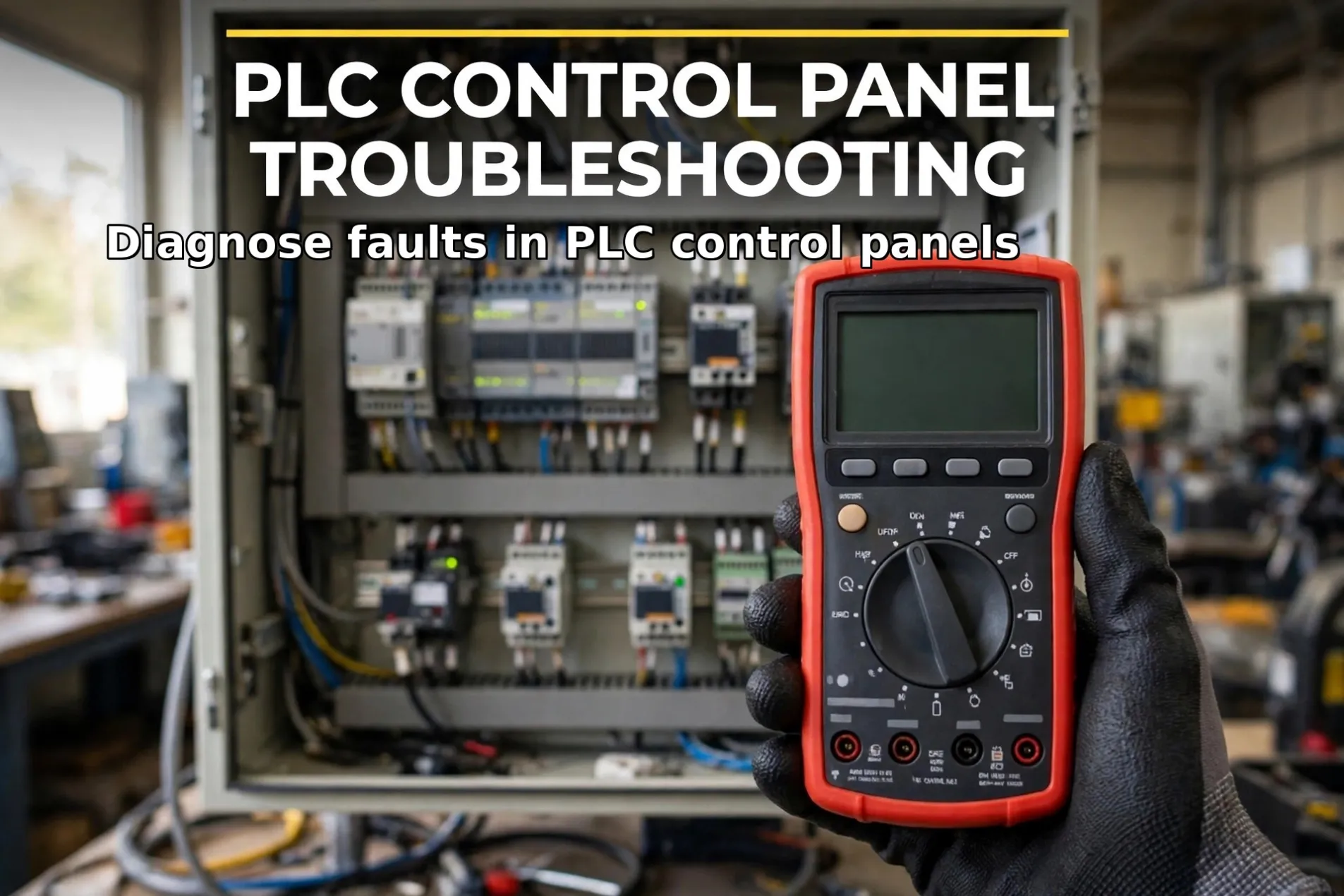
PLC Control Panel Troubleshooting: Choosing the Right Tool
The Short Answer: Start From the Fault, Not the Tool
When a PLC-controlled machine stops, the fastest question is not "which meter do I own?" but "what kind of fault is this?" A logic fault, a drifting analogue signal, a small leakage current and a failing insulation each point to a different instrument. Using the wrong one wastes hours and can mislead the whole diagnosis — a continuity beep, for example, tells you almost nothing about insulation that only breaks down under load.
This guide maps four common control-panel fault types to the right diagnostic tool, then covers what to check before buying, how to evaluate a sample, and what to ask a supplier. It is written for maintenance engineers, panel builders, importers and distributors who buy test instruments for field teams.
Fault Type 1: Logic Faults — Check the PLC First, Then the Wiring
If outputs do not switch, a sensor input never arrives, or a sequence stops halfway, start with the PLC's own diagnostic buffer and status LEDs. Most modern PLCs log I/O errors, communication faults and module failures. That log narrows the search to one card, one channel or one field device in minutes.
Only after that should you reach for a digital multimeter. Use it to verify the basics at the terminal: is the 24 V DC supply present and stable? Does the input terminal actually see the sensor signal? Is the output terminal driving the load, or is the PLC output healthy while the relay, contactor or solenoid downstream has failed? A multimeter with a clear display, reliable test leads and a DC voltage range suited to control circuits is enough here — this is verification work, not precision measurement.
A common mistake is replacing a PLC module before checking the field wiring. Loose terminals, a pinched cable and a failed sensor all look like PLC faults from the control room. Confirm the wiring first; it is the cheapest fix in the panel.
Fault Type 2: Analogue Signal Drift — Use a Loop Calibrator
When a temperature, pressure or flow reading drifts, freezes or disagrees with a local gauge, the suspect is usually the 4–20 mA loop. A standard multimeter can measure loop current, but it cannot tell you whether the transmitter, the wiring or the PLC analogue input card is at fault.
A loop calibrator can. It sources a known 4–20 mA signal, so you can inject 4 mA, 12 mA and 20 mA at the PLC input and check whether the PLC reads them correctly. If the PLC reads correctly, the problem is upstream — the transmitter or the loop wiring. It can also measure the loop current while the process runs, without breaking the loop. For teams that maintain transmitters, this source-and-measure capability turns a half-day of guessing into a twenty-minute test.
When selecting one, check that it covers the 4–20 mA range with enough resolution to spot small drift, that it can both source and measure, and that its display is readable in a dim panel room. Ask the supplier whether it supports loop-powered testing and what accessories — test leads, clips, a carry case — are included, so the field kit is complete on arrival.
Fault Type 3: Intermittent Trips and Nuisance RCD Operation — Use a Leakage Clamp Meter
Some of the hardest panel faults are intermittent: a breaker trips once a week, an RCD operates for no clear reason, or a drive faults only at full load. A standard clamp meter usually cannot help here, because the leakage currents involved are in the milliamp range — far below what a general-purpose clamp resolves.
A clamp meter designed for small leakage current can measure these currents without disconnecting anything, by clamping around the live and neutral conductors together. Comparing readings across circuits usually isolates the leaking branch quickly. This is also a useful preventive check: rising leakage on a motor circuit often appears weeks before the insulation fails outright.
For buyers, the key specification is the lowest current range and its resolution, not the maximum current. Also check jaw size against the cables in your panels, and confirm the meter can hold a reading — you will often be measuring in an awkward position inside a cabinet.
Fault Type 4: Insulation Failure Under Load — Use an Insulation Tester
A cable or motor winding can pass a continuity test and still fail in service. Continuity only proves a path exists at low voltage; insulation breakdown happens at working voltage, under heat and load. That is why an insulation tester, not a multimeter, is the right tool when a motor trips on start-up, a heater circuit leaks to earth, or insulation resistance is trending downward.
An insulation tester applies a test voltage and measures the resulting resistance, revealing damp, aged or damaged insulation that a multimeter cannot see. For control-panel work, check that the test voltage options match the circuits you maintain, that the instrument is rated for the environment it will be used in, and that test leads are rated for the same test voltage.
Record the readings. A single insulation value is less useful than a trend: the same motor measured every six months tells you when to plan a replacement instead of reacting to a breakdown.
Quick Comparison: Which Tool for Which Fault
Fault symptom | First check | Right tool | What it proves |
|---|---|---|---|
Output not switching, sequence stops | PLC diagnostic buffer, status LEDs | Digital multimeter | Supply present, signal reaching the terminal |
Reading drifts or disagrees with gauge | Loop current at the transmitter | Loop calibrator | Whether transmitter, wiring or PLC input is at fault |
Breaker or RCD trips intermittently | Leakage per circuit | Leakage clamp meter | Which branch leaks, and how much |
Motor trips on start-up, insulation trending down | Insulation resistance trend | Insulation tester | Insulation condition at working voltage |
Most field kits need at least a multimeter and one specialist instrument. Which specialist depends on the plant: analogue-heavy process lines justify a loop calibrator first, while motor-heavy sites should prioritise an insulation tester.
What to Check Before Buying
Range and resolution where it matters. A meter's headline maximum range is rarely the deciding factor. Check the lowest ranges you will actually use: milliamps for leakage, small resistance changes for insulation trends, and fine current resolution for loop work.
Accuracy that matches the decision. A reading used to accept or reject equipment needs better accuracy than a reading used only to confirm presence or absence of voltage. Ask for the accuracy specification at the ranges you use, not only at the headline range, and confirm how accuracy is stated — as a percentage of reading, of range, or both.
Safety rating for the environment. Control panels mix low-voltage control circuits with mains-powered sections. Confirm the instrument's safety category rating suits the highest voltage it may be exposed to, and check that the test leads carry the same rating. A mismatched lead is a common and avoidable risk.
Durability and field usability. Panel work means dust, vibration, drops and poor light. A backlit display, a hold function, a protective holster and a clear low-battery indication matter more in daily use than an extra decimal place. Ask how the instrument behaves after a drop — suppliers should be able to describe its construction, not just its specifications.
Calibration and after-sales support. Ask how often calibration is recommended, whether a calibration certificate can be supplied, and how long a repair or replacement typically takes. For distributors, confirm whether calibration support and spare accessories will still be available in a year — a tool that cannot be serviced becomes a disposable cost.
How to Evaluate a Sample
Before placing a volume order, test a sample the way your technicians will actually use it:
- Reproduce a real fault: inject a known loop current, measure a known leakage, or test a cable with a known insulation value, and check that the instrument reads it correctly.
- Test it in the panel, not only on the bench: check display readability in dim light, lead length inside a cabinet, and jaw fit around real cable bundles.
- Check repeatability: measure the same point several times and after a power cycle. A reading that wanders is worse than a slightly less accurate one that is stable.
- Confirm the full kit: leads, clips, batteries, case and manual. Missing accessories discovered after delivery delay the whole rollout.
Keep a short written record of the sample test — it becomes the acceptance reference for the bulk delivery.
Questions to Ask Your Supplier
- Which fault types is this instrument designed for, and where are its limits?
- What are the accuracy, range and resolution at the ranges we will actually use?
- What safety category rating do the instrument and its test leads carry?
- What is included in the box, and what accessories are available separately?
- How often is calibration recommended, and can a certificate be supplied?
- What are the warranty and repair arrangements, and what is the typical turnaround?
- For private-label orders: can the logo, packaging, manual and barcode be customised, and what are the requirements? Confirm these details with the supplier before committing — they vary by model and order size.
The Bottom Line
Control-panel troubleshooting is faster and cheaper when the tool follows the fault: PLC diagnostics and a multimeter for logic and wiring faults, a loop calibrator for drifting analogue signals, a leakage clamp meter for intermittent trips, and an insulation tester for insulation that fails under load. Buy for the faults your team actually meets, verify a sample against a real fault, and confirm calibration and after-sales support before you commit.
Shenzhen Zhanyueda Technology Co., Ltd. supplies handheld test and measurement instruments — including digital multimeters, clamp meters, insulation testers and related diagnostic tools — and supports OEM/ODM orders with customised branding, packaging and documentation. To discuss a sample, a specification, or a private-label requirement, contact us through www.zydhardware.com.