
Buying Guides
True RMS vs Average-Responding Multimeters: A Distributor's Guide to What the Spec Sheet Doesn't Say
A practical B2B guide for distributors and private-label buyers: how True RMS differs from average-responding meters, what to test on samples, and how to set batch QC rules.
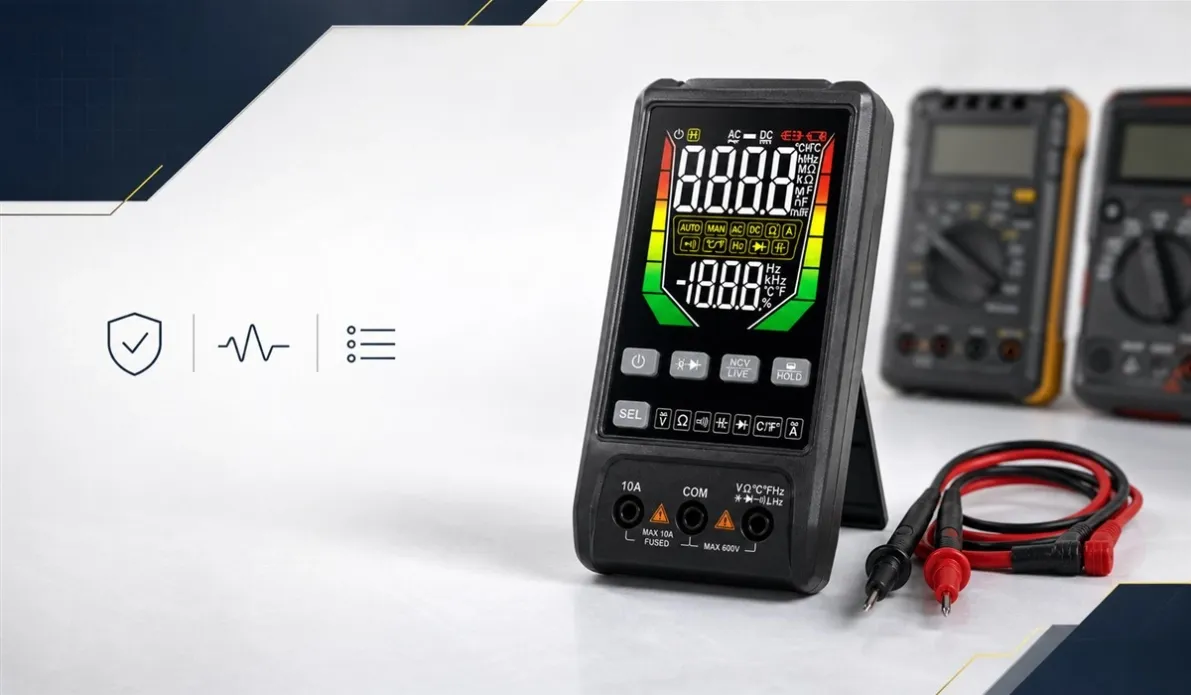
The label is not the specification
A meter can be perfectly accurate on a sine wave and still mislead a technician on a VFD output. "True RMS" is often printed on the front of a multimeter as if it were a complete performance claim. It is not. It describes how the meter calculates AC values, but it says nothing by itself about bandwidth, crest factor, input protection, resolution, or the quality of the test leads.
For a distributor or private-label buyer, the useful question is not "Does it say True RMS?" It is "For the waveforms and ranges my customers actually measure, will this meter give a dependable reading, and can I prove batch consistency?"
What average-responding meters actually measure
An average-responding meter rectifies the AC signal, averages it, and scales the result to display the RMS value of a pure sine wave. That works well when the waveform is close to a sine wave.
It becomes a problem when the waveform is distorted. Variable-frequency drives, UPS systems, dimmers, switching power supplies, and many HVAC inverter outputs are not clean sine waves. The average-responding meter still applies its sine-wave scaling, so the display can be significantly different from the true RMS value. The size of the error depends on the waveform and the meter; it is not a fixed percentage you can safely apply to every job.
A True RMS meter computes the root mean square of the waveform. That makes it more suitable for distorted signals, but only within its specified bandwidth and crest-factor limits.
A practical spec-sheet checklist
Before comparing prices, compare the claims that affect real measurements.
Spec sheet claim | What to ask for | Why it matters |
|---|---|---|
True RMS | Is RMS computed, or is the meter average-responding with a "True RMS" label? | The label alone does not define performance. |
AC bandwidth | At what frequency does the stated accuracy still apply? | A meter may be accurate at 50/60 Hz and roll off at higher frequencies. |
Crest factor | What is the maximum crest factor at the stated accuracy? | Distorted waveforms can have high peaks; beyond the limit, the reading degrades. |
Accuracy expression | Is it +/- (% of reading + digits) for each range? | The digits term matters more on low ranges. |
Input impedance | Is there a low-Z or LoZ mode? | Ghost voltage and floating signals can mislead high-impedance inputs. |
CAT rating | Is the rating marked on the meter and matched by the test leads? | Safety ratings are a system, not a sticker on the case. |
Test leads | Are the leads rated for the same CAT environment? | A CAT III meter with ordinary leads is not a CAT III measurement system. |
Calibration | What certificate and traceability are provided? | "Calibrated" is not the same as a certificate with a defined scope. |
Low-pass filter | Does the model provide one for VFD measurements? | Not every True RMS meter has this function. |
Resolution | How many counts, and what is the resolution on the range customers use? | A high-count display is not useful if the low-range resolution is poor. |
Sample approval: seven checks before a purchase order
Do not approve a meter from a catalogue photo or a single sine-wave test. A practical sample review should cover:
- Establish a reference. Use a meter or calibrator with a known accuracy and a current calibration status. Record the reference model and certificate.
- Test a clean sine wave. Confirm the basic AC function, range switching, and display stability. This proves the meter works, but it does not prove True RMS behavior.
- Test a distorted waveform. Use a known non-sinusoidal source if available, or compare against a reference True RMS meter on the same signal. Record the waveform, frequency, and expected value.
- Check low ranges. Test the lowest voltage and current ranges customers will use. The digits term in the accuracy specification has the largest effect there.
- Check crest factor and bandwidth. If the target application includes drives or inverters, test above 50/60 Hz and with a peaky waveform. Ask for the meter's stated limits.
- Check the mechanics. Rotary switch feel, terminal tension, fuse access, battery compartment, display contrast, and lead condition all affect field reliability.
- Freeze the configuration. Record the model, firmware or hardware revision, lead set, battery type, and accessories. A later batch is not the same product if these change.
Batch QC: what to record
A sample that passes is not proof that the next shipment will pass. For distributor and private-label programs, define the test points and acceptance rules before the first batch arrives.
Checkpoint | Method | Record |
|---|---|---|
Appearance and markings | Visual inspection | Model, rating markings, labels, packaging |
Basic function | Reference comparison at fixed points | Reading, range, reference value |
Repeatability | Repeat the same measurement several times | Spread and any drift |
Low-range performance | Test the lowest range used by customers | Reading and digits |
Accessories | Inspect leads, probes, clips, battery | Condition and rating |
Documentation | Check manual, certificate, packaging | Revision and language |
Golden sample | Keep an approved unit | Serial or batch reference |
Set the acceptance limits and sample size with your quality team. A universal "test three pieces" rule is not a QC plan.
CAT rating and test leads are one system
A CAT III or CAT IV marking describes the transient overvoltage environment the meter is designed for. It does not make every measurement safe. The test leads, probes, and accessories must be rated for the same environment, and the person using the meter still needs the correct isolation and work practices.
For distributor listings, keep the safety documentation with the model file: the standard the meter is claimed to meet, the certificate or declaration, the lead rating, and the instruction manual. If the documentation does not match the model, treat the claim as unverified.
RFQ questions that prevent costly assumptions
Ask suppliers these questions before comparing quotations:
- Is the AC measurement True RMS, and over what bandwidth?
- What maximum crest factor is supported at the stated accuracy?
- What is the accuracy expression on the lowest range?
- Does the model have a low-pass filter or LoZ mode?
- What CAT rating is marked on the meter, and what rating do the supplied leads carry?
- What calibration certificate and traceability are included?
- Which standards and test reports are available for the target market?
- What changes between the sample and the production batch?
- What are the MOQ, packaging, and private-label requirements?
FAQ
Is True RMS always better?
Not automatically. It is more suitable for distorted waveforms, but bandwidth, crest factor, resolution, safety rating, and build quality still matter. A well-designed average-responding meter may be adequate for clean sine-wave work.
Can I verify True RMS with a normal sine wave?
No. A sine wave is the case where average-responding and True RMS meters are expected to agree. Use a distorted waveform or a reference meter on a non-sinusoidal signal.
Does a True RMS meter automatically have a low-pass filter?
No. The two functions are separate. Check the model's functions and the intended application.
Is a higher CAT rating always better?
The rating must match the work environment and the test leads. A higher rating is not a substitute for correct isolation, PPE, and procedures.
How many samples should we test?
There is no universal number. Define the sample size and acceptance rules with your quality team based on the supplier, the application, and the cost of a bad batch.
Turn the specification into a purchase decision
If you are sourcing multimeters for distribution, private-label, or mixed-SKU programs, start with the measurement task: the waveform, the range, the environment, the documentation, and the batch consistency you need. Then compare samples against those requirements, not against a single "True RMS" line on the box.
ZYD supplies test and measurement instruments to distributors and private-label buyers. Share your target specification, sample quantity, and documentation requirements, and the team can match them to available models for evaluation.