Sep 11, 2026Buying Guides
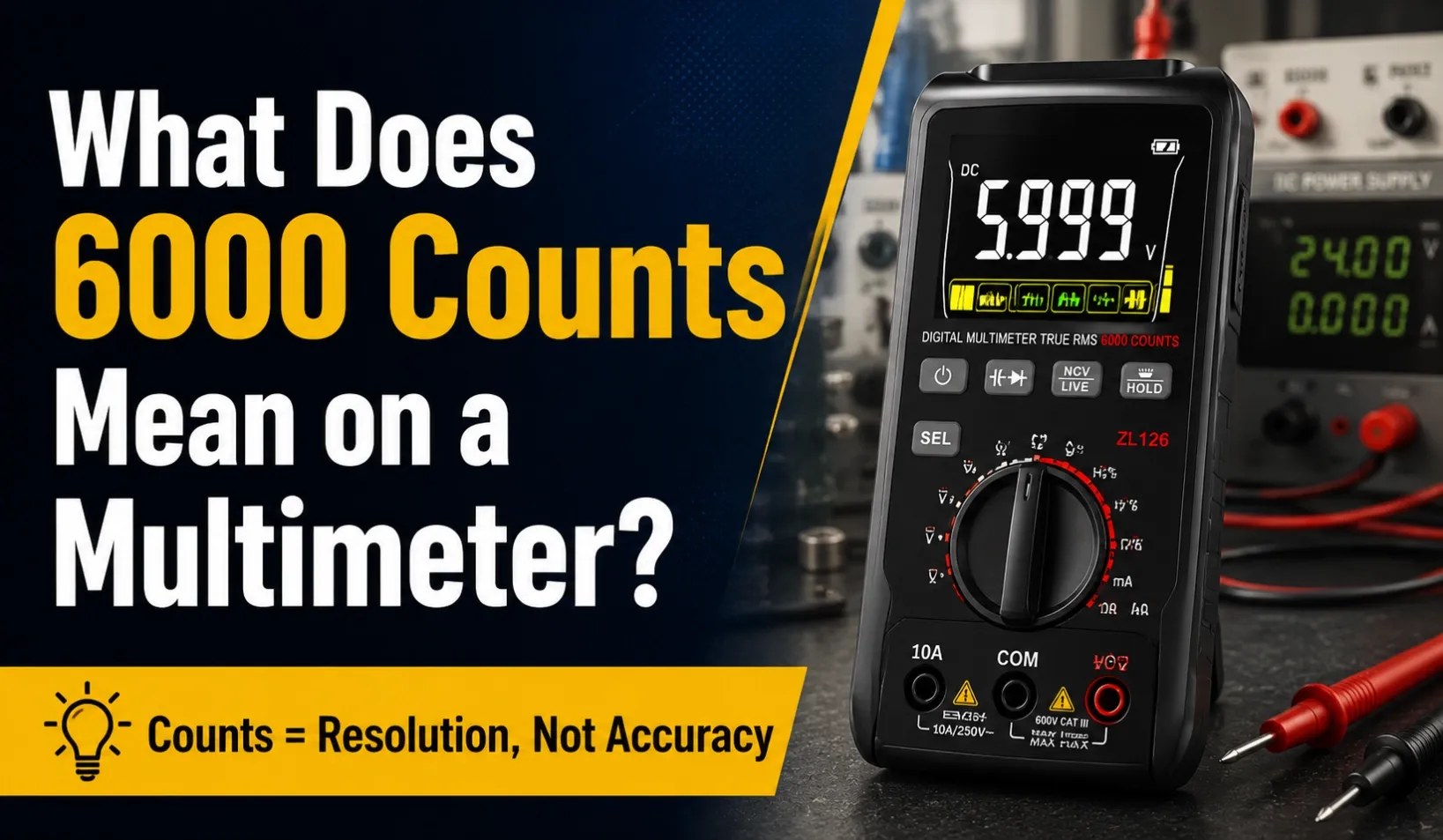
What Does 6000 Counts Mean on a Multimeter? A Professional Buyer’s Guide
What Does 6000 Counts Mean on a Multimeter? A Professional Buyer’s Guide When comparing digital multimeters, you will often see specifications such as 2000 counts, 4000 counts, 6000 counts
What Does 6000 Counts Mean on a Multimeter? A Professional Buyer’s Guide
When comparing digital multimeters, you will often see specifications such as 2000 counts, 4000 counts, 6000 counts, or 20000 counts.
But what does 6000 counts actually mean—and does a higher count automatically make a multimeter better?
The short answer is:
A 6000-count multimeter can typically display values from 0 to 5999 before switching to the next measurement range. Counts describe display resolution, not measurement accuracy.
For electricians, HVAC technicians, industrial maintenance teams, and professional buyers, understanding this distinction helps prevent one of the most common mistakes when comparing multimeter specifications.
What Does “Count” Mean on a Multimeter?
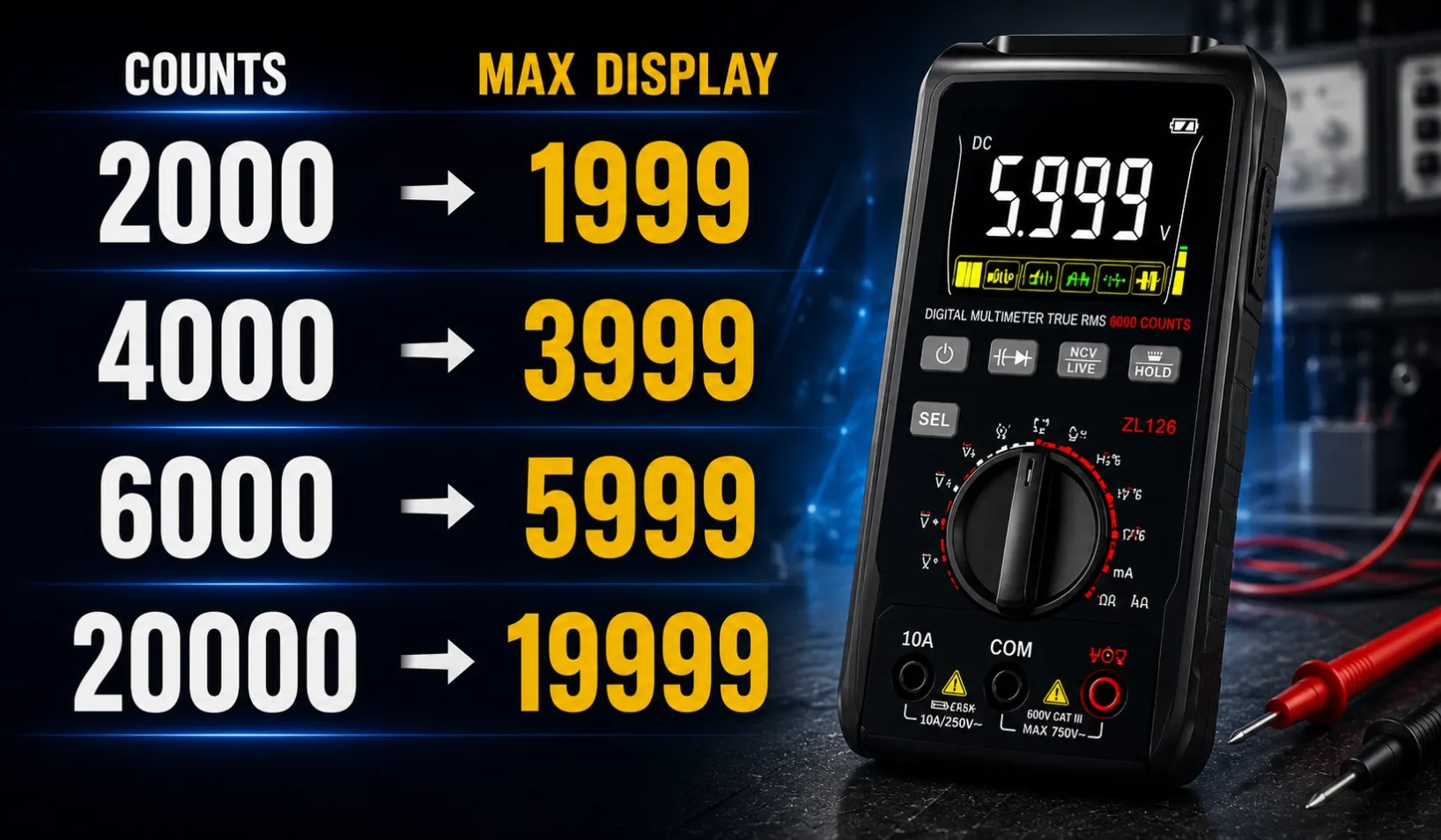
“Count” describes the maximum numerical value a digital multimeter can display within a measurement range.
For example:
- 2000-count meter: typically displays up to 1999
- 4000-count meter: typically displays up to 3999
- 6000-count meter: typically displays up to 5999
- 20000-count meter: typically displays up to 19999
The decimal point changes depending on the selected range.
For example, a 6000-count meter may provide ranges such as:
Measurement Range | Display Resolution |
|---|---|
600.0 mV | 0.1 mV |
6.000 V | 0.001 V |
60.00 V | 0.01 V |
600.0 V | 0.1 V |
This means that on the 6.000 V range, the meter may display a reading such as:
5.237 V
rather than only:
5.23 V
The additional displayed digit gives the user more resolution.
Why Do Counts Matter?
Higher counts allow a multimeter to show smaller changes over a wider portion of a measurement range before it needs to switch ranges.
This can be useful when technicians need to observe relatively small changes in:
- Voltage
- Resistance
- Current
- Sensor signals
- Electronic circuits
For general field work, this may make readings easier to interpret.
However, higher counts do not automatically mean the measured value is closer to the true value.
That depends on another specification:
Accuracy.
Counts vs Accuracy: The Most Common Misunderstanding
This is the most important distinction for professional buyers.
Counts = Display Resolution
Counts describe how finely the meter can divide and display a measurement range.
Think of it like the number of markings on a ruler.
More markings allow you to display smaller differences.
Accuracy = Closeness to the True Value
Accuracy describes how close the meter's reading is expected to be to the actual electrical value under specified conditions.
For example, a multimeter may have an accuracy specification such as:
±(0.5% of reading + 2 counts)
This means measurement uncertainty includes:
- A percentage of the measured value
- An additional number of least-significant display counts
So a meter can display many digits without necessarily having excellent accuracy.
Buyer’s Note: A higher-count display is useful only when the rest of the instrument—accuracy, stability, input design, and measurement range—is appropriate for the application.
2000 vs 4000 vs 6000 vs 20000 Counts
Here is a simple comparison:
Display Counts | Approx. Maximum Reading | Typical Positioning |
2000 Counts | 1999 | Basic / entry-level measurement |
4000 Counts | 3999 | General electrical and maintenance use |
6000 Counts | 5999 | Professional handheld electrical and HVAC use |
20000 Counts | 19999 | Higher-resolution electronics and technical applications |
This table should be treated as a general positioning guide, not a universal industry standard.
Two meters with the same count can perform very differently depending on:
- Accuracy
- Measurement speed
- Input protection
- True RMS capability
- CAT rating
- Component quality
- Test leads
- Firmware and filtering
Is 6000 Counts Enough for Professional Use?
For many professional handheld applications, 6000 counts provides a practical balance between useful display resolution and field usability.
Typical applications may include:
- Electrical maintenance
- HVAC servicing
- Industrial troubleshooting
- Automotive electrical diagnosis
- Commercial electrical work
- General equipment maintenance
For these users, moving from 6000 counts to 20000 counts may not provide as much practical benefit as improving other specifications.
For example, a professional electrician may value the following more:
- True RMS
- CAT III or CAT IV rating appropriate to the application
- Reliable input protection
- Fast continuity response
- Good test leads
- Capacitance
- Temperature
- Min/Max
- LoZ where required
So the better question is not:
“How many counts can I get?”
It is:
“How much resolution does my application actually need?”
When Are Higher Counts More Useful?
Higher-count meters can be useful when smaller changes need to be observed.
Typical examples include:
Electronics Repair
Electronics technicians may need to distinguish small changes in:
- Low-voltage signals
- Resistance
- Sensor outputs
- Circuit behavior
Engineering and R&D
Higher display resolution can help when comparing small variations during testing and development.
Bench Measurements
Laboratory or bench users may benefit from instruments designed for higher resolution, better stability, tighter accuracy, and more controlled measurement conditions.
However, count alone should never be used to describe an instrument as “lab grade” or “precision grade.”
Professional bench instruments are usually evaluated using a broader set of specifications, including:
- Resolution
- Accuracy
- Noise
- Stability
- Measurement speed
- Calibration performance
Does 6000 Counts Make Auto-Ranging Better?
Not exactly.
Counts and auto-ranging are related, but they describe different things.
Counts determine how many display steps are available within a range.
Auto-ranging determines when the meter automatically switches from one measurement range to another.
A higher-count meter may sometimes remain on a finer range longer before switching, which can preserve more displayed detail.
However, actual auto-ranging behavior also depends on the meter's design and firmware.
So buyers should not assume:
More counts = faster auto-ranging.
They are separate specifications.
What About EV, Solar, and Industrial Applications?
These applications are increasingly important, but count should not be treated as the main selection factor.
Automotive and EV Service
For automotive electrical diagnostics, useful specifications may include:
- DC voltage
- DC current
- Frequency
- Duty cycle
- Min/Max
- Appropriate resolution
For high-voltage EV systems, however, the instrument's working voltage, safety category, accessories, and service procedures are far more important than display count alone.
Solar and DC Systems
For photovoltaic and battery-system testing, buyers should evaluate:
- DC voltage range
- DC current capability
- CAT rating
- Working voltage
- Input protection
- Measurement accuracy
Industrial VFD Applications
For variable-frequency drives and other non-sinusoidal loads, True RMS capability and appropriate measurement specifications may be more important than increasing display counts.
The application should always determine the instrument specification—not the other way around.
Is a 20000-Count Meter Better Than a 6000-Count Meter?
Not automatically.
Consider two hypothetical products.
Meter A
- 6000 counts
- True RMS
- Appropriate CAT rating
- Strong input protection
- Fast continuity response
- Suitable professional test leads
Meter B
- 20000 counts
- Average-responding AC measurement
- Lower safety rating
- Basic input protection
- Slower response
For an electrician working on commercial electrical systems, Meter A may be the better tool despite having fewer counts.
For an electronics technician working on low-energy circuits, the priorities may be different.
That is why professional buyers should compare the entire specification rather than selecting the largest number printed on the packaging.
What Should Distributors Compare Besides Counts?
For distributors, wholesalers, and private-label buyers, counts should be used mainly to help position different products within a range.
1. Target User
Start with the intended customer:
- General electrician
- HVAC technician
- Automotive technician
- Industrial maintenance technician
- Electronics repair technician
- Engineering or laboratory user
Different users need different specifications.
2. Accuracy
Compare the actual accuracy on the measurement ranges customers are most likely to use.
3. True RMS
For modern AC loads such as:
- Variable-frequency drives
- Inverters
- Electronic controls
- HVAC equipment
- Switching power supplies
True RMS can be an important professional feature.
4. Safety
Review:
- CAT rating
- Rated voltage
- Input protection
- Fuse design
- Test-lead rating
- Applicable safety documentation
5. Measurement Functions
Depending on the target market, buyers may require:
- Capacitance
- Frequency
- Temperature
- NCV
- Min/Max
- Duty cycle
- LoZ
- Data logging
6. Usability
Professional users also care about:
- Display readability
- Backlight
- Continuity response
- Range-switching speed
- Battery life
- Probe quality
- Enclosure durability
These factors may have a greater impact on everyday use than the difference between 6000 and 20000 counts.
How Should Distributors Position Different Count Levels?
Instead of selecting every product by maximum count, build a clear product ladder around real applications.
For example:
Entry-Level
4000-count general-purpose multimeter
Suitable for basic electrical measurements and price-sensitive markets.
Professional
6000-count True RMS multimeter
Suitable for electricians, HVAC technicians, and general industrial maintenance.
Useful supporting functions may include:
- Capacitance
- Temperature
- NCV
- Min/Max
- LoZ where relevant
Advanced
Higher-count multimeter
Suitable for applications where greater displayed resolution is useful, such as electronics repair, engineering, and more detailed diagnostics.
This approach creates clearer differences between models and can help reduce unnecessary SKU overlap.
Quick Buying Checklist
Before comparing two multimeters, ask:
- How many counts does each meter provide?
- What resolution is available on the ranges customers will actually use?
- What is the specified accuracy?
- Is True RMS required?
- What safety category is appropriate?
- What is the maximum working voltage?
- How are current inputs protected?
- Which functions matter to the target customer?
- How fast and stable are the readings?
- Are the test leads suitable for the intended application?
Counts should be one line on this checklist—not the entire purchasing decision.
Frequently Asked Questions
What does 6000 counts mean on a multimeter?
A 6000-count multimeter can typically display values from 0 to 5999 before switching to another measurement range.
Does 6000 counts mean higher accuracy?
No. Counts describe display resolution. Accuracy is a separate specification.
Is 6000 counts better than 4000 counts?
A 6000-count meter can provide more displayed resolution in some ranges, but whether it is the better instrument depends on accuracy, functions, safety, and application.
Is 20000 counts better than 6000 counts?
It provides more potential display resolution, but that does not automatically make it more accurate, safer, or better suited to professional field work.
Is 6000 counts enough for electricians?
For many professional electrical applications, 6000 counts provides adequate display resolution. Other factors such as True RMS, CAT rating, input protection, and test-lead quality may be more important.
What is the difference between counts and digits?
Both are ways of describing display resolution. Counts directly describe the maximum display value, while digit-based descriptions such as 3½ or 4½ digits use a different convention.
Final Takeaway
The meaning of 6000 counts is simple:
It tells you how finely the multimeter can display a measurement—not how accurate the measurement is.
For many professional handheld applications, 6000 counts offers a useful balance of resolution and practical usability.
But a professional buyer should never choose a multimeter based on count alone.
A better comparison is:
Resolution + Accuracy + True RMS + Safety + Functions + Application
That combination tells you far more about whether a multimeter is right for the intended user.