
Buying Guides
What Does LPF Do on a Multimeter? (And When to Use It)
LPF on a multimeter filters out high-frequency noise so you can measure VFD output accurately. Learn what it does, when to use it, and what it cannot fix.
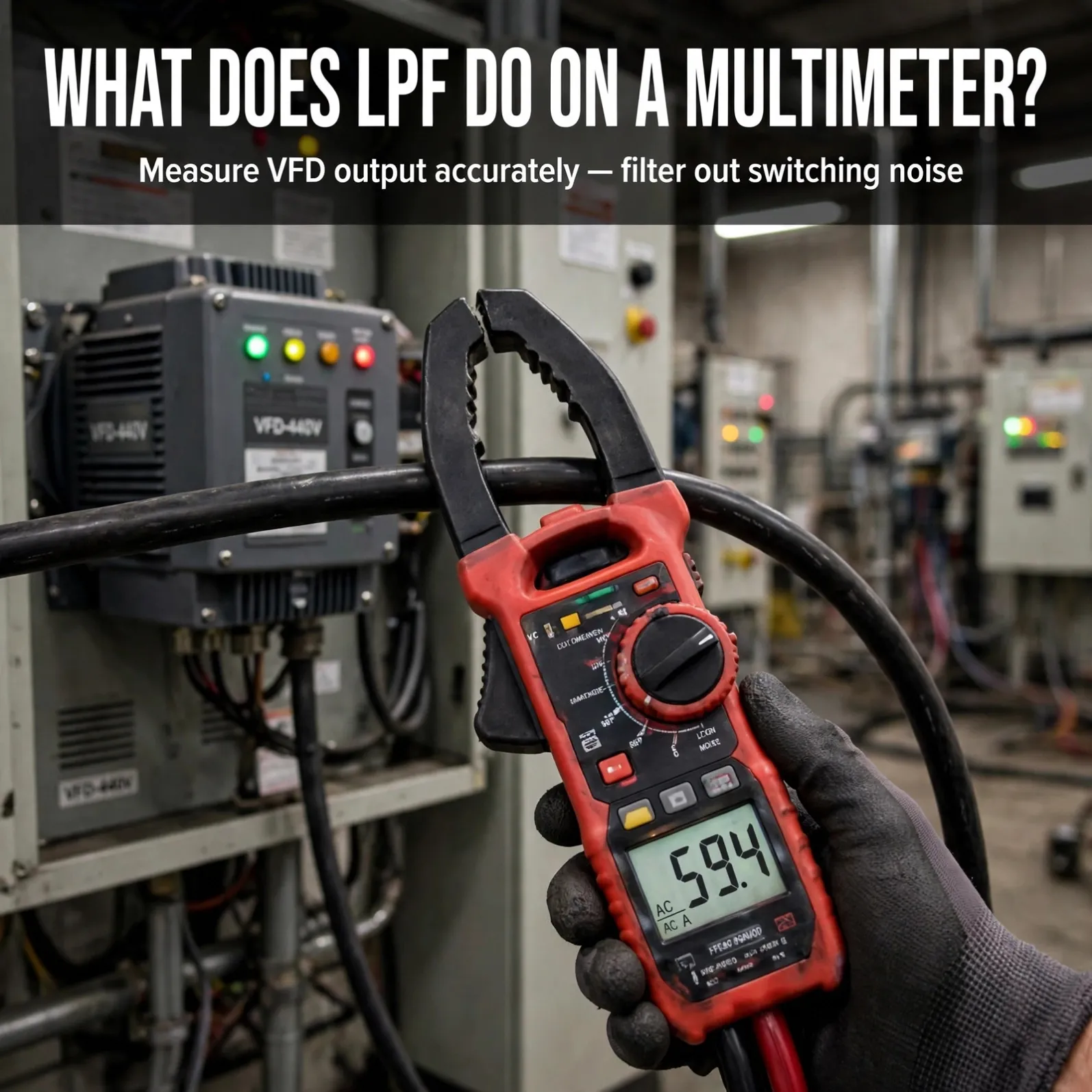
What Does LPF Do on a Multimeter?
The Short Answer
LPF stands for low-pass filter. Switch it on, and your multimeter blocks signals above a cutoff frequency and measures only the lower-frequency part. On most handheld meters the cutoff is around 1 kHz, but the exact value varies by model — check the manual.
That one button exists mainly for one job: measuring the output of a variable frequency drive (VFD). A VFD does not output a clean sine wave — it outputs a pulse-width-modulated (PWM) waveform full of high-frequency switching noise, and a standard meter reading that waveform will report a number that does not match what the motor actually receives. Switch on LPF, and the meter strips away the switching noise and reads the fundamental voltage, so the reading agrees with the drive's own display.
Why a VFD Output Confuses a Normal Meter
A mains supply is a smooth 50 or 60 Hz sine wave. A VFD switches its output on and off thousands of times per second to build up an average voltage that controls motor speed. The result is a composite waveform: the low-frequency fundamental the motor follows, plus a high-frequency carrier that is only switching noise as far as measurement is concerned.
First, an average-responding meter reads the wrong value, because it assumes a sine wave and scales its reading accordingly — Fluke's troubleshooting guidance warns that a regular multimeter can read up to 40 percent off on a VFD output. Second, even a true-RMS meter can read high, because true-RMS captures the whole waveform including the switching carrier. In one field report on the control.com forum, a technician measured 455 V on a drive output while the drive itself displayed 399 V. Fluke's application note for its 289 meter describes the same pattern: without the filter, readings typically run 20 to 30 percent higher than the drive display.
What LPF Actually Does
When it is switched on, the signal is routed through a filter before it reaches the measurement circuit. Frequencies below the cutoff pass through and are measured normally — this is the fundamental, for example a drive running a motor at 30 Hz — while frequencies above the cutoff are blocked, so the kilohertz switching carrier is removed before it can inflate the reading. The meter then reports the fundamental voltage and frequency, the values that should agree with the drive controller's display.
On many meters, switching on LPF also switches the meter to manual ranging — autoranging is disabled in LPF mode on models such as the Fluke 87V, so you select the range yourself. LPF is sometimes labelled "VFD mode" on a meter's dial or button: LPF is what the circuit does, VFD mode is what it is for.
When to Use LPF — and When Not To
Use LPF when measuring voltage or frequency on the output side of a VFD, between the drive and the motor — this is its main job. It also helps on the output of a UPS or a switching power supply, where high-frequency noise rides on the signal you actually want. And it is a useful diagnostic check: measure the VFD's input side with LPF on and off. The input is clean mains power, so the reading should not change. If it does, that points to harmonic problems on the supply worth investigating with more capable equipment.
Do not use LPF to check whether a circuit is dead. Every major meter manual states this as a safety warning: never use the low-pass filter to verify the absence of hazardous voltage, because the filter can hide voltage that is actually present. Always measure first without the filter, and only then switch LPF on. LPF also adds nothing on a clean mains sine wave, and if you need to see harmonics or switching behaviour itself, use an oscilloscope — LPF deliberately removes that information.
LPF Is Not the Same as LoZ
Buyers sometimes confuse LPF with LoZ (low-impedance) mode, because both are "extra" voltage modes on better meters. They solve different problems: LPF filters out high-frequency switching noise so a VFD reading is accurate, while LoZ loads the circuit so weak ghost voltage from capacitive coupling collapses — what you need when verifying a circuit is really dead. A meter can have one, both, or neither.
What LPF Cannot Fix
LPF is useful, but it does not turn the wrong meter into the right one. First, it does not replace true-RMS: the filter removes the carrier, but the remaining fundamental is still non-sinusoidal, and an average-responding meter with LPF will still misread it — for VFD work you need true-RMS and LPF together. Second, it does not fix a wrong safety rating: VFD work inside a plant is typically a CAT III environment, often at 480 V or 600 V, and the meter's CAT rating matters independently of any filter function. Third, it does not diagnose the drive: a filtered reading that matches the drive display tells you the drive is delivering the expected voltage, but nothing about the motor or the load.
Buying Checklist: LPF on a Multimeter for VFD Work
If your customers work on drives, put these questions on the specification checklist before ordering. Does the model have a VFD or LPF mode at all? Many general-purpose meters do not — in the 2025 Zhanyueda catalogue, for example, the HT208A clamp meter lists "Inrush/VFD: yes" alongside true-RMS, but that is one model, not the whole range, so confirm per model. What is the filter's cutoff frequency, and what accuracy applies in LPF mode? Get the figure from the manual. Is the meter true-RMS on both voltage and current? LPF without true-RMS still leaves a wrong reading on a PWM waveform. Is the safety rating documented for this specific model? And does it cover inrush as well — motor starting current is a separate VFD-adjacent job, and a meter that does both saves a second instrument on site.
Finally, test the sample on a real drive: run it at two speeds and compare the filtered reading against the drive display. Also confirm what is in the box — test leads, batteries, carry case, and a manual in your market's language — plus OEM/ODM options for logo, packaging and manual if you are buying under your own brand.
The Bottom Line
LPF on a multimeter is a low-pass filter that removes high-frequency switching noise so the meter can read the fundamental voltage of a VFD output. It is not a general accuracy upgrade, a safety feature, or a substitute for true-RMS — but on a drive, it turns a confusing number into a trustworthy one. If your customers measure drive outputs, make sure the meter you supply has it, verify the cutoff and accuracy in the manual, and test it on a running drive before committing to a volume order.
Looking for multimeters and clamp meters with VFD mode for your market? Visit www.zydhardware.com to browse the range or request a quotation — OEM/ODM options for logo, packaging, and manual are available. Contact us to discuss your requirements and sample evaluation.
Internal links: multimeter selection guide / clamp meter vs multimeter / VFD voltage measurement troubleshooting