
Buying Guides
What European Electricians Look for in a Multimeter
What do European electricians check first? A verified CAT III/CAT IV rating, True RMS, LoZ mode, safe test leads and a traceable calibration certificate.
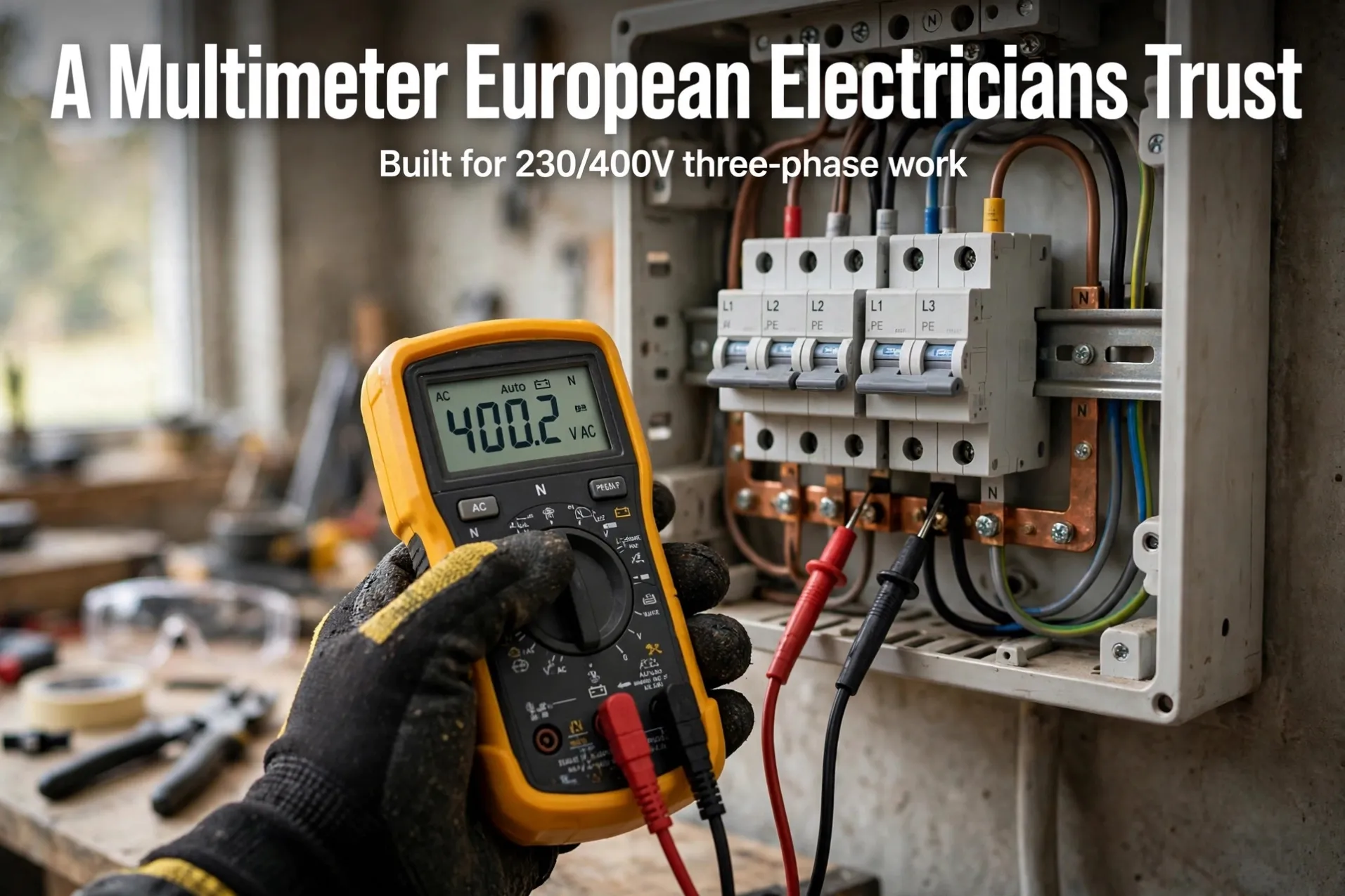
Ask a European electrician what they want from a multimeter and the answer starts with safety, not features. Most of their work is on 230 V single-phase and 400 V three-phase systems, where a transient can carry far more energy than the voltage on the display suggests. A professional meter earns its place by proving four things: it is rated for the installation, it reads distorted waveforms correctly, its leads are as safe as the meter, and its accuracy is backed by a calibration certificate.
1. A safety rating matched to the installation
The measurement category (CAT) rating is the first check, and it is a pair, not a single number: category plus voltage. Defined under IEC 61010 (EN 61010 in Europe), it describes the transient energy a meter must survive at a given point in an installation: CAT II covers plug-in appliances, CAT III covers distribution boards and fixed equipment, and CAT IV covers the service entrance. CAT III 600 V is the minimum for fixed-installation work; many contractors standardise on CAT III 1000 V / CAT IV 600 V.
The danger is not the voltage being measured. It is the transient nobody expects: switching a motor or a transformer can throw a spike across a board that a lower-category meter cannot contain. A CAT II meter may read 400 V correctly on a normal day and still arc dangerously when a transient hits.
Do not take a printed rating on trust alone. In one documented recall, meters marked CAT III 600 V were fitted with fuses of inadequate breaking capacity, creating an arc risk above 400 V. Look for independent testing to IEC 61010 by a recognised laboratory: a CE mark alone does not prove third-party verification, because CE marking can be self-declared. Ask the supplier for the test reports behind the rating.
2. True RMS for modern loads
Variable-speed drives, LED lighting, switched-mode power supplies and HVAC inverters draw current in short pulses rather than smooth sine waves. An average-responding meter assumes a sine wave, and on distorted waveforms that can be wrong by 10% to 40%: the difference between a motor that looks healthy and one running hot.
A True RMS meter measures the actual heating effect of the waveform, whatever its shape. On any site with drives, LED drivers or UPS systems, this is not optional. When evaluating a sample, compare it against a known drive output: a large, consistent gap from a second meter on the same drive is a warning sign.
3. LoZ mode to separate ghost voltage from real voltage
Long cable runs often sit parallel to live conductors. A de-energised cable picks up a capacitively coupled voltage from its neighbour, and a standard high-impedance meter will display it, commonly 40 V to 80 V AC, on a circuit that is in fact dead. The result is a technician who cannot tell whether the circuit is safe to touch.
Low-impedance (LoZ) mode solves this by loading the circuit slightly and bleeding the coupled voltage away. A real voltage stays; a ghost voltage collapses to near zero. For long runs in trunking or cable trays, put LoZ on the must-have list. Note also that a multimeter should not be the only tool used to prove a circuit dead: in the UK, HSE guidance note GS38 recommends a dedicated two-pole voltage indicator to BS EN 61243-3 for that job, because a multimeter left on the wrong range can show zero on a live circuit.
4. Test leads: the weakest link in the system
A meter is only as safe as its leads: the system rating is set by the lowest-rated part, so a CAT IV meter with CAT II leads is a CAT II system. The UK's GS38 guidance sets out what good leads look like: exposed probe tips no more than 4 mm, with 2 mm or less recommended, so a tip cannot bridge a live conductor and adjacent earthed metalwork; flexible, well-insulated leads with no accessible bare conductor; and leads rated to BS EN 61010-031.
The recall record backs this up: in one case, over 100,000 sets of test leads were recalled after connection faults caused wrong readings and failures to detect voltage. Before accepting a sample, short the leads together: a good set reads close to 0.0 ohms, a worn set several ohms.
5. Calibration and traceability, because readings become records
In much of Europe, an electrician's measurements go into certificates and reports under wiring regulations such as BS 7671 in the UK, so the accuracy behind those numbers has to be confirmed. That means formal calibration supported by certificates traceable to national standards, with UKAS-accredited laboratory certificates preferred where they apply.
Two practical points follow. First, a new meter may not be supplied with a calibration certificate unless one is specifically requested, so ask for it at the ordering stage. Second, accuracy specifications are typically valid for one year after calibration, and most calibration is done on an annual cycle. Keep the certificate with the meter and log the calibration date.
6. Built for the site, not the bench
A meter on a European job will be dropped, knocked against boards, and used in dust, damp and cold. Look for a case built to survive a drop onto concrete, a display that stays readable inside a poorly lit panel, and a backlight that does not switch off after a few seconds. Ingress protection of IP54 or better is a sensible baseline for site work.
Speed matters as much as toughness. A continuity beeper that responds in under a millisecond turns a wiring check into a quick sweep, and a Min/Max mode catches intermittent dips and spikes that a single reading misses.
How to evaluate a sample before you commit
Confirm the CAT rating and voltage on the meter body and on the leads, and ask for the test reports behind them. Test True RMS and LoZ on real site conditions: a known drive output, and a long de-energised run next to a live one. Short the leads and check the resistance reads close to 0.0 ohms. Confirm the calibration certificate is available with the order, and check the accessories: spare fuses, a carry case, and replacement leads that carry the same rating as the meter.
For distributors and own-brand buyers, these answers are also a commercial advantage: customers who can prove a meter is safe and calibrated are less likely to return a unit or dispute a reading. If you plan to sell under your own brand, confirm OEM and ODM options for logo, packaging, manuals and barcodes first.
The bottom line
A European electrician does not buy a multimeter for its feature list. They buy it because they trust it on a 400 V board, because its readings stand up in a certificate, and because its leads are as safe as the meter. A meter that proves its CAT rating, reads distorted waveforms correctly and arrives with a traceable calibration certificate is worth more than a cheaper meter with a longer specification sheet.
Contact us at zydhardware.com to discuss professional multimeter options, calibration support, and OEM/ODM supply for your market.