
Buying Guides
What Makes a Multimeter Truly Useful for HVAC Work?
A general meter can't test a flame sensor or a run capacitor. See what makes a multimeter useful for HVAC work: microamps, capacitance, temperature, safety.
What Makes a Multimeter Truly Useful for HVAC Work?
A multimeter earns its place in an HVAC technician's bag by covering the four measurements the trade makes every day: flame-sensor microamps, capacitor microfarads, temperature, and safe voltage and current on live equipment. A general-purpose meter often covers only the last one — so the technician owns a good meter and still cannot finish the diagnosis, because the one range the job needs is the one the meter lacks. For distributors, that gap is the buying decision: an HVAC-useful meter is defined by its missing ranges, not its longest feature list.
The Four Measurements That Decide It
Measurement | What it diagnoses | What to check on the meter |
|---|---|---|
DC microamps (µA) | Flame sensor proving flame in a gas furnace | A dedicated µA DC range, ideally 0.1 µA resolution |
Capacitance (µF) | Weak or failed run and start capacitors | Range covering 5–80 µF run capacitors, higher for start capacitors |
Temperature (°C/°F) | Supply and return air, superheat and subcooling, flue temperature | Thermocouple input, ideally dual input for temperature split |
True-RMS voltage and current | Compressors, fans and VFD-driven motors | True RMS on voltage and current, CAT III 600 V minimum |
Flame sensors need microamps, not amps
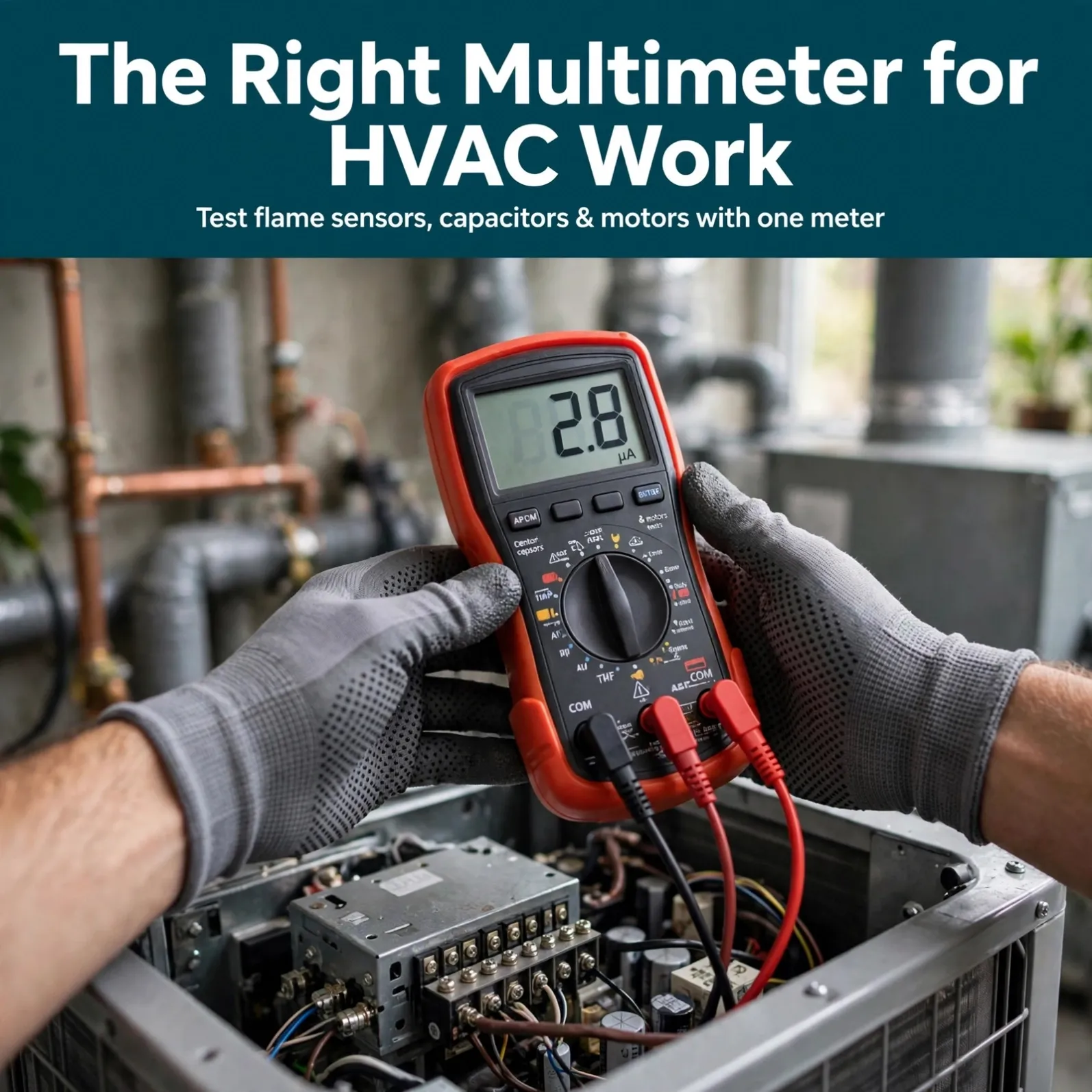
A gas furnace proves flame by rectification: the sensor passes a tiny DC current, typically 1 to 6 microamps, to the control board. If it falls too low, the board shuts the furnace down — the classic light-then-lockout fault. Most standard meters cannot measure this: their lowest current range is milliamps, a thousand times too coarse. In one technician Q&A, a user with a new flame sensor read zero microamps because his meter had no µA setting; the expert's reply was blunt — an amps setting alone will not suffice. After cleaning the sensor he measured 2.8 µA against an expected 4 to 6 µA, pointing at a dirty sensor rather than a dead board. Without the µA range, that diagnosis is guesswork: replace the sensor, replace the board, hope the callback stops.
Capacitors need a capacitance range, not a resistance guess
A failing run capacitor is the most common single-component cause of no-cooling calls. With a capacitance function the test is quick: power off, discharge safely, disconnect, and read microfarads against the rating on the body. Most run capacitors are marked ±6%, so a 45 µF part should read about 42–48 µF. Well below rating means weak — replace it before the motor fails; zero or overload means already failed open. A resistance check cannot do this: the reading climbs as the capacitor charges and says nothing about lost capacitance. A weak capacitor can pass a resistance check and still leave a compressor humming. Without a capacitance range the technician carries a second instrument or swaps parts.
Temperature turns a meter into a system diagnostic tool
Voltage tells you whether a component has power; temperature tells you whether the system works. Supply-return air split, superheat and subcooling, and flue temperature all come from the meter's thermocouple input. A dual input is worth having: two points at once gives the difference directly.
True RMS matters more every year
More HVAC equipment now runs on variable-speed compressors and ECM fan motors driven by inverters, whose waveforms are not clean sine waves. An average-responding meter reads them inaccurately. A True-RMS meter handles the distorted waveform correctly; add a clamp jaw for amp draw without breaking the circuit, and inrush capture for a compressor that trips on start.
Why a General-Purpose Meter Falls Short
The failure is not that a cheap meter breaks — it is that it quietly cannot do the job, and the technician finds out on a customer's roof. Three gaps repeat in field reports and buying guides: no microamp range, so a lockout is misdiagnosed as a bad board; no capacitance range, so a no-cooling call becomes a parts swap; no temperature input, so system checks need a separate thermometer. Each gap costs the distributor too: a customer who finds the missing range after purchase returns the meter or buys the HVAC model from someone else. A meter that looks complete on a datasheet and incomplete on the job is the most expensive bargain.
What to Check Before You Buy
- Dedicated DC microamp range. Confirm it exists; 0.1 µA resolution is the useful level for flame sensor work.
- Capacitance covering your market's parts. Run capacitors 5–80 µF, start capacitors up to several hundred µF — check both ends.
- Temperature with the thermocouple probe in the box. A function without its probe is not a function on the job.
- True RMS on voltage and current. A baseline for inverter-driven equipment, not a premium extra.
- Safety rating of CAT III 600 V minimum. Ask for rating documentation for the specific model, not a general brand claim.
- Field durability. Backlight, auto-ranging, Min/Max, and a holster — the meter must survive rooftops and crawl spaces.
- Ghost-voltage handling. A low-impedance (LoZ) mode removes phantom voltage on control circuits near live conductors, if the model offers it.
How Technicians Use It on a Call
A no-cooling call starts with the capacitor: one reading settles motor problem versus component problem. A furnace lockout starts with the flame sensor: one microamp reading separates a dirty sensor from a failing board. A compressor drawing high amps gets a clamp reading against nameplate full-load amps, then a capacitor check. A rough-running variable-speed fan gets a True-RMS voltage and frequency check. None of this needs an exotic instrument — each step needs the right range on the meter already in the bag. That is what "useful" means in HVAC: fewer return visits, fewer parts swapped on suspicion.
Sample Evaluation: Questions to Ask Your Supplier
Before ordering for HVAC customers, verify on real equipment. Ask: does this model have a dedicated DC microamp range, and at what resolution? What capacitance range, and is a thermocouple probe included? Is it True RMS on voltage and current, and what safety documentation covers this model? Then test the sample on a running furnace and air conditioner: flame sensor against a known-good sensor, capacitor against its printed rating, temperature against a reference thermometer. Consistent, close results beat any specification claim. Our 2025 catalogue's ZT-219, for example, is True-RMS with 19,999 counts, capacitance to 9.999 mF, frequency and duty cycle, NCV and 550 V protection — but microamp and temperature coverage varies by model, so confirm the exact functions of your chosen model with your supplier. OEM/ODM options for logo, packaging, manual and barcode can be discussed with the same order.
The Bottom Line
A multimeter is truly useful for HVAC work when it measures what HVAC faults produce: microamps, microfarads, temperature, and true-RMS power on inverter-driven equipment. Count the functions that match the trade's daily calls, not the functions on the dial — and verify the top three on a real furnace and air conditioner before a volume order.
Need an HVAC-ready multimeter for your market? Contact us at zydhardware.com for the catalogue, sample terms, and OEM/ODM options.