
Buying Guides
Industrial Multimeter: What Matters for Troubleshooting
Five field checks decide whether an industrial multimeter helps or misleads: verified CAT rating, True RMS, LoZ mode, fast continuity, and input protection.
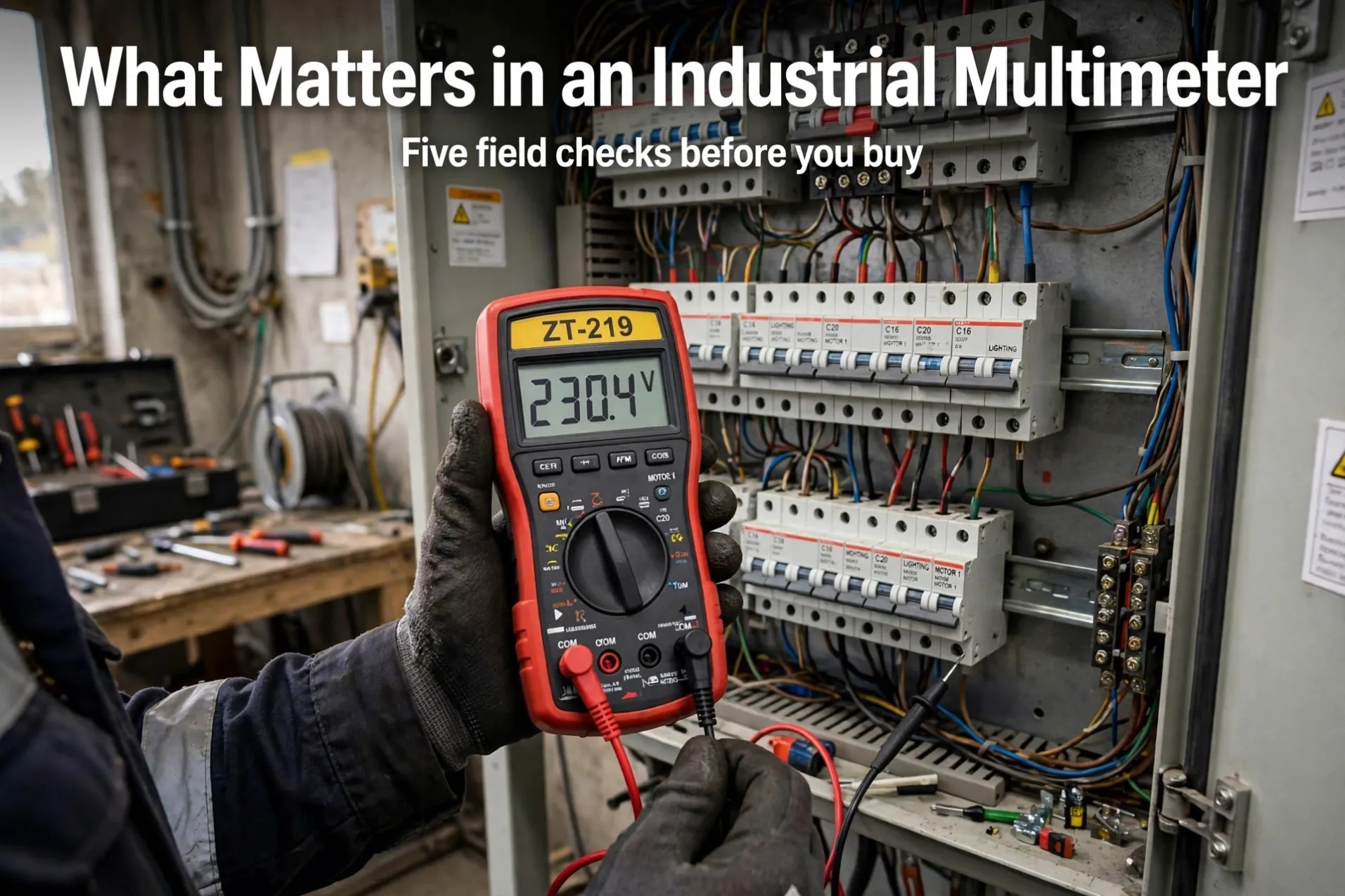
Ask a maintenance electrician what they want from a multimeter and the answer is rarely a longer feature list. It is a reading they can trust on a circuit that may or may not be live. On an industrial site, a meter earns its place by doing five things well: surviving the fault it is connected to, reading distorted waveforms correctly, telling a real voltage from a ghost one, keeping up with fault-finding, and surviving the site.
1. A safety rating that holds up under fault conditions
The measurement category (CAT) rating is the first thing to check. Defined under IEC 61010, it describes the transient energy a meter must survive: CAT II covers plug-in appliances, CAT III covers distribution panels and fixed industrial equipment, and CAT IV covers the service entrance. For most industrial work, CAT III 600V is the practical minimum; many plants standardise on CAT III 1000V or CAT IV 600V.
The danger is not the voltage you are measuring — it is the transient you are not expecting. Switching a motor or a transformer can throw a spike across a panel that a lower-category meter cannot contain. A CAT II meter may read 400V fine on a normal day, and still arc dangerously when a transient hits.
Do not take the printed rating on trust alone: in one documented recall, meters marked CAT III 600V were fitted with fuses of inadequate breaking capacity, creating an arc risk above 400V. Check the rating is printed on the meter and the test leads, look for recognised certification marks, and ask the supplier for the test reports behind it.
2. True RMS, because plant loads are not sine waves
Most loads on a modern plant — variable frequency drives (VFDs), LED drivers, switched-mode supplies, HVAC inverters — draw current in short pulses, not smooth sine waves. An average-responding meter assumes a sine wave, and on distorted waveforms that can be wrong by 10% to 40%: the difference between a motor that looks healthy and one running hot.
A True RMS meter measures the actual heating effect of the waveform, whatever its shape. If your site has VFDs, this is not optional. Compare a sample against a known VFD output and a second meter: a large, consistent gap between two meters on the same drive is a warning sign.
3. LoZ mode to kill ghost voltage
Long cable runs in industrial buildings often run parallel to live conductors. A de-energised cable picks up a capacitively coupled voltage from its neighbour, and a standard high-impedance meter will display it — commonly 40V to 80V AC on a circuit that is, in fact, dead. The result is a technician who cannot tell whether the circuit is safe to touch.
Low-impedance (LoZ) mode solves this by loading the circuit slightly and bleeding the coupled voltage away. A real voltage stays; a ghost voltage collapses to near zero. For long runs in trunking or cable trays, put LoZ on the must-have list.
4. Speed and readability that match fault-finding
Troubleshooting is fast, repetitive work: test a point, move on, test the next. First, the continuity beeper: the best meters respond in under a millisecond, so a wiring check is a quick sweep rather than a pause at every terminal. Second, fast auto-ranging and a Min/Max mode, which catches intermittent dips and spikes a single reading misses. Third, a backlit, high-contrast display that stays readable inside a poorly lit panel, plus a hold function.
5. Input protection and build quality
A meter on an industrial site will be dropped, knocked against panels, and used in dust and damp. It also needs to protect itself — and its user — when something goes wrong at the input. Look for high-rupture-capacity (HRC) fuses, MOVs and PTC devices on the voltage path, and a case built to survive a drop onto concrete.
Protection components are also a diagnostic clue. A blown internal fuse is one of the most common causes of wrong readings: wildly fluctuating voltage, or a current range that shows no change, often traces back to a fuse rather than the circuit under test. Repair forums report the same pattern from the other side — a meter reading about 2 ohms with its leads shorted, caused by contamination and worn protection components at the input jacks. Before you accept a sample, short the leads and check the resistance reads close to 0.0 ohms.
What matters less than the brochure suggests
Not every headline specification earns its place. Extremely high display counts are the clearest example: moving from 6,000 to 20,000 or 40,000 counts rarely changes everyday tasks such as checking a supply voltage or tracing a control circuit. Accuracy and stability matter far more — a high count on an unstable meter is just a more precise-looking wrong answer.
The same applies to rarely used extra functions: a transistor tester or a duty-cycle range you never select adds nothing to a day of industrial fault-finding. Connectivity and data logging can help with commissioning records, but they are a bonus, not a substitute for the five checks above.
The five checks at a glance
Check | Why it matters on site | What to verify before buying |
|---|---|---|
CAT rating (CAT III/IV) | Survives panel transients | Rating on meter and leads; test reports on file |
True RMS | Reads VFDs and non-linear loads | Compare on a known drive output |
LoZ mode | Separates ghost from real voltage | Dead cable reads near zero |
Speed and display | Keeps pace with fault-finding | Fast beeper, Min/Max, backlit display |
Input protection and build | Protects user and meter | HRC fuses; shorted leads near 0.0 ohms |
How to evaluate a sample before you commit
Do not approve a batch on the datasheet alone. Run a sample through five quick tests: measure a known voltage source; short the leads and check the zero reading; time the continuity beeper on a long run; use LoZ mode on a de-energised cable beside live ones; compare the sample against a trusted meter on a VFD output. If the sample fails any of these, ask the supplier why before you order more.
Questions to ask your supplier
Before ordering, ask for the calibration certificate behind the stated accuracy, and how often the meter should be recalibrated. Ask what warranty and after-sales support are included, and whether spare fuses and leads are stocked. If you need your own brand, confirm OEM/ODM options — logo, packaging, manual, and barcode — and confirm the minimum order quantity and lead time with the supplier.
The bottom line
A good industrial multimeter is not the one with the most functions or the highest count. It is the one whose safety rating you can verify, whose readings stay true on distorted waveforms, that tells a ghost voltage from a live one, and that survives the site. Check those five things on a sample, and the purchase decision largely makes itself.
For a multimeter built for daily industrial troubleshooting — verified safety ratings, True RMS measurement, OEM/ODM support for your brand — visit www.zydhardware.com and send us your requirements.