
Buying Guides
Why Your Anemometer Reads Differently at the Same Vent
Your anemometer reads differently at the same vent — is it broken? Usually not. Learn the six causes, from probe position to turbulence, and a 5-minute check.
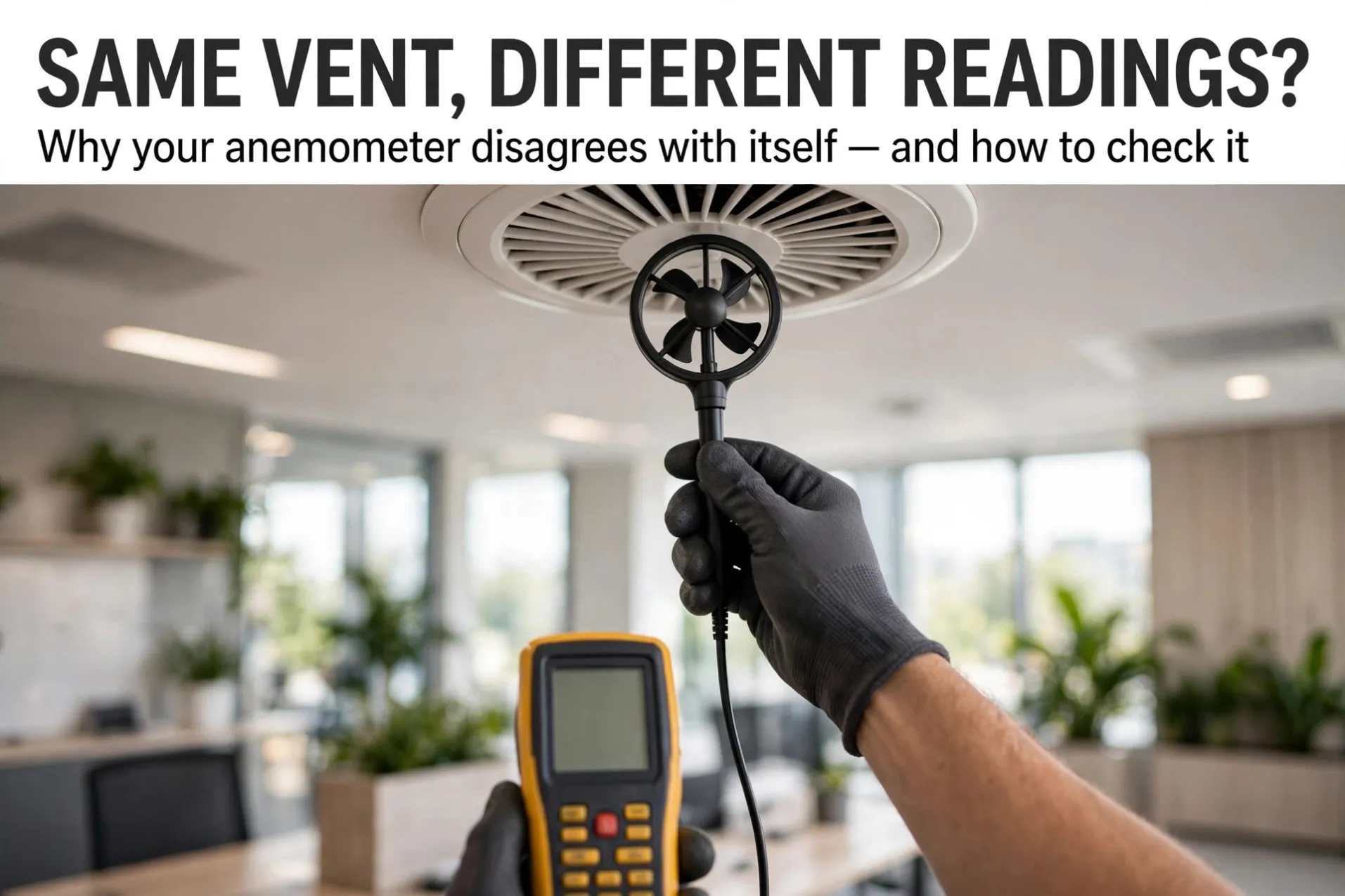
Your anemometer reads 2.4 m/s at a vent. You lift it, put it back in what looks like the same place, and now it reads 3.1 m/s. A colleague's meter says 1.9 m/s. Is your meter broken?
Probably not. Air velocity at a vent is not one number — it changes across the face of the grille, with turbulence, and when the system itself changes. The industry standard for airflow measurement, ASHRAE Standard 111, puts it plainly: a rotating vane anemometer is accurate to about ±5% in smooth, uniform flow, but the error can reach ±30% in nonuniform flow. Both readings can be "correct" at the exact point they were taken — and still disagree by a third.
Before you return the meter, work through the six causes below — most take five minutes to rule out.
Air at a Vent Is Never Uniform
There is no single "air velocity at this vent" to compare against. Air moves fastest near the centre and slows to almost zero at the walls, where friction creates a boundary layer. A bend, damper or grille upstream stirs the flow, so one corner of a diffuser can read high while another reads low. A single reading at the centre can easily overstate the average by 20–30%.
That is why a single-point reading is almost never a measurement of the vent — it is a measurement of one spot. HVAC balancing technicians measure a traverse: a grid of points across the duct or grille face, averaged together. If two readings at the "same" vent differ, the first question is always: were they taken at the same point?
Six Reasons Your Readings Disagree
1. You measured a different spot
A few centimetres is enough. The centre of a diffuser can read 3 m/s while a point near the frame reads 1.5 m/s. Hold the vane in the same marked position for every comparison, and average a traverse instead of trusting one spot reading.
2. You measured too close to a disturbance
Air leaving a bend, damper, fan or branch connection is turbulent and uneven. ASHRAE Standard 111 recommends measuring at least 7.5 duct diameters downstream and 1.5 diameters upstream of any disturbance. Right after a bend, readings can swing minute to minute as eddies pass the sensor.
3. The vane was not square to the flow
A vane anemometer reads the airflow passing through the impeller. Tilted 20–30 degrees off axis, it under-reads. Your body or hand can also block or deflect the flow — stand to the side of the airstream, not in front of it, and keep the vane head clear of the grille frame.
4. The system changed between readings
A damper adjusted, a fan staging up or down, a door opened, another zone calling for air — any of these changes the flow. If the first reading was taken with the system in one state and the second in another, the meters are not disagreeing; the air is different. Note the system state with every reading.
5. The CFM number is wrong, not the velocity
Many handheld anemometers calculate air volume (CFM) from velocity times the duct or grille area you enter. If the area is wrong, the CFM is wrong even when the velocity reading is perfect — the free area of a grille is less than its overall face size. And velocity and volume are different quantities: the same velocity through a small opening and a large one means very different airflow.
6. The meter itself has a problem
This is the last cause to check, not the first. A vane that spins stiffly or catches — dust, lint or a bent blade — under-reads, especially at low velocities. A low battery can also distort readings on some models. Every instrument drifts: ASHRAE Standard 111 calls for field verification against a pitot-tube traverse and manufacturer calibration roughly every six months. If the vane does not spin freely, or the meter reads in still air when it should read zero, the meter needs cleaning or service.
A 5-Minute Check That Separates Method From Meter
- Repeat in place. Hold the vane in one marked position, take ten readings, and note the spread. In steady air, a healthy meter repeats within a few percent; wide scatter means turbulent air, not a bad meter.
- Use average mode. Take a simple traverse — centre plus four corner points — and average them. Compare averages, not single readings.
- Compare side by side. Hold two meters at the same point in turn, with the same settings and units. A consistent offset points to calibration; random disagreement points to method.
- Check the obvious. Confirm the units (m/s vs ft/min), the area entered for CFM, and the battery. A meter set to knots instead of m/s will "read" about half of what you expect.
- Verify against a traverse. If a result is disputed — a balancing report, a warranty claim, a customer complaint — a pitot-tube duct traverse is the reference method, accurate to about 5–10% under good field conditions. Test and balance contractors compare handheld readings against it and apply a correction factor for that grille type: a linear slot diffuser, for example, typically reads 10–15% different from a traverse.
When It Really Is the Meter
Replace or recalibrate when the vane is damaged or spins unevenly, when readings drift in still air, when the meter disagrees with a reference by a fixed percentage across the range, or when calibration is long overdue. A single odd reading is not evidence; a repeatable, consistent error is.
What to Check Before You Buy
For importers and distributors, repeatability is a buying criterion, not just a troubleshooting topic. Ask for the accuracy specification and the range it applies to — a ±5% figure that only holds above a certain velocity says little about low-speed comfort checks. Check whether the model has max/min/average functions and a CFM calculation, whether the sensor head is separate from the display, and whether the supplier supports calibration. Catalogue examples show the range available: a wired vane model covering 0–45 m/s at ±5% with a 72 mm sensor head and 24 groups of stored readings, a model with a telescopic probe for ducts, a pocket model weighing about 52 g, and a multi-function model that calculates air volume up to 9,999 CFM. Test the sample on a real grille, at several points, before you commit to a quantity.
Questions to Ask Your Supplier
- What accuracy is quoted, and over which part of the velocity range does it hold?
- Does the model average a traverse, and can it calculate CFM from an entered area?
- Is the sensor head separate, and is there a telescopic probe option for duct work?
- What is the minimum readable velocity, and how does the meter behave at low airspeeds?
- Can you provide a sample for a side-by-side test, and what calibration support do you offer?
Different readings at the same vent are usually a message about the air, not the instrument. Measure at the same point, average a traverse, keep the system state constant, and check the meter last. When the readings agree after that, you can trust the number — and the decision that follows.
Related reading on this site: how to choose an anemometer for HVAC airflow; how to choose a manometer for HVAC and industrial use; how to choose a temperature and humidity meter.
Looking for an anemometer for your market? Contact us through zydhardware.com for samples, specifications and OEM options.