
Why Your Capacitor Test Gives the Wrong Reading
Wrong capacitor reading? In-circuit paths, residual charge, ESR and test frequency are the usual causes. This five-minute check usually finds the real one.
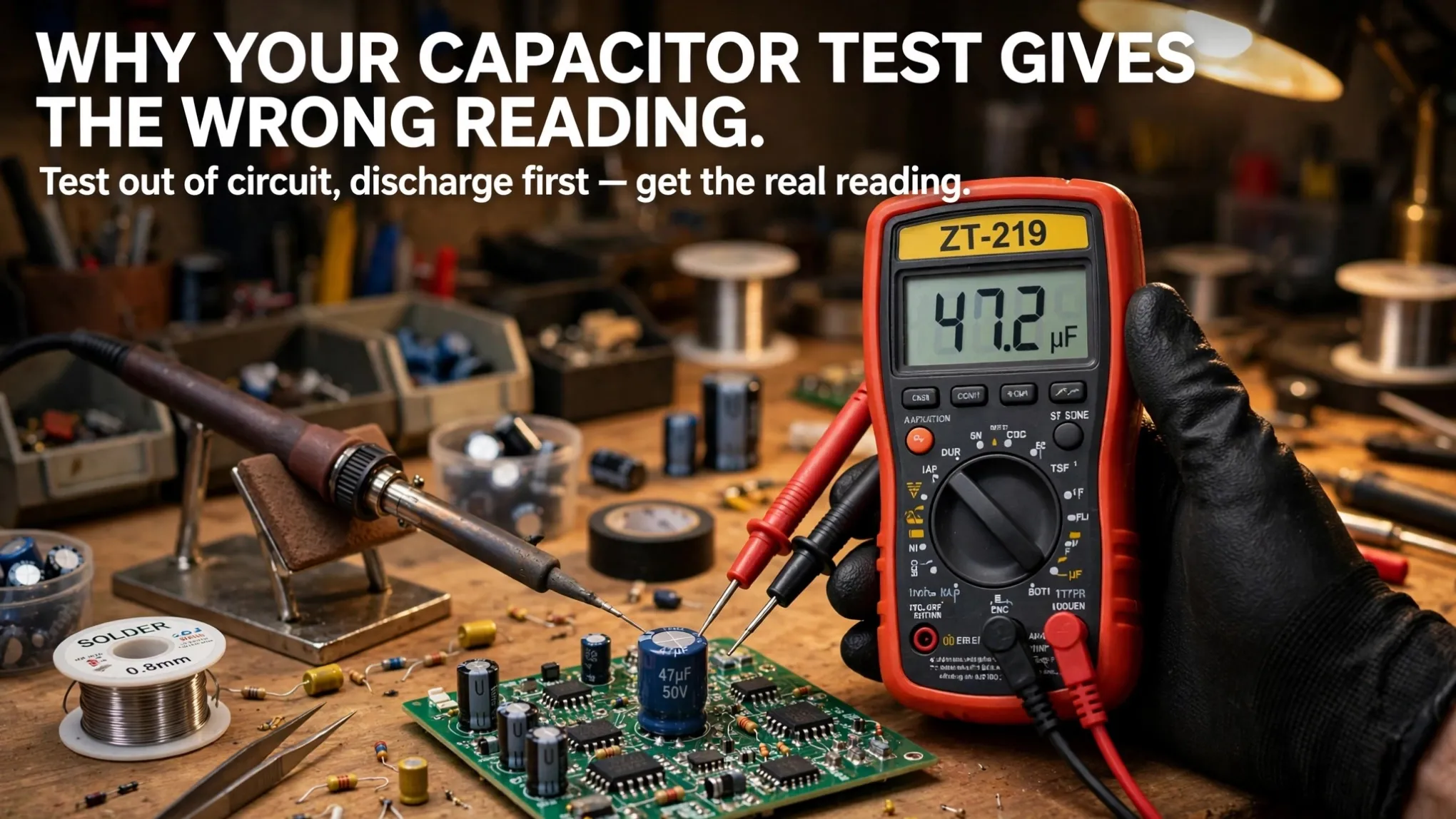
A capacitor can read 47 µF on the label and 63 µF, 12 µF, or OL on your meter — and the meter is usually not broken. In most cases the test setup is wrong, not the instrument and not the capacitor. A capacitance meter charges the part with a known current and times the voltage rise; any parallel path, leftover charge, or extra capacitance of its own changes that timing — and the number on the screen.
The short answer: test out of circuit, discharge first, zero the leads for small values, and judge against tolerance, not the printed number. The five checks below take about five minutes and settle most cases.
The Five-Minute Check That Settles Most Cases
Run them in order — they remove the four most common errors. If the reading is still wrong afterwards, you have a real fault.
- Power off and discharge. Connect a resistor across the terminals — a 20 kΩ, 5 W resistor is the usual choice for larger capacitors — and wait a few seconds. Never short a large capacitor with a screwdriver; a charged power-supply or motor-start capacitor can hold hundreds of volts after power-off.
- Take it out of the circuit. Remove the capacitor completely, or at least desolder one lead. This is the single most important step, and the one most often skipped.
- Zero the leads. With the probes shorted together, press REL (relative) to cancel the capacitance of the leads. This matters most for small capacitors, as explained below.
- Pick the right range. On a manual-ranging meter, select a range above the rated value; on auto-ranging, give it time to settle — large electrolytics take several seconds to charge.
- Compare against tolerance, not the label. Most capacitors are rated at ±10% to ±20%. A 100 µF capacitor reading 80 to 120 µF is within specification. A reading far outside that band is the signal, not a 5% difference.
Cause 1: Testing In-Circuit — the Most Common Error
A capacitor on a circuit board is rarely alone. It sits in parallel with resistors, transistors, other capacitors, and sometimes whole sub-circuits. Those surrounding components give the meter's test current alternative paths, so the meter measures the capacitor plus everything connected to it — not the capacitor alone. The result looks plausible, which is what makes it dangerous: a good capacitor can read bad, and worse, a bad capacitor can read good.
The fix is mechanical: desolder at least one lead and measure again — even makers of in-circuit testers advise this when a reading must be trusted.
Cause 2: Residual Charge — Wrong Reading and a Damaged Meter
A capacitor stores charge after power is removed. A charged capacitor in capacitance mode gives a wrong reading — the meter's timing starts from an unexpected voltage — and can damage the meter's input. Large electrolytics in power supplies, motor drives, and HVAC equipment can hold enough energy to destroy a multimeter input or cause a serious shock.
Discharge is part of getting a correct reading, not only a safety step: use a resistor, wait for near-zero volts, then switch to capacitance mode.
Cause 3: The Right Value but a Bad Capacitor — ESR
Here is the trap that catches experienced technicians: the capacitor reads within tolerance, yet the equipment still fails. A capacitance reading only measures capacitance. It says nothing about equivalent series resistance (ESR) — the internal resistance that rises as an electrolytic dries out with age and heat.
A capacitor with high ESR can read the correct µF value at the meter's low test voltage and still fail under real operating load: a motor that hums but will not start, or a power supply that resets under load. The capacitor has not lost its capacitance; it has lost its ability to deliver current quickly.
If the reading looks fine but symptoms persist, check ESR, or swap in a known-good part of the same value and voltage rating.
Cause 4: Test Frequency and Tolerance
Two numbers explain many small disagreements. First, most handheld meters test at a low frequency, often around 100 Hz, while many capacitors are rated at 120 Hz — that alone can shift the value by a few percent. Second, the part's own tolerance is wide: ±10% to ±20% is standard.
Reading | What it usually means |
|---|---|
Within ±10–20% of rated value | Capacitor is good |
More than 20% below rated value | Degraded — dried-out electrolyte |
Significantly above rated value | Possible internal leakage or short |
OL (overload) | Open circuit — failed |
0.00 µF or near zero | Dead or open |
Reading drifts or never settles | Residual charge, leakage, or parallel path |
A reading that is "a bit off" is not a failure. A reading far outside tolerance, an OL, or a zero is.
Cause 5: Small Capacitors and the Capacitance of Your Own Leads
Below about 50 pF, the test leads themselves become part of the measurement. A pair of ordinary test leads has roughly 2–5 pF of stray capacitance, and some meters cannot measure below about 200 pF at all because of it. A 10 pF capacitor can easily read 15 pF — not because the part is wrong, but because the meter is reading the part plus the leads.
The fix is the REL button: short the probes, press REL to zero out the lead capacitance, then connect to the capacitor. For very small values, use short leads and a dedicated LCR meter with a test fixture.
Choosing a Meter for Capacitor Work
When you specify or buy, check these points:
- Range coverage. A 20 nF–2000 µF range covers most repair and incoming-inspection work; wider ranges, such as 40 nF–40 mF, suit motor-start and power-supply capacitors.
- REL (relative) function. Essential for small capacitors and for cancelling lead capacitance.
- Auto-ranging with a settle time. Large electrolytics charge slowly; a meter that rushes the reading will report low.
- ESR capability. A capacitance reading alone cannot catch a dried-out electrolytic; an ESR or LCR meter can.
- Input protection. Mistakes happen — proper overload protection survives the day a charged capacitor gets connected by accident.
Questions to Ask Your Supplier
Before ordering meters or capacitors, these questions prevent the most common disputes:
- What test frequency does your capacitance measurement use, and at what frequency is the capacitor rated?
- Is the quoted tolerance ±10%, ±20%, or wider — and is it printed on the part or only in the datasheet?
- Can you supply ESR data or a low-ESR grade for power-supply and motor applications?
- What is the capacitance range and accuracy of the meter, and does it have a REL function for small values?
- What after-sales and calibration support do you offer if a batch of meters or capacitors is questioned?
A supplier who can answer these plainly is one whose readings you can trust — the goal is a measurement both sides can reproduce.
Contact us at zydhardware.com to discuss multimeter and capacitance-testing options, and OEM/ODM support for your market.