
Buying Guides
Why Your Clamp Meter Can't Catch Motor Inrush Current
Your clamp meter shows normal running current but misses the startup surge. Learn why inrush current escapes ordinary meters and what to check before you buy.
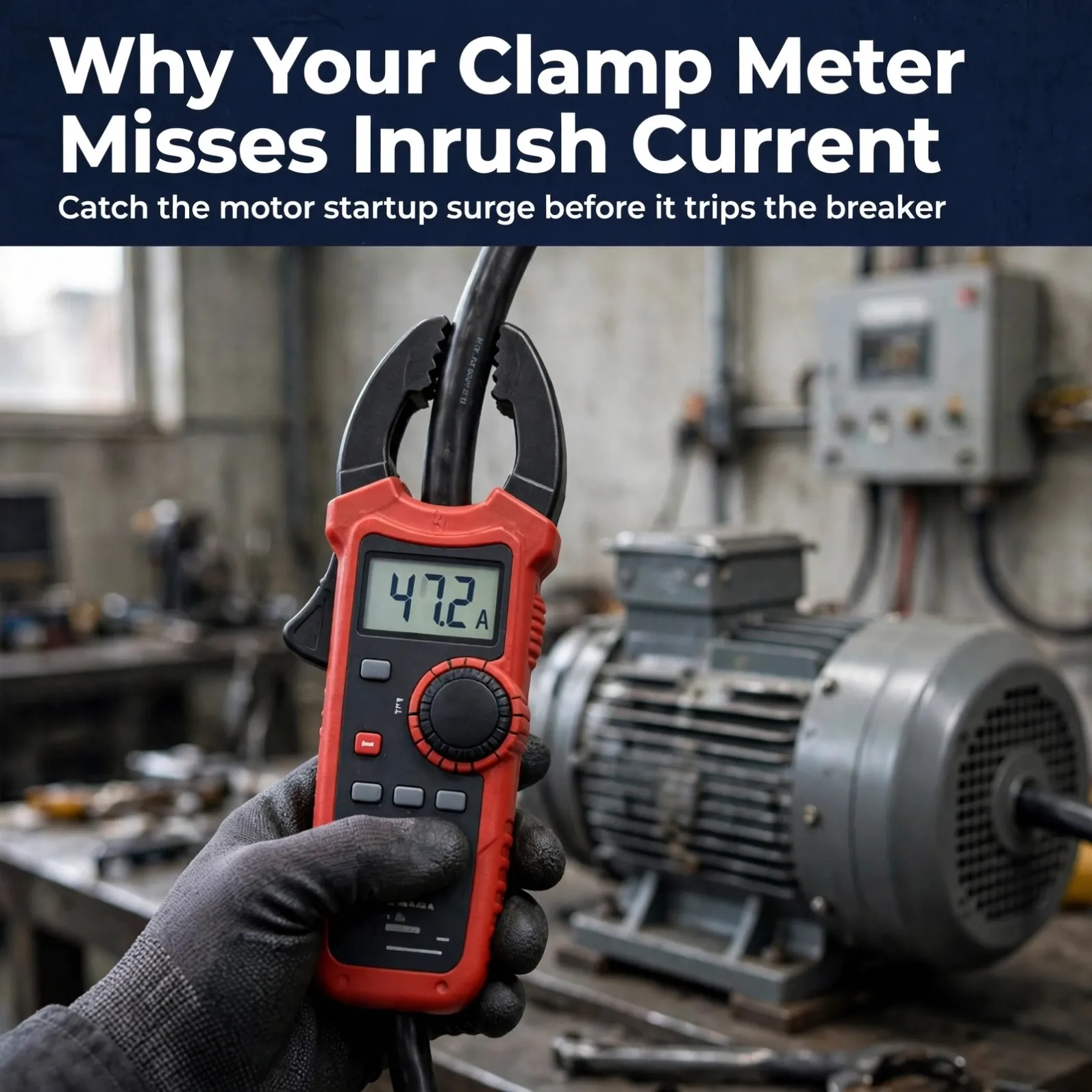
Why Your Clamp Meter Can't Catch Motor Inrush Current
A motor trips its breaker on startup, yet your clamp meter shows a perfectly normal running current — until the next start trips it again. The problem is usually not your technique. Most standard clamp meters simply cannot see the event you are trying to measure.
Motor inrush current is a brief surge lasting roughly 75 to 150 milliseconds and reaching four to ten times the motor's normal running current. A standard clamp meter averages readings over a much longer window, so by the time the display updates, the surge is gone. Check this specification gap before you order.
What Inrush Current Is — and Why It Matters
When a motor starts from rest, it draws a large current to build up its magnetic field and overcome the inertia of the rotor — often called locked-rotor current, and a normal part of every start. A typical induction motor might run at 5 amps and briefly pull 30 to 50 amps at startup; on a large industrial motor, the surge can reach 1,500 to 2,000 amps.
Inrush matters for three practical reasons. First, it explains nuisance breaker trips: a breaker sized for running current may trip on a healthy motor if the startup surge is high enough. Second, it is a diagnostic signal — a motor with a failing start capacitor, worn bearings, or an overloaded shaft draws a higher or longer surge than a healthy one. Third, repeated surges stress contactors, starters, and windings, shortening their life.
Why a Standard Clamp Meter Misses the Surge
A standard clamp meter is built to measure steady current. It samples the signal, averages it, and refreshes the display a few times per second — fine for a running motor, but far too slow for an event that peaks and falls within a tenth of a second.
Three limits are at work: sampling speed (a 100-millisecond surge can fall between samples or be averaged down), display update rate (most meters refresh only two to four times per second), and peak capture (standard mode reports an average or RMS value, not a peak — and inrush is a peak event).
That is why two technicians can measure the same motor start and report different numbers.
Three Other Reasons Your Reading Looks Wrong
Even with the right meter, three simple mistakes cause wrong readings.
Clamping the whole cable. A clamp meter measures the magnetic field around a single conductor. Clamp around an entire power cord and the opposing fields of live and neutral cancel out, reading near zero. Always clamp one conductor only — on three-phase motors, one phase at a time.
The wrong range. A range too low overloads on the surge; a range far too high loses resolution. Select a range above the expected surge, not just above the running current. A motor running at 20 amps may surge past 150 amps, so a 400-amp or higher range is a safer starting point.
AC-only inrush on a DC circuit. Many inrush functions work on AC current only. On a DC motor drive or battery-powered system, the inrush button may do nothing at all. Confirm the function covers the current type you need.
How to Measure Inrush Current Correctly
A clamp meter with a dedicated inrush function captures the peak current during the first 100 milliseconds after startup and holds it on the display. The order matters:
- Turn the dial to AC current and press the INRUSH button before starting the motor — the meter must be armed before the event, not during it.
- Clamp around a single conductor, jaw fully closed, conductor centred in the jaw.
- Make sure the equipment is fully stopped and has rested for a few minutes, so you capture a true cold start.
- Start the motor and read the held peak. Repeat two or three times: a consistent surge is a baseline, while a rising surge over weeks warns of a developing fault.
What to Look for When Buying a Clamp Meter for Motor Work
Not every meter with an "inrush" label performs the same way — compare models against this checklist:
Feature | Why it matters | What to check |
|---|---|---|
Dedicated inrush function | Captures the 100 ms startup peak and holds it | Confirm the capture window and AC-mode support |
True RMS | Accurate on distorted motor waveforms | Averaging meters under-read on variable-speed drives |
Current range headroom | Surge can be 4–10× running current | Range should cover the expected peak |
Jaw size | Must close fully around the conductor | Check jaw opening against your largest cable |
Safety rating | Motor circuits carry high fault currents | Ask for rating documentation for the model |
Display and hold | Read the peak after the event | Peak hold and a backlit display help in dark panels |
Our 2025 catalogue lists the HT208A with an inrush function, True RMS measurement, a 5,999-count display, and AC current ranges of 60, 600, and 1,000 amps. Confirm the details with your supplier before ordering — the right model depends on the motors your customers service.
Sample Evaluation: Test Before You Commit
For importers and distributors, the sample stage is where inrush capability is easiest to verify — and where it is most often skipped. Test the sample on a real motor start before placing a volume order. Measure the same motor with the sample and with a reference meter you trust, and compare the peak values. Test on a small motor and a large one: a meter that captures a 40-amp surge may still miss a 400-amp surge. Check that the jaw closes fully on your thickest cable and that the display is readable at arm's length. Run the test five times — consistent results mean the capture is reliable. Finally, confirm what is included: test leads, batteries, carry case, and manual in your market's language.
Questions to Ask Your Supplier
Before you order clamp meters for motor maintenance customers, ask: does the inrush function capture AC only, or AC and DC? What is the capture window, and is the peak held on the display? What is the maximum current it can capture? Is the meter True RMS, and does it handle variable-frequency drive waveforms? What safety rating documentation and calibration support are available for this specific model? And can it be supplied with your logo, packaging, and manual under OEM/ODM terms? A supplier who answers clearly — with documentation, not just a datasheet line — is one you can build a product line around.
The Bottom Line
A clamp meter that cannot catch inrush current is not a bad meter — it is simply the wrong tool for motor startup work. The surge is too fast and too large for a standard averaging measurement. If your customers maintain motors, make the inrush function a line item in your specification checklist, verify it on a real motor start during sample evaluation, and choose a model whose current range covers the surge.
Looking for a clamp meter with inrush measurement for your market? Contact us at zydhardware.com for the catalogue, sample terms, and OEM/ODM options.