
Buying Guides
Why Your Clamp Meter Reads Zero on a Live Circuit
Clamp meter reads 0.00 A on a live circuit? Usually it is not broken — two wires cancelling, wrong AC/DC mode, open jaws or no load are the usual causes.
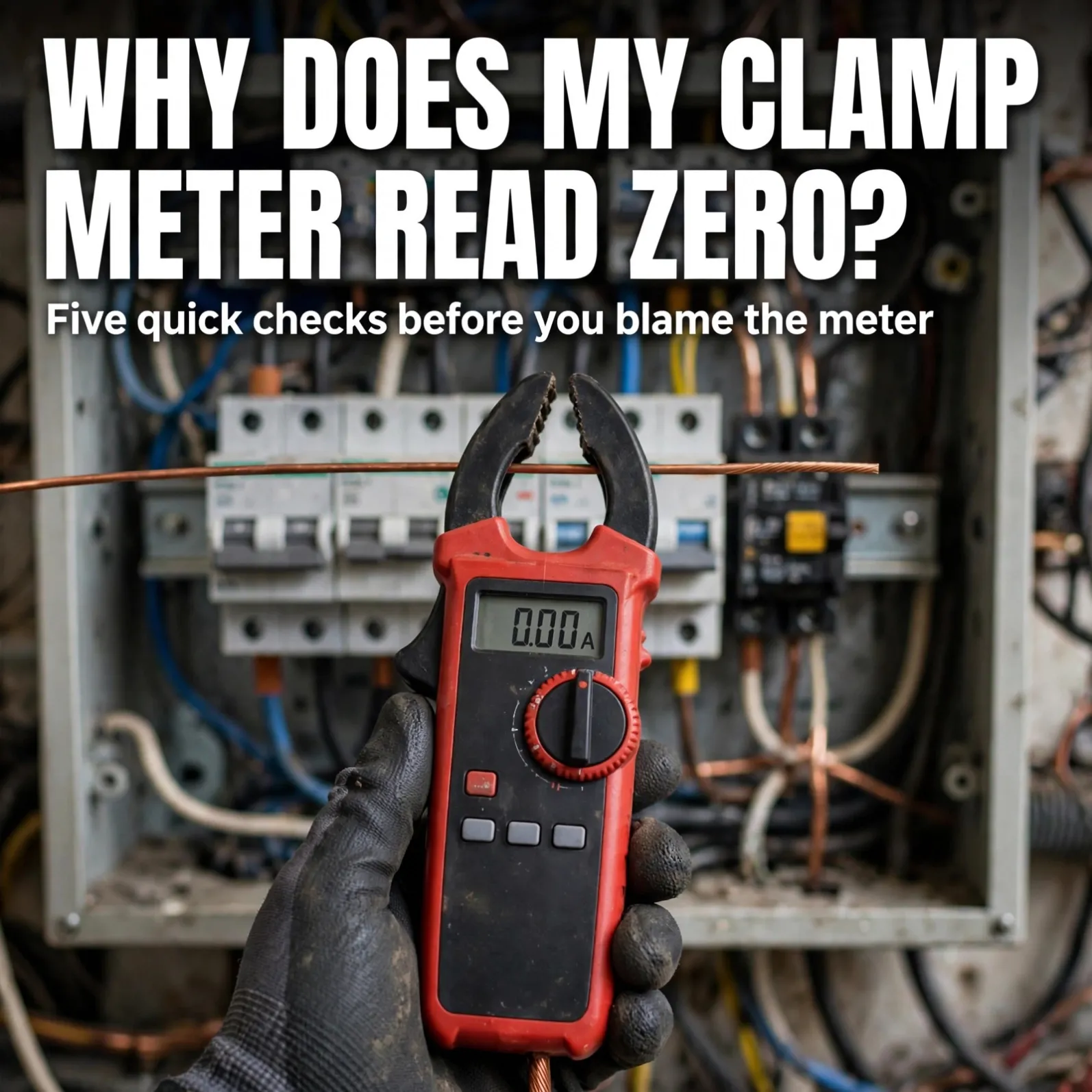
Why Your Clamp Meter Reads Zero on a Live Circuit
You clamp the meter around a wire, the equipment at the far end is running — and the display reads 0.00 A. In most cases the meter is not broken. A clamp meter reads the magnetic field around a single conductor, and anything that removes that field, cancels it, or hides it from the jaws reads as zero. The cause is usually one of five things, and four of them take less than a minute to check.
1. You clamped two conductors at once
Inside an ordinary cable, live and neutral carry the same current in opposite directions, so their magnetic fields cancel inside the jaws. The meter reads zero even though 10 A is flowing to the load.
In a public forum thread, a user with a UNI-T UT202A reported 0.03 or 0.07 A on a cable, and 0.00 A on a wire feeding a lit lamp — because the whole cable was in the jaws. Measure one conductor at a time, and the reading appears.
Isolate a single conductor: at a breaker, a terminal block, or with a line splitter. Never strip or separate live conductors just to get a reading unless you are qualified to do so. The same setup, used on purpose, is how leakage current is measured — the reading is the difference between the two currents, the current leaking to earth.
2. The wrong mode: an AC clamp on a DC circuit reads zero
A basic AC-only clamp is a current transformer: the conductor is a one-turn primary, the coil in the jaws the secondary. A transformer only works on a changing field, so around a DC conductor the static field induces nothing and the meter reads zero — this time it genuinely is missing something.
DC-capable clamps solve this with a Hall-effect sensor in the jaw, which detects a steady field. So check the dial first: is the meter set to AC current while the circuit is DC? Solar strings, battery banks, and EV charging are all places where this mistake is common.
3. The circuit is live, but nothing is drawing current
"Live" and "loaded" are not the same thing. Voltage can be present while no current flows: the load is off, in standby, or on a timer. A clamp meter measures current, not voltage, so an energised but unloaded conductor correctly reads zero. Switch the load on and watch the reading rise. Do not assume a circuit is dead because the current is zero; that is answered with a voltage tester, not a clamp meter.
4. The jaws are not fully closed, or the conductor is off-centre
The jaws are a split magnetic core that forms a ring around the conductor, and any air gap in that ring weakens the flux. Dirt on the jaw faces, a cable so fat it holds the jaws ajar, or a latch not clicked shut can all make a real current read low or zero.
Position matters too: the field is captured most evenly when the conductor sits in the centre of the jaws, while a wire jammed against one side can give a skewed reading. Centre the conductor, wipe the jaw faces clean, and confirm the jaws close fully. Nearby conductors and motors can add stray fields, so keep the jaws away from other live cables and repeat the measurement after rotating the meter. On DC, zero the meter with empty jaws first.
5. The current is smaller than the meter can usefully read
Every clamp meter has a smallest current it can measure with confidence. A modern LED lamp draws around 0.1 A; a sensor circuit may draw far less. On a 600 A range, that signal is buried in noise and reads as zero.
Three fixes, in order. First, drop to the lowest current range. Second, loop the conductor through the jaws several times — two turns doubles the reading, ten turns makes 0.1 A read as 1 A — then divide the display by the number of turns. Third, if you regularly measure standby or leakage currents, use a clamp meter built for low currents, with a milliamp range, rather than a general-purpose high-current clamp.
A zero reading is not proof the circuit is dead
A zero current reading means "no current detected here, measured this way." It never proves a circuit is de-energised. Always verify absence of voltage with a proper voltage tester before touching conductors.
Klein recalled its CL110, CL210, and CL310 clamp meters in 2016 because a loose fastener could cause a live system to be misread as zero voltage. That recall was about voltage, not current, but the lesson is the same: a zero on the display can be a meter fault, not a safe circuit.
A five-minute check before you blame the meter
- One conductor only? If the whole cable is in the jaws, separate one conductor and re-measure.
- Right mode? AC setting for AC circuits, DC setting for DC circuits — and the lowest range.
- Load actually running? Switch it on and watch the reading.
- Jaws fully closed, conductor centred? Clean the faces, centre the wire, check for a gap.
- Current big enough for this meter? Try a lower range, or loop the wire through the jaws.
If all five check out, try a second meter on the same conductor — if it reads correctly, the first one is faulty and belongs in a service laboratory, not in the field.
What to ask a supplier before you buy
A clamp meter that reads zero in the field is usually a mismatch between the meter and the job, not a broken meter. Before ordering for a distributor range, ask: is the clamp AC-only or AC/DC? Does it offer True RMS and an inrush function for motor starting current? What is its lowest range and resolution? How wide do the jaws open, and do the faces meet cleanly? Does the DC range have a zero button?
Evaluate a sample the way your customers will use it: measure a known load through a single conductor, then the whole cable, then a small load on the lowest range. A meter such as the HK215D in our catalogue — an AC/DC True RMS clamp meter with inrush, LoZ, and NCV functions — suits mixed AC/DC field work; confirm the exact ranges in the manual before quoting a customer. We support OEM/ODM on our clamp meters, including logo, packaging, manual, and barcode.
A clamp meter that reads zero on a live circuit is usually not lying. It is reporting that no magnetic field reached its sensor — two fields cancelled, the wrong mode was selected, no current was flowing, the jaws were open, or the current was too small to see. Work through the five checks, and the meter will start telling the truth.
Related reading: clamp meter vs multimeter; why your clamp meter can't catch motor inrush current; why your DC clamp meter won't read zero after a big current.
To discuss clamp meters for your distributor range or your own brand, or to request a sample evaluation, visit zydhardware.com and send an inquiry.