
Buying Guides
Why Your DC Clamp Meter Won't Zero After a Big Current
Your DC clamp meter shows 0.3 A with empty jaws after a large current? Learn why residual magnetism causes the offset and how to zero or demagnetize it.
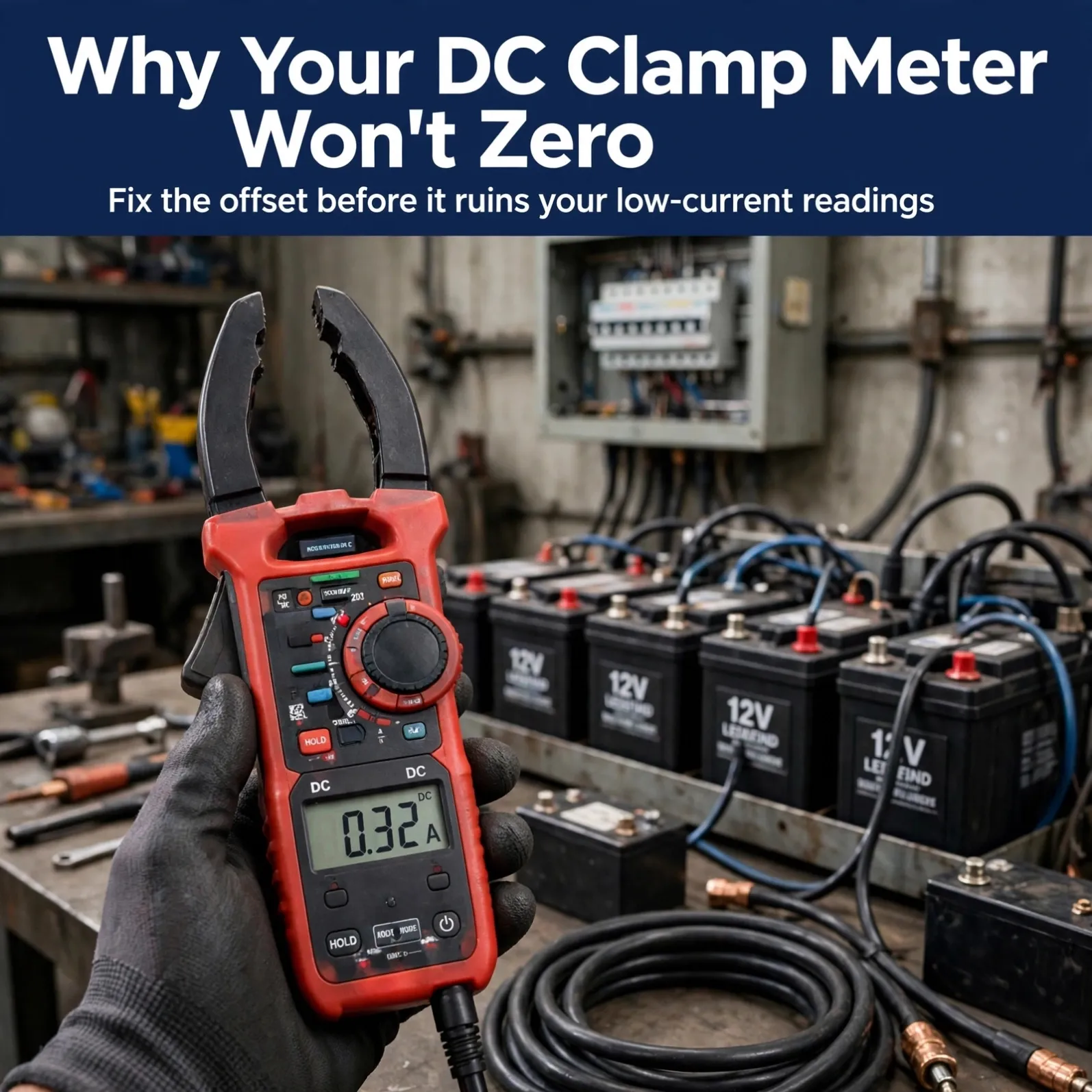
Why Your DC Clamp Meter Won't Zero After a Big Current
You measure a DC cable, move on, then open the jaws and point the meter at nothing — and the display still shows 0.3 A, or even several amps. The meter is usually not broken. In most cases the cause is residual magnetism left in the clamp jaws by a large current, combined with the way DC clamp meters sense current. The short answer: press ZERO with empty jaws in the measuring position first, and if the offset will not clear, the jaws need demagnetising. Only if neither step works should you suspect a faulty meter.
A 0.3 A offset is invisible on a 100 A starter-motor test, but it is a 30% error on a 1 A solar string.
Why DC Needs Zeroing and AC Usually Does Not
A DC clamp meter measures current with a Hall-effect sensor in the jaw. The sensor detects the steady magnetic field around the conductor, and the meter converts that field into amps. Any steady magnetic field looks like current to the sensor — including the Earth's magnetic field, nearby steel, and magnetism left in the jaw itself.
AC is different. An alternating field reverses many times a second, so its average is zero and the meter can cancel it out. That is why an AC clamp meter can read zero on empty jaws without a manual step, while a DC clamp meter cannot. On DC, the only way to remove the offset is to tell the meter what "zero" looks like right now, in this position, with the ZERO or REL button.
What a Large Current Does to the Jaws
The jaws are made of magnetic material, and a large DC current magnetises them slightly. After the conductor is removed, some of that magnetism stays behind. Technicians call it residual magnetism, and it produces a fixed offset that appears even with empty jaws.
Field reports describe the pattern clearly. In EEVblog forum discussions, users report an Agilent clamp meter that, after measuring a large DC current, would not read low currents properly and stayed stuck at an offset of about 30 mA; demagnetising the jaws restored normal readings. Another user reported a UNI-T UT210E showing an offset of about 5 A that the zero button could not clear, with other forum members pointing to a strong magnetic field or a current well above the rating as the likely cause, again recommending demagnetisation.
Independent testing by lygte-info.dk confirms the mechanism and its limits. In controlled tests with simulated currents from 0.3 A to 300 A, some clamp meters magnetised and their offset changed significantly, particularly the sensitive models with 1 mA resolution. Crucially, the same tests found that magnetisation did not spoil measurement accuracy in practice — as long as the REL/Zero button was used before each measurement.
How to Tell Which Cause You Have
Zero with empty jaws, in the measuring position. Open the jaws, hold the meter exactly as you will hold it to measure, and press ZERO or REL until the display reads 0.00. Then clamp the conductor without moving or rotating the meter more than necessary. If the reading is now correct, the problem was an unzeroed offset — the most common cause.
Open and close the jaws several times, then zero again. A jaw that does not close cleanly — dirt, a small burr, or a misaligned face — leaves a gap in the magnetic circuit and makes the offset unstable. Wipe the mating faces clean, check that they meet evenly with no visible gap, and zero again.
Test on a known small current. Loop a conductor with a known current through the jaw two or three times; the meter should read two or three times the current. If the reading is consistently high by the same fixed amount, that amount is your offset. If the zero button has no effect at all, or the offset is several amps on a low range, the jaws are probably magnetised beyond what the zero function can cancel — that is the point to demagnetise, not to keep pressing the button.
How to Fix It
Zero correctly every time. On DC, zero before every measurement, not once per day. Zero with empty jaws, in the same orientation and location as the measurement, and away from other live conductors. Repeat the step if you switch ranges, as some meters need the zero applied after each range change.
Demagnetise the jaws. If the offset will not zero out, the jaws need a decaying alternating magnetic field — a degaussing coil, a tape-head demagnetiser, or, as some technicians report, a few turns of wire carrying AC current through the jaw. The field should start strong and fade slowly to zero while the clamp is moved away from it.
Do not try to fix a stuck offset by opening the meter or adjusting internal potentiometers. Forum advice is consistent on this point: those adjustments are sensitive, hard to restore, and can make a repairable meter worse. Do not wave a strong permanent magnet at the jaws as a first resort either — it can reduce the offset on one pole and increase it on the other.
Re-test, then decide. After demagnetising, zero the meter and measure a known load. If the reading is correct and the empty-jaw offset stays small, the meter is usable again. If demagnetising does not help, the zero button has no effect, or the meter reads wrong on AC as well as DC, the fault is deeper — a damaged Hall sensor or a calibration problem. A certified calibration laboratory can confirm it; for a low-cost meter, replacement is often cheaper than repair.
What Buyers Should Check Before Ordering
A clamp meter that is only ever tested on a large current can pass every check and still fail on small DC currents in the field. Build the low-current test into your sample evaluation: zero the meter, measure a large DC current, then re-zero and measure a 1 A load. Check that the jaw faces meet evenly with no gap, that the smallest DC range and resolution suit the currents you need, and that the ZERO or REL button works on the DC range. Ask the supplier for the DC zero offset specification, if any, what the manufacturer recommends when the jaws become magnetised, and the recommended calibration interval. If the answer is vague, treat the low-current accuracy claim as unverified and test a sample yourself before committing to volume.
The Bottom Line
A DC clamp meter that will not zero after a big current is usually telling you about magnetism, not about a broken meter. Zero it with empty jaws in the measuring position, keep the jaw faces clean and fully closed, and demagnetise the jaws when the offset will not clear. Test every sample on a small current after a large one before you approve it for sale.
Related reading: clamp meter vs multimeter; motor inrush current; choosing an industrial multimeter.
Contact the Zhanyueda team at www.zydhardware.com to discuss clamp meter specifications, samples, and OEM/ODM options for your market.