
Buying Guides
Why Your Gas Detector Alarms When There Is No Gas
A gas detector alarming with no gas present is usually drift, cross-sensitivity, or a dying sensor. Learn the four causes and how to tell them apart — fast.
Why Your Gas Detector Alarms When There Is No Gas
The Short Answer: The Alarm Is Usually Right About Something — Just Not the Gas You Think
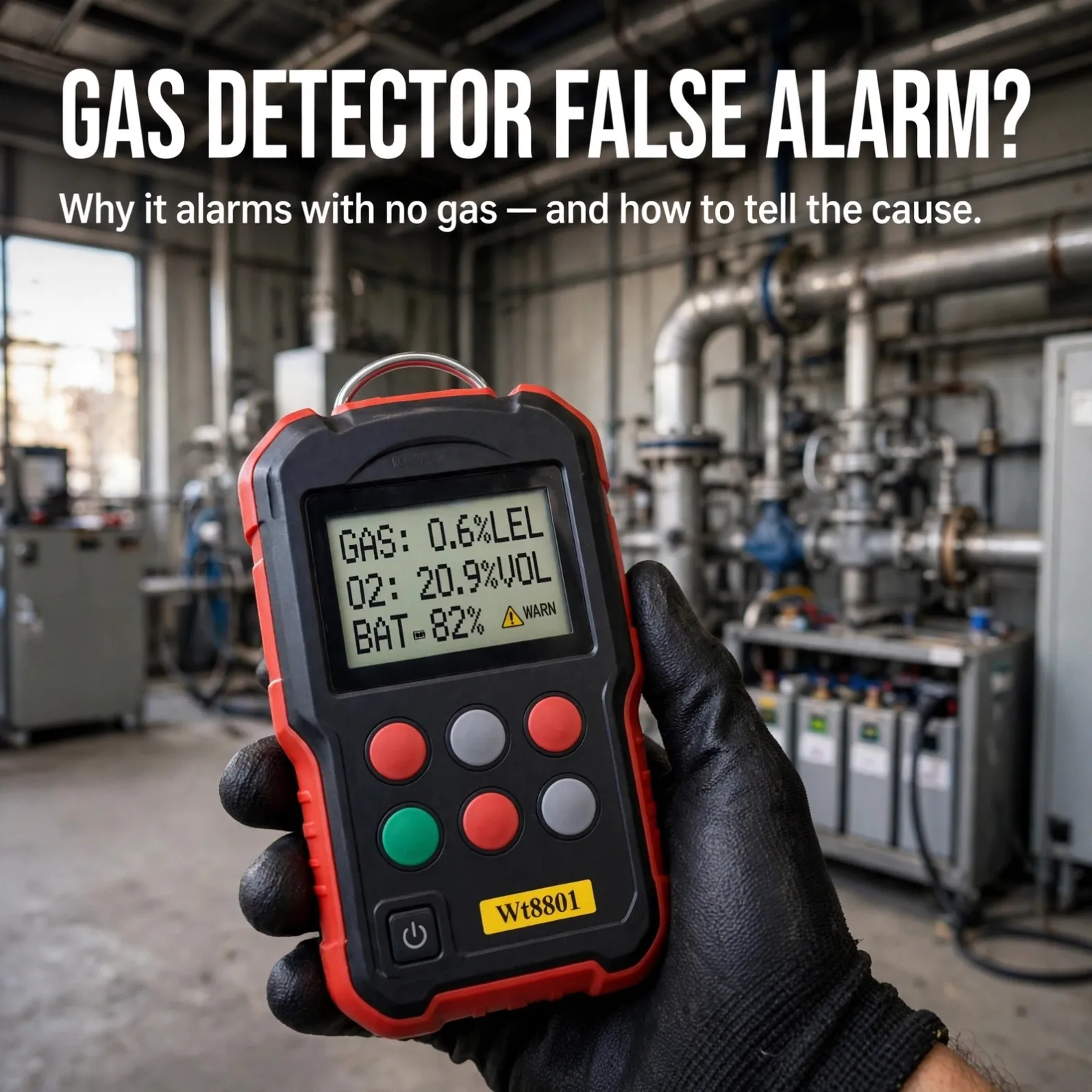
A gas detector that alarms when no gas is present is one of the most frustrating problems in industrial safety. The usual causes are sensor drift, cross-sensitivity to a different gas, a sudden change in temperature or humidity, or a sensor that is dying. Each cause leaves a different pattern, and once you know what to look for, you can tell them apart in minutes.
One rule comes first: treat every alarm as real until proven otherwise. Move people to clean air, and only investigate the instrument once everyone is out.
Cause 1: Drift — The Sensor's Zero Has Moved
Drift is the most common reason a detector alarms in clean air. A sensor's zero point — what it reads in clean air — and its span — how it responds to a known concentration — both move over time, as the sensing element ages, temperature swings shift its baseline, and knocks disturb it.
The sign is that the reading follows the instrument, not the location: it reads above zero in fresh air, the offset stays roughly the same wherever you carry it, and the alarm clears only after a zero adjustment or fresh calibration.
The test is the bump test: expose the detector to a known test gas and check that it responds and alarms. It is a quick before-use check, not a full calibration. A detector that fails it, or cannot hold zero in fresh air, should not return to service until calibrated. If it still will not hold zero afterwards, the sensor is probably at the end of its life.
Cause 2: Cross-Sensitivity — A Different Gas Is Really There
Sometimes the detector is not wrong at all. It is accurately reporting a gas it was never meant to measure. Electrochemical sensors work by a chemical reaction at an electrode, and any gas that drives the same reaction produces a signal the instrument reports as the target gas. Calibration cannot fix this: it is the chemistry doing the measuring.
The pairs behind most "no-gas" alarms are well documented by calibration specialists. A standard CO sensor reads 40–60% of ambient hydrogen as if it were CO, so battery charging rooms push a CO channel up with no CO present — the answer is a hydrogen-compensated CO sensor. H2S sensors cross-respond to mercaptans, the odorants added to natural gas. And a catalytic LEL sensor burns whatever reaches it, so solvent and cleaning vapours trigger it with no target leak.
Tell cross-sensitivity apart from drift by what the alarm follows: a cross-sensitivity alarm tracks an activity — it rises when batteries charge, a solvent job starts, or a gas line is opened nearby, and clears when the activity stops. Drift sits still and follows the instrument. The fix is selection, not calibration: choose a compensated sensor variant where one exists, or a different sensing principle. Ask your supplier for the cross-sensitivity table before you buy, and check it against the gases on your site.
Cause 3: Temperature, Humidity, and Airflow — The Environment Moved
Not every false alarm is chemical. Condensation on the sensor face can cause transient alarms. A sudden temperature change — from an air-conditioned room into a hot plant, or from a warm vehicle into cold outdoor air — can produce a temporary signal drift until the sensor stabilizes. Fans cycling on or off can move air rapidly past a diffusion-type sensor and create momentary changes that look like alarm events.
Alarms that line up with shift changes, washdowns, or equipment startups, and clear on their own within minutes, point to the environment, not a leak. Let the detector stabilize where it will be used, and keep the sensor face dry and unobstructed.
Cause 4: A Dying or Poisoned Sensor
The fourth cause is the one that ends the sensor's life. Electrochemical sensors have a finite life, typically measured in years, and their response weakens as they age. A sensor near the end of its life may pass a bump test on a good day and fail on the next, or hold calibration for a shorter period after each adjustment. If calibration intervals keep shrinking, replacement — not another adjustment — is the honest answer.
Catalytic combustible-gas sensors can also be poisoned: silicones, lead, and sulfur compounds can permanently damage the sensing element, and calibration cannot reverse it.
The check is simple. If a detector fails a bump test, will not hold zero after calibration, or needs calibrating far more often than the manual recommends, take it out of service and replace the sensor. Continuing to use it trains workers to ignore alarms — and that is the real cost of a false alarm. Once a crew has been called out three times for nothing, the fourth alarm gets a slower response.
A Five-Minute Field Check
When a detector alarms and no gas source is obvious, work through these steps in clean air. First, move to fresh air and watch the reading: if it falls to zero and stays there, suspect the location or cross-sensitivity; if it stays above zero, suspect drift or a dying sensor. Second, note what was happening when the alarm started — charging, cleaning, or a process startup points to cross-sensitivity or the environment. Third, run a bump test: a pass means the sensor can still respond, a fail means it cannot be trusted. Fourth, zero and calibrate if needed; if the reading will not hold zero, the sensor needs replacing. Finally, log the event — time, place, activity, and reading. A pattern across days points fastest to the cause, and the evidence your supplier needs.
What to Ask Before Buying Your Next Detector
A false-alarm problem is often a selection problem, decided at the buying stage. Before ordering, ask your supplier for the cross-sensitivity table for each sensor, and check it against the gases on your site. Ask whether a compensated sensor variant exists for the gases you actually have — hydrogen near battery rooms is the classic case. Confirm the calibration interval, what test gas is needed, and whether calibration can be done on site.
For distributors and own-brand buyers, these answers are also a commercial advantage: customers who can keep a detector trustworthy are less likely to return a unit or dispute a reading. If your customers work in mixed-gas environments, confirm which sensor combinations are available, including any OEM or ODM options for branding, packaging, manuals, and barcodes, before promising a configuration.
The Bottom Line
A gas detector alarming with no gas present is usually telling you something real: its zero has drifted, another gas is in the air, the environment has shifted, or the sensor is dying. Treat the alarm as real first, then let the pattern point to the cause. The fix is rarely a better guess; it is a bump test, a calibration, the right sensor for the gases on site, or a replacement sensor when the old one can no longer hold its zero. A detector your team trusts is worth more than one they have learned to ignore.
Contact us at zydhardware.com to discuss gas detector options, sensor configurations, and OEM/ODM support for your market.
Related reading on zydhardware.com: gas detector selection for industrial safety, multimeter ghost-voltage troubleshooting, and how to choose an insulation tester for industrial use.