
Why Your Gas Detector Reads Zero When There Is Gas
Your gas detector reads zero in clean air — and still reads zero in gas. Learn why sensor poisoning causes false negatives and how a bump test exposes it.
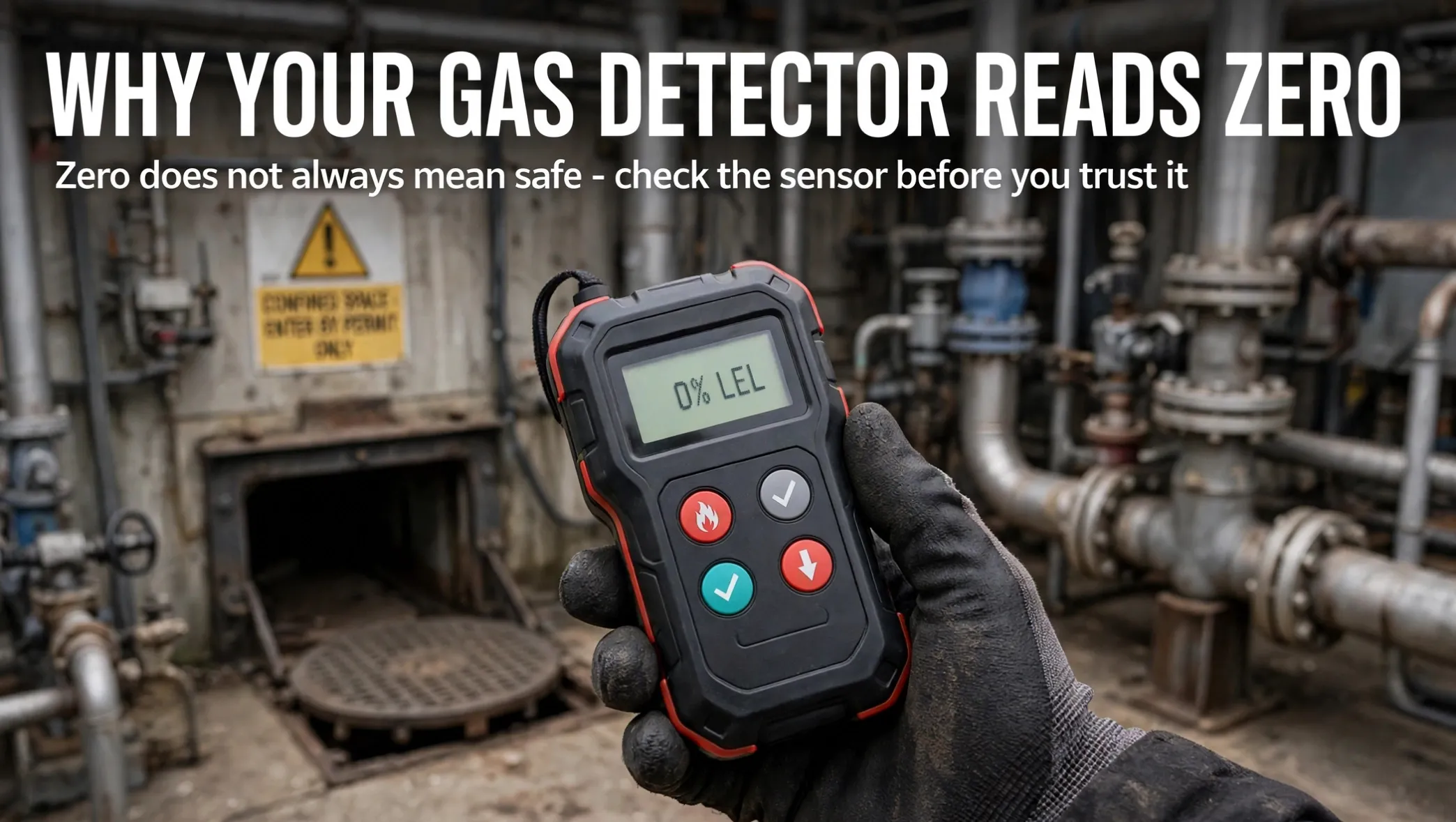
Why Your Gas Detector Reads Zero When There Is Gas
The Short Answer: Zero in Clean Air Proves Nothing
A gas detector that reads zero in clean air and still reads zero where gas is present is not necessarily broken. Its electronics, display, and alarms are usually fine. What has failed is the sensor's ability to react to gas — most often because the catalytic sensor for combustible gas has been poisoned.
This is the most dangerous failure a gas detector can have. A false alarm is annoying; a false zero tells a worker a hazardous atmosphere is safe. Only a bump test — putting known gas on the sensor — exposes a blind detector. ISEA and OSHA guidance, and the standard IEC 60079-29-2, say the same: challenge the detector with known gas before every use.
One rule comes first: if you can smell gas and the detector reads zero, trust your nose and leave the area.
Cause 1: Sensor Poisoning — Permanent and Invisible
Most portable combustible-gas detectors use a catalytic bead sensor, also called a pellistor: gas reaching the active bead is burned by the catalyst, the bead gets hotter, and the instrument converts that change into a % LEL reading.
Poisoning happens when certain chemicals coat or react with that catalyst. Honeywell lists the acute poisons: silicones, lead and sulfur compounds, phosphates, and HMDS. Silicon is the one you will actually meet — it hides in lubricants, adhesives, silicone sealants, and firefighting foams, and a few parts per million of its vapor can degrade a sensor within minutes.
A poisoned sensor under-reads in proportion to the sensitivity it has lost, and a fully poisoned bead reads zero no matter how much gas is present. It also responds more slowly as poisoning worsens.
True poisoning is permanent. No cleaning, fresh air, or calibration restores a poisoned catalyst — the sensor must be replaced. Calibrating a weak sensor only masks the problem.
Cause 2: Inhibition, Low Oxygen, and a Blocked Gas Path
Not every blind sensor is poisoned. Three other causes give the same zero, and each needs a different fix.
Inhibition is temporary. Hydrogen sulfide, halogenated hydrocarbons such as Freons, and styrene can suppress the catalyst without bonding to it, and the response often comes back in clean air. Never assume recovery — verify with real test gas first.
Low oxygen starves the reaction. A catalytic sensor needs oxygen to burn combustible gas, so in a confined space or a nitrogen-blanketed tank the % LEL reading falls. A weak response is not automatically poisoning; it can be the wrong atmosphere for the technology. Buyers in such spaces are often steered toward infrared (IR) LEL detection instead, which measures gas by light absorption, so silicones cannot poison it and it needs no oxygen.
The gas may never reach the sensor. A blocked opening, a waterlogged filter, a kinked tube, or a failed pump can starve the sensor while the display sits calmly at zero. The same applies to the wrong gas: a bump test with a surrogate gas that does not trigger the sensor proves nothing, and with the wrong gas it creates a false pass. Electrochemical sensors dry out and lose sensitivity with age and humidity swings.
Cause 3: Expired Calibration Gas — A False Standard
The test gas itself can be the problem. Calibration gas has a shelf life, and reactive gases such as hydrogen sulfide are notoriously unstable: a bottle labelled 25 ppm may only deliver 15 ppm after reacting with the cylinder walls. Calibrating against it tells the detector a weak gas is a strong one, and every reading after that is wrong in the unsafe direction.
Check the expiry date on every cylinder, and never calibrate with a tank below about 80 PSI, because flow and concentration turn inconsistent as the tank nears empty. For reactive gases such as chlorine or ammonia, use Teflon-lined tubing, because standard tubing can absorb the gas first. If span reserve falls below 20% during calibration, plan to replace the sensor at the next scheduled maintenance.
The One Test That Exposes a Blind Detector
A power-on self-test checks the electronics, display, buzzer, and alarms. It does not prove gas can reach the sensor, or that the sensor responds. Only test gas proves that.
A bump test briefly exposes the detector to a known gas concentration. It passes when the reading reaches the alarm threshold within the manufacturer's response time and all alarms activate. It does not adjust the reading; it only confirms the gas-response path works. A full calibration adjusts the reading against a known standard and is done less often, typically monthly to quarterly.
Test | What it proves | What it does not prove |
|---|---|---|
Power-on self-test | Electronics and alarms work | Sensor responds to gas |
Fresh-air zero | Baseline is normal | Sensor still has sensitivity |
Bump test | Sensor and alarms respond | Exact measurement accuracy |
Full calibration | Reading matches a known concentration | Future accuracy |
If a bump test fails, do not send the detector back into service. Rule out the easy causes first — filter and gas path, cylinder date and pressure, gas and concentration entered — then calibrate and repeat. If calibration fails, or the response is still weak, replace the sensor.
What to Do in the Field, and What to Ask Before You Buy
If gas is suspected and the detector reads zero, leave the area first and investigate only from clean air. Then check the gas path and filter for blockage or water; check the cylinder's expiry date and pressure; and bump test with the target gas at the specified concentration, watching response time as well as the final reading — a slow climb is a warning even if the number eventually arrives. If the bump test fails, calibrate and repeat it; if the span cannot be restored, the sensor is done.
For distributors and importers, the buying questions differ from those for a multimeter. Before ordering, confirm which gases each model covers and with which sensor technology; whether replacement sensors are available and at what cost, since a poisoned sensor is a consumable, not a warranty claim; and whether calibration gas and adapters are easy to source in your market. Sensor life is a total-cost question: a cheaper detector with expensive replacement sensors can cost more over two years than one whose sensors are easy to change.
Verified catalogue examples: the WT8801 covers combustible gas from 0–100% LEL at ±5% FS or better, and the WT8820 covers hydrogen sulfide from 0–100 µmol/mol. For methane leaks, the HT61 and HT601A respond to under 50 ppm, with the HT601A adding a flexible 16-inch probe.
A detector your team trusts is worth more than one they have learned to ignore. Zero only means safe when the sensor behind it has been proven to work — and the proof takes less than a minute with known gas, before every shift.
Contact us at zydhardware.com to discuss gas detector options, sensor configurations, and OEM/ODM support for your market.