
Buying Guides
Why Infrared Thermometer Readings Change with Distance
Your infrared thermometer reads 42°C up close and 31°C from two metres away. The distance-to-spot ratio is usually why — here is how to check it and fix it.
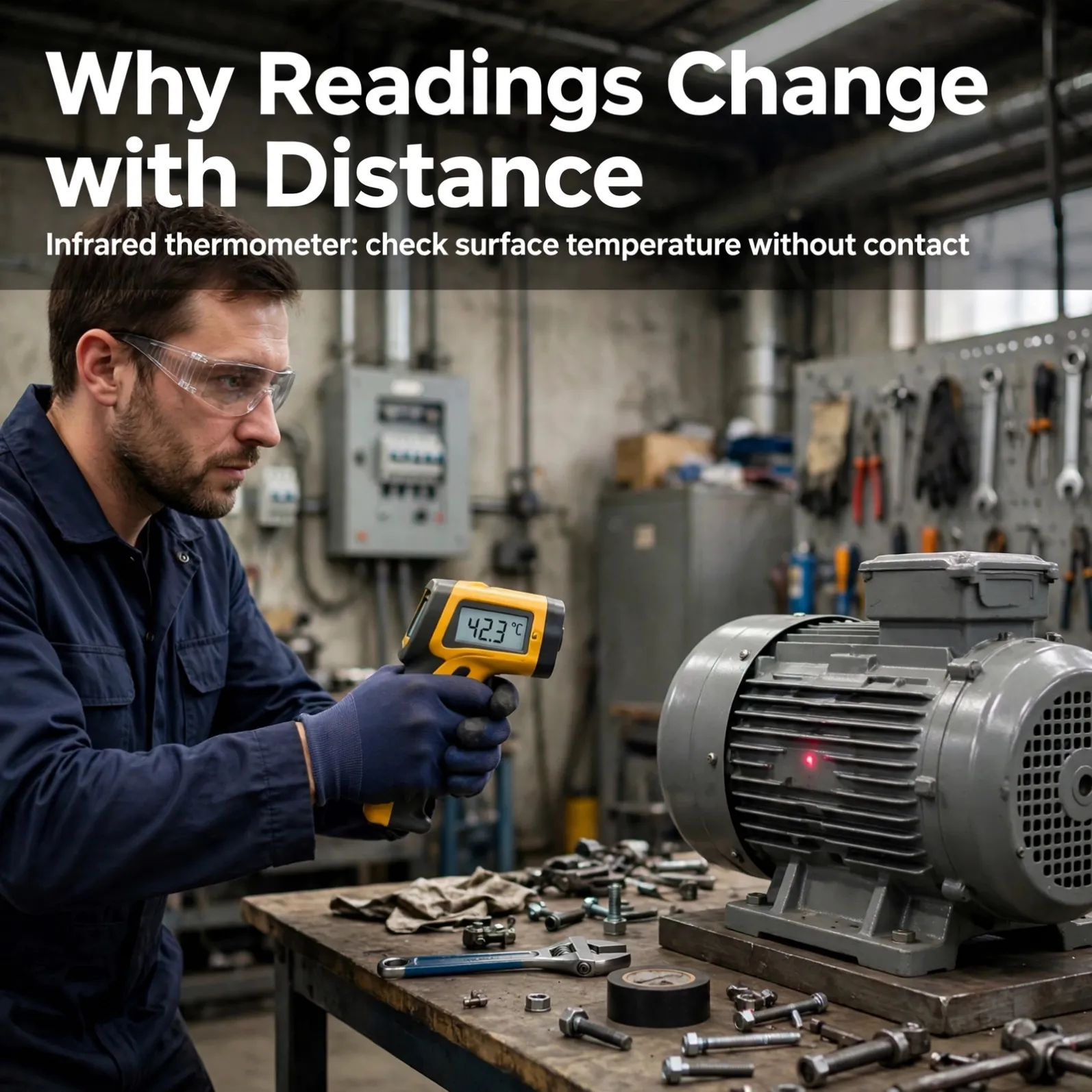
The Short Answer: You Are Measuring a Bigger Area Than You Think
An infrared thermometer does not measure a single point. It measures the average temperature of a circular area — the "spot" — and that spot grows every time you step back. Stand close, and the spot sits neatly on the motor bearing. Step two metres back, and the same spot covers the bearing, the cooler housing and a slice of the wall behind it. The thermometer averages them together, and the reading drops.
Usually the instrument is not broken — the measurement geometry changed. The laser dot only marks the centre of the spot, not its size. The number that controls that size is the distance-to-spot ratio.
The Distance-to-Spot Ratio, in Plain Terms
The distance-to-spot ratio, written D:S, tells you how wide the spot becomes as you move away: divide your distance by the ratio to get the spot diameter. A 12:1 thermometer measures a spot about 1 cm wide at 12 cm, about 5 cm wide at 60 cm, and about 10 cm wide at 1.2 m.
D:S ratio | Spot at 30 cm | Spot at 60 cm | Spot at 1 m | Spot at 2 m |
|---|---|---|---|---|
12:1 | 2.5 cm | 5 cm | 8.3 cm | 16.7 cm |
20:1 | 1.5 cm | 3 cm | 5 cm | 10 cm |
50:1 | 0.6 cm | 1.2 cm | 2 cm | 4 cm |
For a reading you can trust, the target should completely fill the spot — ideally it should be at least one and a half to two times wider than the spot. A 3 cm breaker terminal measured from 2 m with a 12:1 gun is mostly background: the spot is nearly 17 cm wide, so the terminal contributes only a small part of the signal.
Why the Reading Usually Drops When You Step Back
In most plants the background is cooler than the target — a hot bearing against a cool housing, a warm breaker against a cold panel wall — so as the spot grows to include it, the average falls and the reading drops. It can go the other way: a sunlit wall or a steam pipe behind a small valve will push the reading up instead. Either way the pattern is the same: the number moves with the distance, and the movement itself is the clue. A genuinely faulty sensor tends to be wrong in the same direction at every distance; a geometry problem changes with distance.
Three Other Reasons the Number Moves
Distance explains most cases, but not all. Check these three before blaming the instrument.
1. The surface, not the distance. Emissivity — how efficiently a surface emits infrared — varies enormously. Most non-metal surfaces sit near 0.95, the default setting of most thermometers. Polished copper can be as low as 0.03 and polished aluminium around 0.04, so bare metal reflects infrared from its surroundings and reads far too low. Fix it in the field with a piece of matt black electrical tape on the spot, or a model with adjustable emissivity.
2. Something is in the way. Steam, dust and smoke between the lens and the target absorb infrared and lower the reading; a dirty lens does the same. Wipe the lens, wait for steam to clear, and measure again.
3. The thermometer has not settled. A gun carried from an air-conditioned office into a hot plant room needs 15 to 20 minutes to reach the ambient temperature before its readings stabilise.
A Five-Minute Field Check
Measure a painted motor housing from 30 cm, 60 cm and 1 m, aiming at the same spot each time. If the three readings agree within a degree or two, the thermometer is behaving correctly and the target fills the spot. If the reading falls steadily as you step back, the spot is outgrowing the target: move closer, or use a thermometer with a higher D:S ratio. If the reading is wrong at every distance, try the matt tape test, then check the lens and the ambient soak time.
Matching the Ratio to the Job When You Buy
The right D:S ratio depends on how far your team stands from the target. Overhead busbars are measured from a metre or more away, where a 12:1 gun is often too coarse for a small terminal; a 20:1 or 50:1 model keeps the spot on the target. Bench work at arm's length is fine with 12:1 or 16:1, while furnace work, where standing close is not an option, is where the high ratios earn their price.
The 2025 catalogue range illustrates the spread: the DT8380A and GM320 cover roughly −50 to 380 °C at 12:1 for panels and HVAC work; the DT8750 reaches −50 to 750 °C at 16:1; and the GM1150 (20:1), GM1650 (50:1) and GM1850 (80:1) cover up to 1150 °C, 1650 °C and 1850 °C for small or distant targets in metal processing and furnace work. Several models offer adjustable emissivity from 0.10 to 1.00. Catalogue accuracy is quoted around ±1.5% of reading or ±1.5 °C in the laboratory — a figure that only holds in the field when the spot actually fits the target.
How to Evaluate a Sample Before Ordering in Volume
Ask for two or three samples and test them against a known reference before committing to a quantity. Measure the same painted panel ten times from the same distance: readings should cluster within a degree or two. Measure a small target from 30 cm, 60 cm and 1 m: the reading should stay stable while the spot still fits the target. Measure a bare metal bar, then the same bar with matt tape, to see how much emissivity matters for your application. Hand the samples to the technicians who will use them — a trigger that is awkward with gloves on matters more than a slightly better specification.
Questions to Ask Your Supplier
- What is the D:S ratio, and is emissivity fixed at 0.95 or adjustable from 0.10 to 1.00?
- What accuracy is quoted at the top and bottom of the range, and under what conditions?
- Is a calibration certificate available, and what is the recommended recalibration interval?
- What is the warranty period, and how are warranty claims handled for export orders?
- Can the housing colour, logo, packaging, manual and barcode be customised? Shenzhen Zhanyueda supports OEM/ODM orders — confirm minimum quantity and lead time before promising private-label versions to your customer.
- Will the same model still be supplied in twelve months?
Related Reading on This Site
- How to Choose an Infrared Thermometer for Industrial Use
- Electrical Testing and Thermal Imaging for Facility Maintenance
Get a Quote
Sourcing infrared thermometers for distribution or your own brand? Tell us the smallest target your customers measure and how far they stand from it — visit zydhardware.com and send an inquiry for the right model, pricing and lead time.