Sep 11, 2026Buying Guides
Why Is a Clamp Meter Better for Current Measurement?
To measure current with a traditional multimeter, the circuit usually needs to be opened so the meter can be inserted in series.
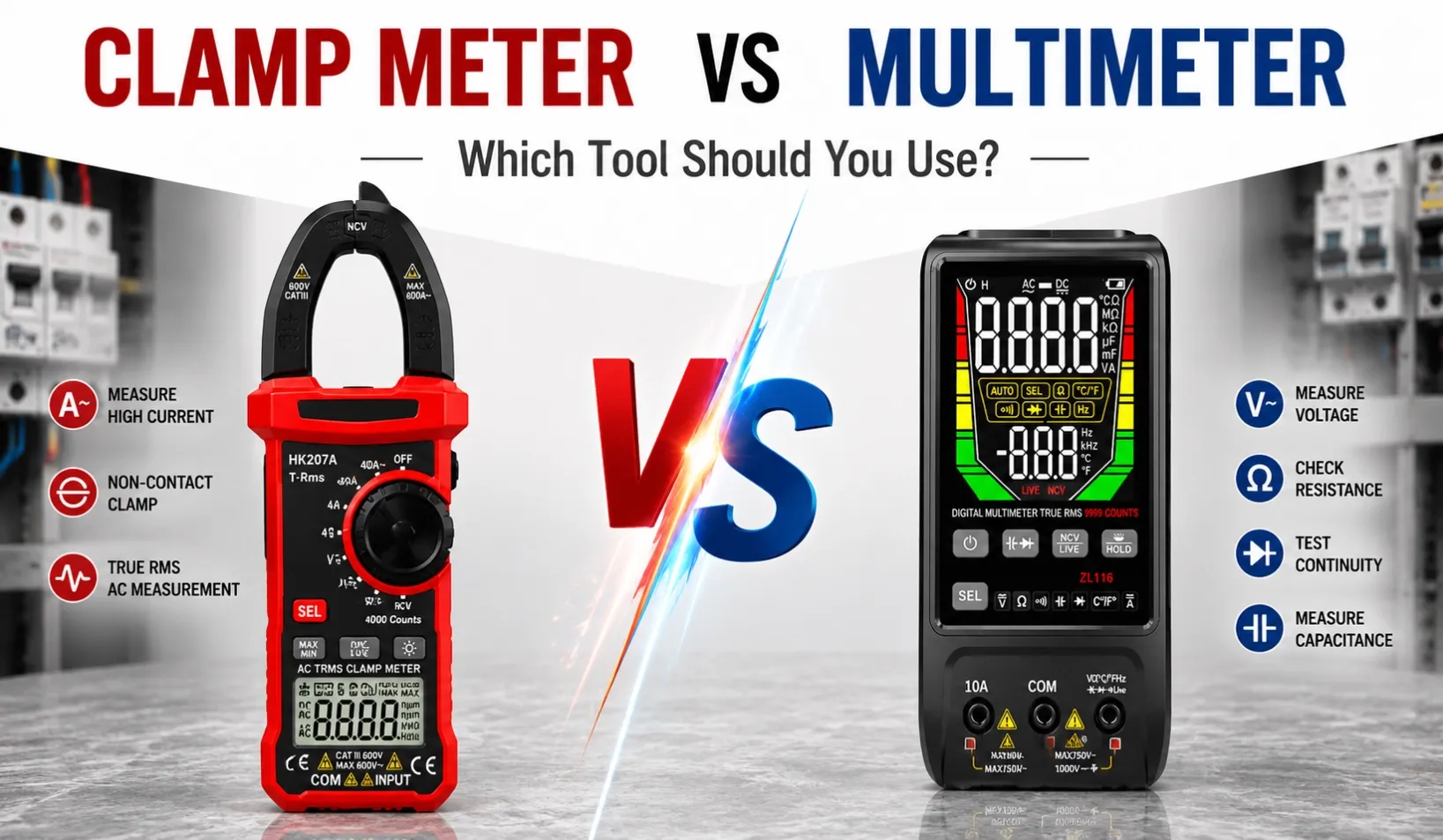
Clamp Meter vs Multimeter: Which Tool Should You Use?
A clamp meter and a digital multimeter can look similar at first glance. Both are commonly used by electricians, HVAC technicians and industrial maintenance teams, and many modern clamp meters can measure voltage, resistance, continuity and other electrical parameters.
But the two instruments are designed around different priorities.
A digital multimeter is primarily a versatile electrical measurement and diagnostic tool, while a clamp meter is primarily designed to measure current quickly without opening the circuit.
That difference becomes important when choosing a tool for professional electrical work.
In this guide, we compare clamp meters and digital multimeters, explain where each performs best, and show how electricians, HVAC technicians and professional buyers can choose the right instrument.
Quick Answer: Clamp Meter vs Multimeter
The simplest difference is:
- Clamp meter: Best for measuring current without disconnecting the conductor.
- Digital multimeter: Best for detailed voltage, resistance, continuity and low-current diagnostic measurements.
A clamp meter measures current by sensing the magnetic field around a conductor. A traditional multimeter normally measures current by being connected in series with the circuit.
For many professional users, these tools are complementary rather than interchangeable.
What Is a Clamp Meter?
A clamp meter is an electrical test instrument with hinged jaws that can be placed around a conductor.
The jaws detect the magnetic field produced by current flowing through the wire and convert it into an electrical measurement.
This allows current to be measured without cutting or disconnecting the circuit.
Clamp meters are commonly used for:
- Electrical distribution
- Motor testing
- HVAC systems
- Industrial maintenance
- Solar and renewable-energy systems
- Automotive electrical work
- Equipment commissioning
Modern digital clamp meters may also include:
- AC/DC voltage
- Resistance
- Continuity
- Capacitance
- Frequency
- Temperature
- True RMS
- Inrush current
- NCV detection
However, their main advantage remains current measurement.
What Is a Digital Multimeter?
A digital multimeter, or DMM, is a general-purpose electrical measurement instrument.
Depending on the model, it can measure:
- AC/DC voltage
- AC/DC current
- Resistance
- Continuity
- Capacitance
- Frequency
- Temperature
- Diodes
- Duty cycle
Professional multimeters may also include:
- True RMS
- Min/Max recording
- Low-pass filtering
- Relative measurement
- Data logging
- Bluetooth connectivity
- NCV detection
A multimeter is particularly useful when troubleshooting requires several measurements rather than simply checking current.
Clamp Meter vs Multimeter: Main Differences
Feature | Clamp Meter | Digital Multimeter |
|---|---|---|
Main strength | Current measurement | General electrical diagnosis |
Measure current without opening circuit | Yes | Usually no |
Measure high current easily | Yes | Limited |
Measure voltage | Yes on many models | Yes |
Measure resistance | Yes on many models | Yes |
Continuity | Often available | Standard feature |
Low-current precision | Model-dependent | Often better |
Inrush current | Common on professional models | Model-dependent |
Capacitance | Model-dependent | Common on many models |
Temperature | Model-dependent | Model-dependent |
Ease of current measurement | Excellent | Less convenient |
Best for | Load/current troubleshooting | Detailed diagnosis |
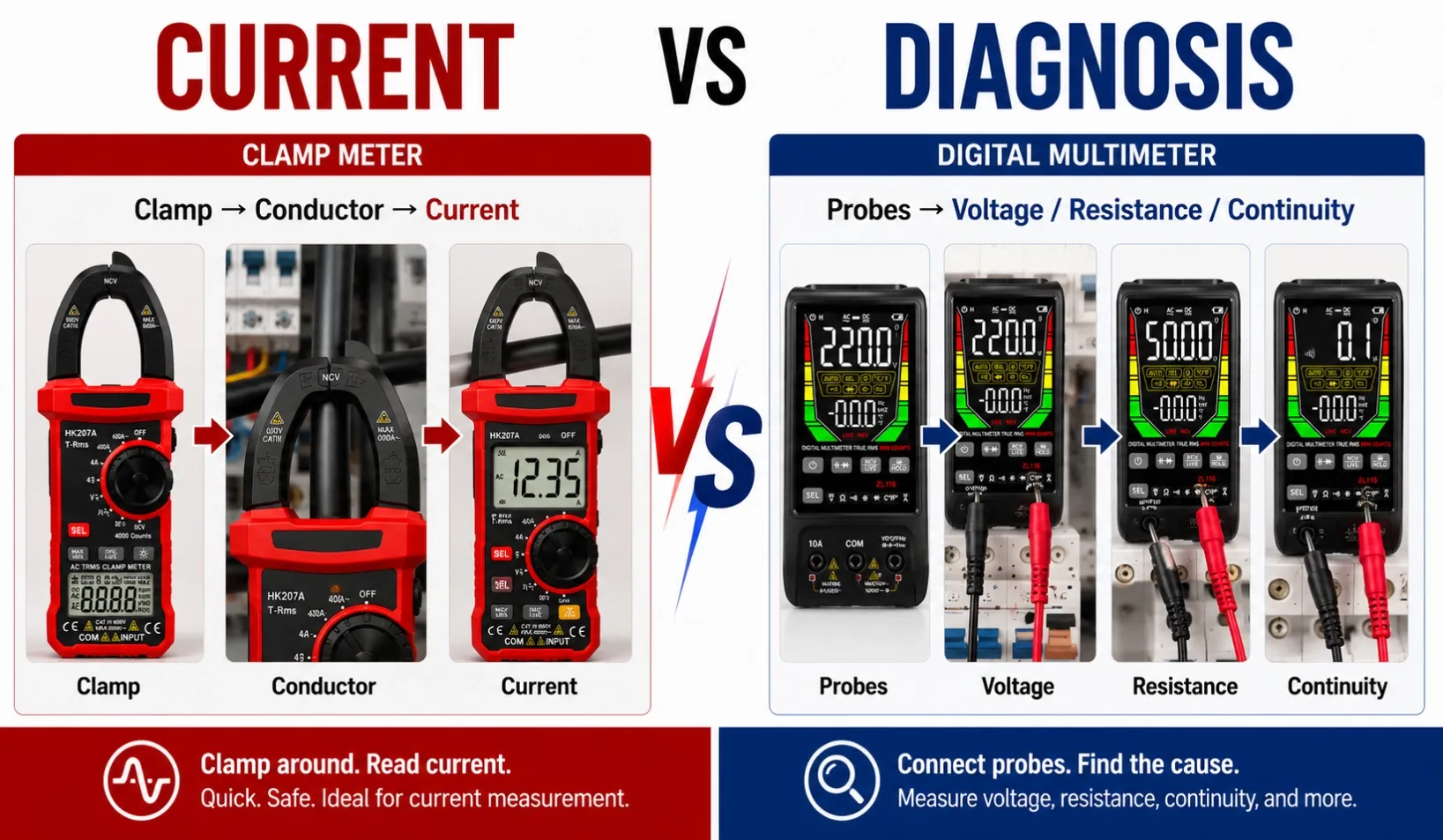
The main practical difference is not how many functions appear on the specification sheet.
It is how the tool interacts with the circuit.
Why Is a Clamp Meter Better for Current Measurement?
To measure current with a traditional multimeter, the circuit usually needs to be opened so the meter can be inserted in series.
That process may require:
- Switching off or isolating the circuit.
- Opening the conductor path.
- Connecting the meter correctly.
- Energizing the circuit again.
- Performing the measurement.
A clamp meter avoids this process for many current measurements.
The user simply opens the jaws and clamps them around one conductor.
Because the circuit does not need to be interrupted, current measurement can often be performed more quickly and conveniently.
This is one of the main reasons clamp meters are popular with electricians and industrial maintenance technicians.
Important: Clamp Around One Conductor
For current measurement, the clamp should normally surround a single current-carrying conductor.
If both the live and neutral conductors of a single-phase circuit are enclosed together, their magnetic fields may largely cancel each other.
The meter may then display little or no current even though the load is operating.
A simple rule is:
One conductor through the jaw for normal load-current measurement.
Leakage-current testing is a different application and may intentionally involve clamping multiple conductors, depending on the test method and instrument.
Can a Clamp Meter Measure DC Current?
Some clamp meters measure only AC current.
Others can measure both AC and DC current.
DC clamp meters typically use technologies such as Hall-effect sensing to detect direct current.
Therefore, buyers should not assume that every clamp meter supports DC current.
Always check the specification.
This is particularly important for:
- Automotive applications
- Battery systems
- Solar installations
- EV systems
- DC power supplies
- Industrial control systems
When Should You Use a Clamp Meter?
A clamp meter is usually the better option when current is the main diagnostic parameter.
1. Measuring motor current
A technician can measure the operating current of a motor without disconnecting its supply conductor.
This helps identify:
- Overload
- Phase imbalance
- Abnormal current draw
- Startup issues
2. Checking HVAC systems
HVAC technicians commonly need to measure:
- Compressor current
- Fan motor current
- Inrush current
- Voltage
- Capacitance
- Temperature
A multifunction clamp meter can cover many of these measurements in one instrument.
3. Measuring high current
Many clamp meters can measure hundreds of amps or more without routing that current through the meter's test terminals.
This makes them useful in:
- Electrical panels
- Industrial machinery
- Large motors
- Solar systems
- EV systems
4. Checking current without shutting equipment down
Because the circuit usually does not need to be opened for clamp-current measurement, technicians can observe equipment while it is operating.
5. Comparing phases
On three-phase equipment, a clamp meter can help compare current between phases.
Significant imbalance may point to:
- Load imbalance
- Motor problems
- Supply issues
- Connection faults
When Should You Use a Multimeter?
A digital multimeter is often better when you need detailed electrical diagnosis.
1. Measuring voltage
Multimeters are widely used to check:
- Supply voltage
- Battery voltage
- Control voltage
- Voltage drop
- Circuit outputs
2. Checking continuity
Continuity testing helps locate:
- Broken wires
- Open fuses
- Faulty switches
- Disconnected conductors
Continuity tests should generally be performed on de-energized circuits according to the instrument manufacturer's instructions.
3. Measuring resistance
Resistance measurement is useful for:
- Components
- Heating elements
- Sensors
- Wiring
- Coils
4. Measuring small currents
A multimeter may provide better resolution when measuring relatively small currents.
Clamp meters are generally optimized for larger current measurements, although specialized leakage-current clamps can measure very small currents.
5. Electronics troubleshooting
Electronics technicians often prioritize:
- Millivolt measurement
- Low current
- Resistance
- Capacitance
- Frequency
- Diode testing
A digital multimeter is usually more appropriate for these applications.
Which Tool Is More Accurate?
There is no universal answer.
Accuracy depends on:
- Instrument design
- Measurement range
- Signal type
- Frequency
- Sensor technology
- Calibration
- Operating conditions
A high-quality clamp meter can provide excellent current measurements.
A precision multimeter can provide excellent voltage and low-current measurements.
However, buyers should avoid comparing instruments based only on the number of display digits.
Always review the actual accuracy specification for the range being used.
What Does True RMS Mean?
True RMS is important when measuring AC signals that are not clean sine waves.
Modern electrical systems often include:
- Variable-frequency drives
- Inverters
- Switching power supplies
- Electronic controls
- HVAC systems
- LED drivers
These loads can produce distorted waveforms.
A True RMS meter is designed to calculate the effective AC value more accurately under these conditions than an average-responding meter within its specified limits.
For industrial, HVAC and inverter-related applications, True RMS is often an important selection factor.
What Is Inrush Current?
Some professional clamp meters include an inrush-current function.
Inrush current is the short surge of current that can occur when equipment starts.
Common examples include:
- Motors
- Compressors
- Transformers
- Power supplies
A standard current measurement may not capture this short event accurately.
An inrush function is designed to capture the startup current over a defined interval.
This can be particularly useful for:
- HVAC compressors
- Industrial motors
- Pumps
- Refrigeration systems
Clamp Meter vs Multimeter for HVAC
For many HVAC technicians, a clamp meter is often the more practical primary instrument.
Useful HVAC functions include:
- AC current
- Inrush current
- True RMS
- Capacitance
- Temperature
- Frequency
- DC microamps
- Voltage
For example, capacitor testing may require capacitance measurement, while compressor diagnostics may require current measurement.
A multifunction HVAC clamp meter can reduce the number of separate instruments a technician needs to carry.
However, a digital multimeter may still be useful for more detailed low-current or electronic-control troubleshooting.
Clamp Meter vs Multimeter for Electricians
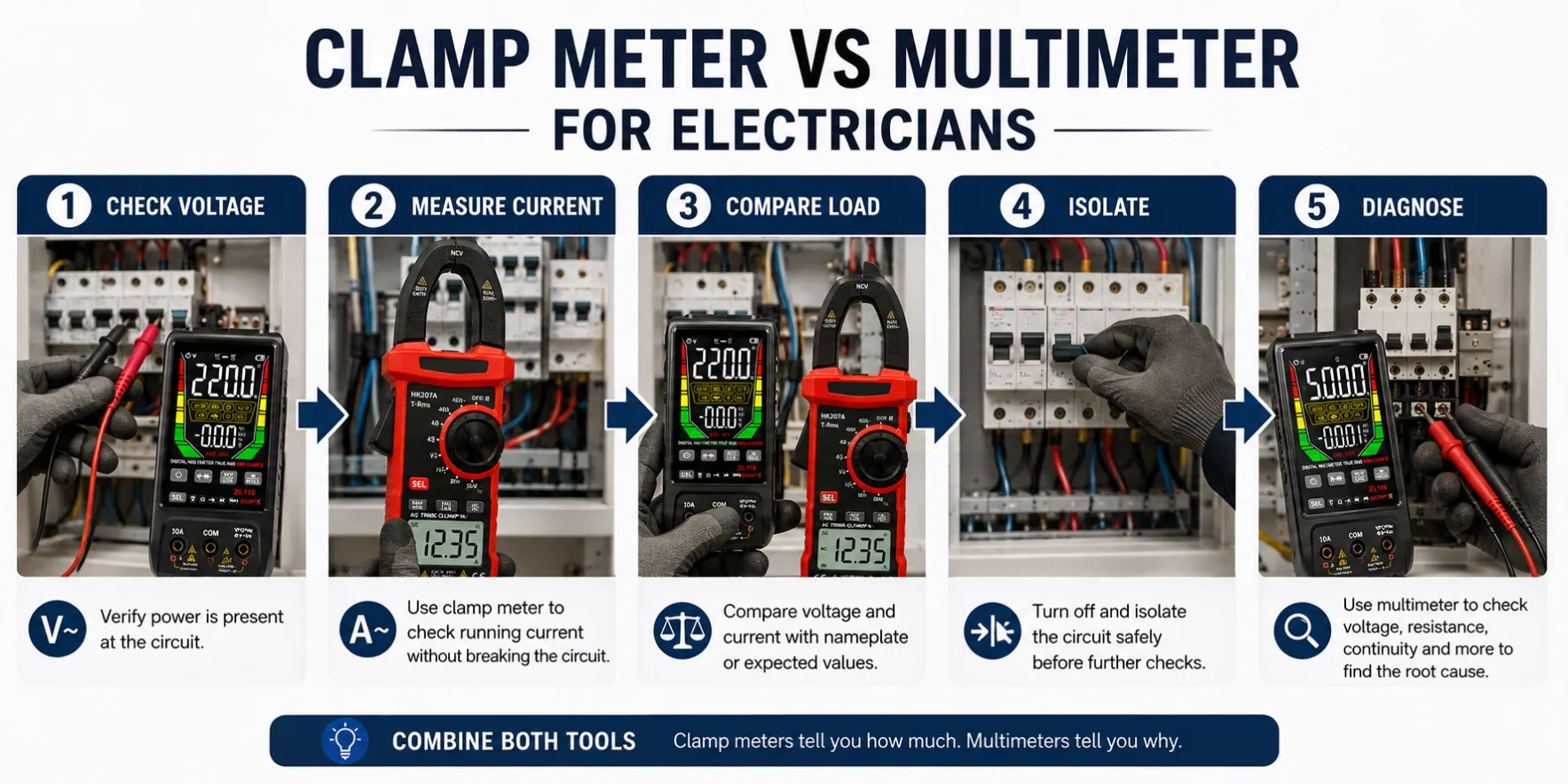
Electricians often benefit from having both.
A typical workflow might look like:
Step 1: Check voltage
Use the meter to verify the electrical condition.
Step 2: Measure load current
Use the clamp around the appropriate conductor.
Step 3: Compare expected and actual current
Check whether equipment is operating within specification.
Step 4: Isolate the circuit
Follow appropriate safety procedures.
Step 5: Perform resistance or continuity tests
Use the multimeter functions to investigate wiring or component faults.
This demonstrates why professional technicians rarely think in terms of:
“Clamp meter OR multimeter?”
Instead, they think:
“Which measurement do I need next?”
Clamp Meter vs Multimeter for Industrial Maintenance
Industrial maintenance teams frequently deal with:
- Motors
- Pumps
- Variable-frequency drives
- Distribution panels
- Control cabinets
- Three-phase systems
A clamp meter is especially valuable for checking:
- Phase current
- Motor load
- Current imbalance
- Startup current
A digital multimeter is useful for:
- Control voltage
- Continuity
- Resistance
- Signal troubleshooting
- Component checks
For industrial environments, the measurement category, rated voltage, input protection and True RMS capability should also be carefully evaluated.
Clamp Meter vs Multimeter for Automotive Work
The answer depends on the task.
A multimeter is useful for:
- Battery voltage
- Sensor circuits
- Continuity
- Resistance
- Low-current measurements
An AC/DC clamp meter can be useful for:
- Starter current
- Charging-system current
- Battery current
- High-current DC circuits
For automotive buyers, it is particularly important to confirm that the clamp meter supports DC current, not only AC.
Can a Clamp Meter Replace a Multimeter?
Sometimes—but not always.
Many modern clamp meters include most basic multimeter functions.
For general electrical maintenance, a high-quality clamp multimeter may perform:
- Voltage
- Current
- Resistance
- Continuity
- Capacitance
- Frequency
- Temperature
This can make it an excellent all-in-one field instrument.
However, a dedicated digital multimeter may still offer advantages such as:
- Better low-current resolution
- Better resistance resolution
- More detailed electronics functions
- Smaller physical size
- Easier bench use
Therefore, whether a clamp meter can replace a multimeter depends on the intended application.
Can a Multimeter Replace a Clamp Meter?
A multimeter can measure current, but it usually cannot provide the same convenience for high-current testing.
For frequent current measurements, using a multimeter can be slower because the circuit may need to be interrupted.
A clamp meter is generally much more practical for:
- Motor current
- HVAC current
- Distribution panels
- High-current circuits
- Repeated load measurements
What Should Professional Buyers Compare?
For distributors, wholesalers and OEM buyers, the comparison should go beyond basic specifications.
Clamp meter purchasing criteria
Check:
- AC only or AC/DC current
- Maximum current
- Jaw opening
- True RMS
- Inrush current
- Low-current capability
- Frequency range
- Capacitance
- Temperature
- CAT rating
- Rated voltage
- Display count
- NCV
- Input protection
- Test leads
- Accessories
Digital multimeter purchasing criteria
Check:
- AC/DC voltage
- AC/DC current
- Accuracy
- Display count
- True RMS
- Resistance range
- Capacitance
- Frequency
- Temperature
- CAT rating
- Fuse design
- Continuity speed
- Test leads
- Accessories
Jaw Size Matters More Than Many Buyers Expect
Clamp jaw opening determines what conductors the instrument can physically measure.
A compact clamp can be easier to use in crowded control panels.
A larger jaw may be necessary for:
- Large cables
- Busbars
- Industrial conductors
Flexible current probes can also be useful where conventional jaws cannot fit around large or tightly packed conductors.
Therefore, current range alone is not enough.
The physical measurement environment matters too.
Safety Rating Matters
Whether you choose a clamp meter or digital multimeter, the CAT rating should match the electrical environment.
For example:
- CAT III is commonly associated with distribution-level circuits and fixed installations.
- CAT IV applies closer to the source of the low-voltage installation.
The voltage rating must also be considered.
A meter marked:
CAT III 1000 V / CAT IV 600 V
has different permitted operating conditions depending on the measurement location.
Test leads and probes should also have appropriate ratings.
Common Buying Mistakes
Mistake 1: Assuming every clamp meter measures DC current
Many basic clamp meters measure only AC current.
Mistake 2: Choosing only by maximum current
Jaw size, accuracy and low-current resolution may be equally important.
Mistake 3: Buying the highest display count automatically
More counts do not guarantee better overall accuracy.
Mistake 4: Ignoring True RMS
For distorted waveforms and modern electronic loads, True RMS can be important.
Mistake 5: Ignoring CAT rating
Measurement category is a safety specification, not simply a marketing number.
Mistake 6: Choosing too many nearly identical models
For distributors, too much overlap can create inventory and positioning problems.
A clearer product ladder is usually easier to sell.
Recommended Product Mix for Distributors
A practical clamp meter range may include:
Entry-Level AC Clamp Meter
Suitable for basic electrical maintenance.
Professional True RMS Clamp Meter
For electricians and industrial maintenance.
AC/DC Clamp Meter
For automotive, solar, battery and industrial applications.
HVAC Clamp Meter
With capacitance, temperature, inrush current and relevant HVAC functions.
Flexible Clamp Meter
For large conductors and confined spaces.
This creates clearer product positioning than offering many models with nearly identical specifications.
Frequently Asked Questions
Is a clamp meter better than a multimeter?
Neither is universally better. A clamp meter is generally better for convenient current measurement, while a multimeter is often better for detailed electrical diagnosis.
Can a clamp meter measure voltage?
Many digital clamp meters can measure AC/DC voltage using test leads.
Can a clamp meter measure resistance?
Many multifunction clamp meters include resistance and continuity measurement.
Can a clamp meter measure DC current?
Only if the model is designed for DC current measurement. Many basic clamp meters measure AC current only.
Why use a clamp meter instead of a multimeter for current?
A clamp meter can measure current without opening the circuit, making it faster and more convenient for many field applications.
Which is better for HVAC technicians?
A multifunction clamp meter with True RMS, capacitance, temperature and inrush-current capability is often highly practical for HVAC work.
Which is better for electronics repair?
A digital multimeter is usually more suitable because electronics work often requires voltage, resistance, continuity and low-current measurements.
Final Thoughts
A clamp meter and digital multimeter are not simply two versions of the same instrument.
They are designed around different measurement priorities.
A clamp meter excels when current needs to be measured quickly without interrupting the circuit.
A digital multimeter excels when detailed voltage, resistance, continuity and diagnostic measurements are required.
For electricians, HVAC technicians and industrial maintenance teams, carrying both can provide the most complete troubleshooting capability.
For distributors and private-label buyers, the right product mix should be based on the target user, application, current range, True RMS requirements, CAT rating and feature set—not simply the number of functions listed on the packaging.
Looking for Clamp Meters and Digital Multimeters for Distribution?
Explore our range of professional electrical testing instruments for electricians, HVAC technicians, industrial maintenance and private-label programs.
Available options may include:
- Digital Multimeters
- AC Clamp Meters
- AC/DC Clamp Meters
- True RMS Models
- HVAC Clamp Meters
- Flexible Clamp Meters
- OEM / Private Label Options