
Buying Guides
Why Your Lux Meter Gives Different Readings in the Same Room
Same room, same light — but your lux meter shows a different number every time? Six causes, from sensor angle to LED spectrum, and a 5-minute check.
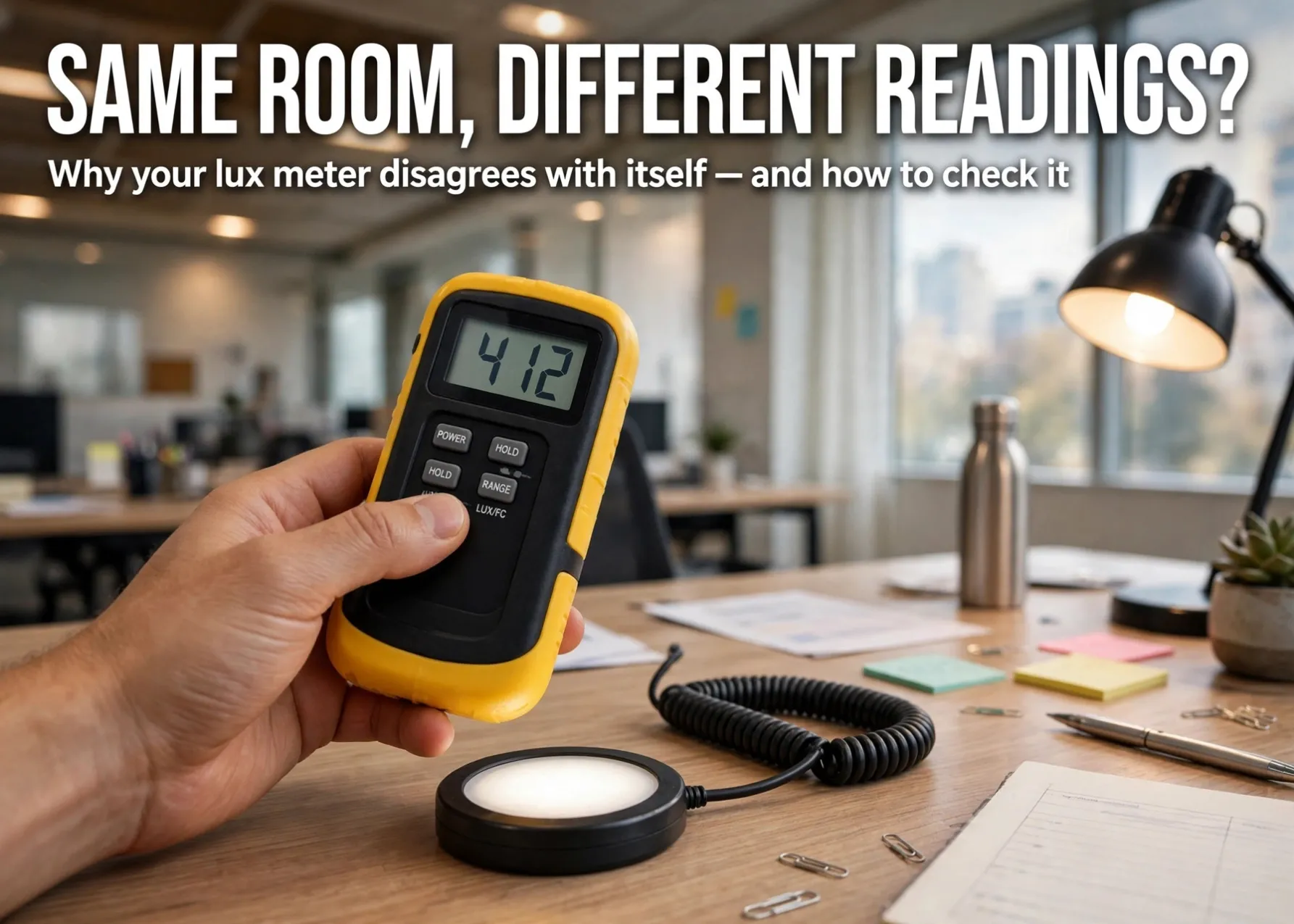
The Short Answer: It Is Usually Not Broken
A lux meter does not measure "the light in the room". It measures the light falling on its sensor at one exact spot, angle and moment. Move the sensor a few centimetres, tilt it a few degrees, or wait for a cloud to pass, and the number changes — even though nothing is wrong with the meter. Two readings in the same room can differ by 10 to 30 percent — work through the six causes below before you return it.
1. The Sensor Angle Changed
A lux meter follows the cosine law: light arriving straight onto the sensor counts in full, while light arriving at an angle counts for less. Tilt the sensor by 20 degrees and the reading drops noticeably. A hand-held sensor is rarely level twice in a row — one reading flat on the desk, the next tilted toward the window — and the numbers look like two different rooms. Keep the same plane: flat on the desk for desk work, flat on the floor for floor lighting.
2. Your Own Shadow Is in the Reading
Your body blocks part of the light when you stand between it and the sensor; your clothes can reflect extra light onto it from the side. Either way, the number is partly yours, not the room's.
A detachable sensor solves this: the sensor sits on the work surface while you stand back and read the display. The KT-600, for example, uses a sensor on a 1-metre lead, so the sensor stays where the light is being measured and your shadow stays out of it. Without one, hold the meter at arm's length, body to the side of the light path.
3. The Daylight Moved While You Were Measuring
A workstation near a window can read 450 lux in the morning and 380 lux an hour later — not meter drift, just a cloud moving or the sun shifting. Two readings taken hours apart are not comparable, even at the same desk. LED fixtures with dimming, occupancy sensors or automation add the same problem indoors.
Note the time and weather with every reading, close the blinds or measure after dark, and let the lighting settle first. Compare readings taken minutes apart under the same conditions — not a sunny morning against a cloudy afternoon.
4. The LED Spectrum Fools the Sensor
Inside a lux meter, a silicon photodiode sits behind a photopic filter matching the human eye's sensitivity curve, V(λ), peaking at 555 nanometres. That filter is calibrated against a standard source — traditionally an incandescent lamp.
White LEDs do not behave like that calibration source: their spectrum has sharp peaks and troughs, so the same meter can be accurate under an incandescent lamp and off by a double-digit percentage under a cool-white LED. User forums report budget meters reading 15 to 20 percent low against higher-quality meters under LED lighting.
In 2023 the CIE introduced the L41 LED reference spectrum (CIE 251:2023), which roughly halved the average spectral mismatch error for LEDs in the study. A calibration certificate proves accuracy under the calibration source, not under every LED on your site. If your work is mostly LED, ask the supplier how the meter performs under LED sources.
5. The Sensor Is Dirty, Scratched or Ageing
The sensor is an optical window in a dusty place: dust, fingerprints or a scratched diffuser cut the light reaching the photodiode, and the reading drops. Wipe it with a soft, dry cloth before measuring, and never touch the dome with bare fingers.
Ageing is slower but just as real. The photopic filter's dyes can bleach after long exposure to strong light and UV, and the cosine corrector can discolour. When the filter's response curve shifts, the error shows up most under narrow-spectrum sources such as LEDs. A meter in daily field use for years without a calibration check deserves a check against a reference meter — not the bin.
6. The Light Is Flickering, or the Battery Is Low
Fluorescent tubes flicker and dimmed LEDs pulse, so a meter sampling twice a second catches different points of the cycle. Let it settle, then average two or three readings instead of trusting one snapshot.
A low battery is the simplest cause: as voltage drops, readings become unstable — replace it and repeat the measurement before blaming the meter.
When Two Meters Disagree, Which One Is Right?
Two lux meters in the same spot rarely show the same number, and that alone proves nothing. Different accuracy specifications, spectral response, sensor geometry and calibration conditions all push the numbers apart — and under LED lighting the gap is wider. Field readings commonly differ from calculated photometrics by 10 to 20 percent, before two different instruments are even involved.
Compare them fairly: both sensors side by side, same height and angle, under a stable light, read at the same moment. A steady offset is a calibration or spectral difference, not a fault; if one jumps while the other is steady, the jumping one has the problem.
The 5-Minute Check
Change one thing at a time:
- Clean the sensor. Wipe the window, check for scratches, keep fingers off the dome.
- Fresh battery. Replace it and repeat the same measurement at the same spot.
- Fix the plane and the angle. Sensor flat, at the height you care about, same position every time.
- Get out of the light path. Stand to the side, or use a detachable sensor and step back.
- Stabilise the light. Blinds closed or lights settled, no dimmer or sensor changing output mid-measurement.
- Take three readings. Same spot, a few seconds apart. If they agree within a few percent, the meter is fine — the earlier difference was the method.
If it still jumps on a stable light source, with a clean sensor and a fresh battery, talk to the supplier — and note the light type, time of day and sensor position.
What This Means When You Are Buying
For importers and distributors, inconsistent readings are a support cost, not just a complaint. Test a sample the way end users will: on a real desk under LED lighting, at working height. Before ordering in volume, check the essentials: a range that covers your application (0.1 to 200,000 lux covers offices, warehouses and outdoor work), a detachable sensor, lux/foot-candle switching, and data logging if readings must be recorded — the KT-600 stores 32,000 readings. The LX1330B covers the same range at 0.1 lux resolution and is specified for LED measurement; confirm its accuracy figures and test light source in the manual before quoting them.
OEM and ODM buyers should confirm that the sample, the bulk order and the manual all match — same sensor, same range, same accessories. Shenzhen Zhanyueda Technology Co., Ltd. supports OEM/ODM orders with custom branding, packaging and documentation; confirm logo, packaging, manual language and barcode requirements before ordering.
For a catalogue and a quotation on digital lux meters and other handheld test instruments, contact Shenzhen Zhanyueda Technology Co., Ltd. through zydhardware.com.