
Buying Guides
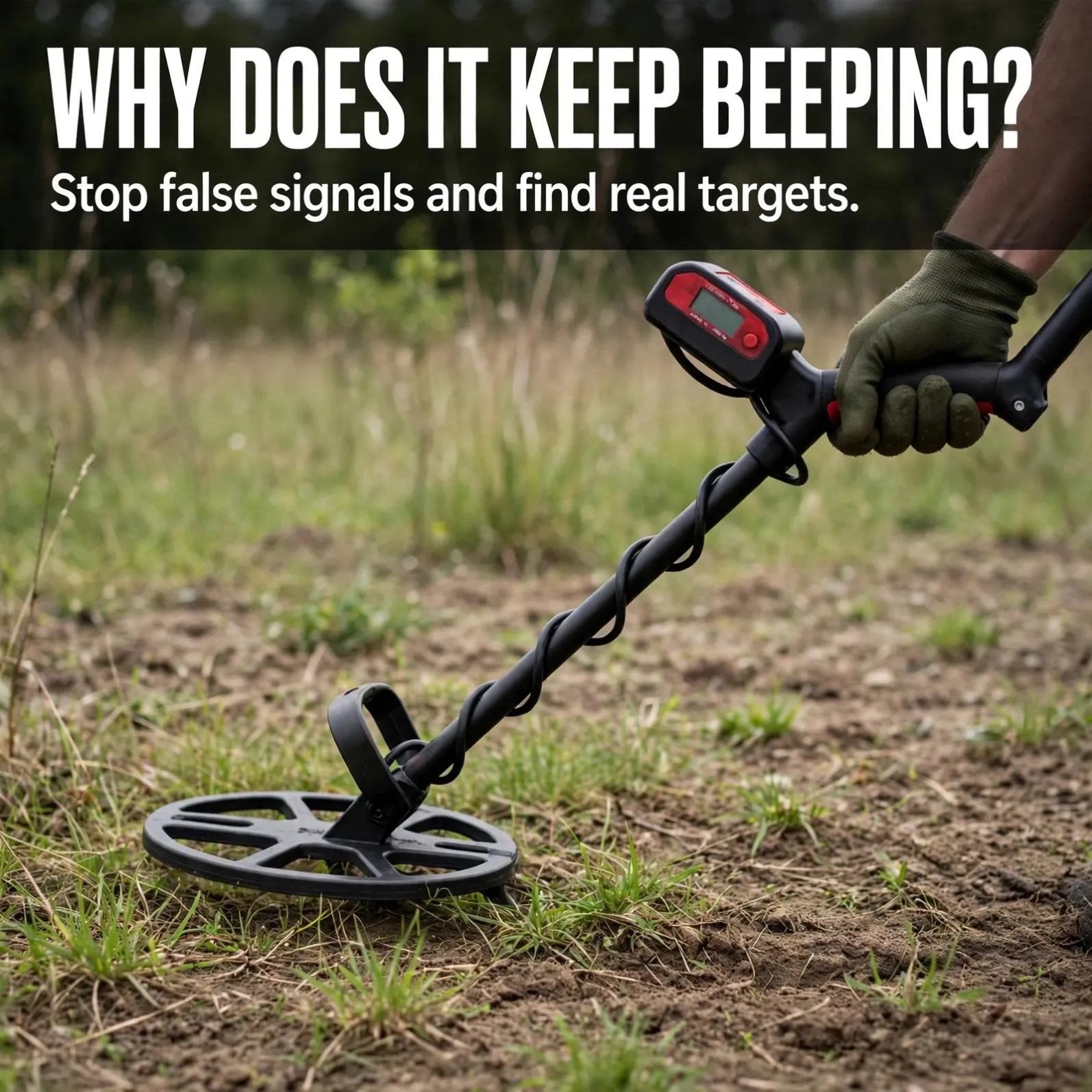
Why Your Metal Detector Keeps Beeping at Nothing
Your metal detector beeps with no metal in sight? Six causes — sensitivity, EMI, ground balance, coil, battery — and a 5-minute field check to fix it.
The Short Answer: It Is Usually Not Broken
A metal detector that beeps at nothing is frustrating — and it is rarely a fault. The machine is reacting to a tiny change in an electromagnetic field, but the change is not a target. It is the ground itself, electrical noise, a setting turned too high, or a loose connection. Work through the six causes below before you return it: most take five minutes to rule out, and the fix is usually a setting, not a repair.
First, Check Whether the Signal Is Real
A real target is repeatable. Sweep over the spot from a second direction and the tone comes back at the same place, with similar strength and a fairly stable target ID.
A false signal is unstable. The tone stutters, crackles, or jumps between high and low, and the target ID number bounces and will not settle. The signal appears at the ends of your swing, disappears when you change the coil angle, or vanishes after you dig a few centimetres. If the beep cannot be repeated from two directions, treat it as suspect, not as a find.
Six Reasons Your Detector Beeps at Nothing
1. The sensitivity is set too high
This is the most common cause. Sensitivity controls how strongly the detector reacts to small changes in the ground. Turned to maximum, it does not only find deeper targets — it also picks up ground minerals, moisture changes and background electrical noise. A detector running at a stable medium sensitivity finds more than one hissing at maximum. Lower the sensitivity a few steps until the chatter stops, then raise it only as far as the machine stays quiet.
2. Electromagnetic interference (EMI)
Power lines, electric fences, mobile phones, Wi-Fi routers, other detectors nearby and even buried cables all put electrical noise into the detector's receiver. A detector held still in the air that still chatters is usually hearing EMI, not metal. Move away from the suspected source and test again. Many detectors have a noise-cancel or frequency-shift function: hold the coil still, in the air and away from metal, run it, and let the machine pick a quieter channel. If the beeping stops at a quiet spot, the cause is the environment, not the detector.
3. The ground itself — mineralisation and ground balance
Soil is not invisible to a detector. Iron-rich red soil, wet clay, black sand and salty beach sand all contain minerals that produce a signal of their own. After rain, or on a different piece of land, the same detector can go from quiet to noisy without anything being wrong with it. Ground balance tells the detector to ignore the ground and listen only for targets. If it is wrong for the local soil, the ground itself becomes a target. Redo the ground balance whenever you change sites, after rain, and whenever the ground changes under your feet. On mineralised ground, a model with ground balance and discrimination is worth more than extra depth on paper.
4. The coil, cable or connector is loose or damaged
A detector that is quiet when held still but starts beeping as soon as you sweep is often telling you about its hardware. A loose coil cable, a worn connector, or a cable that moves against the shaft as you swing can send irregular signals that sound exactly like targets. False beeps at the ends of each swing are a classic sign of this. Check that the coil connector is fully seated and the cable is secured along the shaft with a little slack at the coil end — tight enough not to flap, loose enough not to pull.
5. The battery is low
Dying batteries cause more strange detector behaviour than any other single fault. As voltage drops, the machine can produce false signals, fading tones, or constant beeping, and the symptoms come and go. A detector that worked fine an hour ago and now chatters for no reason should have its battery checked before anything else. Replace or recharge the battery and test again at the same spot.
6. Metal on you, or the coil touching the ground
Sometimes the target is attached to the operator. A ring, watch, steel-toe boots, metal shoelace eyelets, a digging tool on your belt, or a spade carried too close to the coil can all trigger a signal, especially at the ends of a swing. So can the coil itself: bumping it against the ground, catching it on vegetation, or swinging too fast over uneven soil changes the coil height suddenly, and the detector reads that change as metal. Keep the coil level and a steady couple of centimetres above the ground, swing slowly and evenly, and keep metal objects away from the coil.
The 5-Minute Field Check
Work through this in order, changing one thing at a time:
- Fresh battery. Swap in a charged or new battery and sweep the same spot.
- Move away from EMI. Step away from power lines, fences and phones, and run noise cancel with the coil held still in the air.
- Lower the sensitivity. Drop it several steps until the machine is quiet, then raise it slowly to the highest stable level.
- Redo the ground balance. Balance on clean ground at the new site, and again after rain or a change of soil.
- Check the coil and cable. Reseat the connector, secure the cable, and inspect the coil for cracks.
- Test with a known target. Bury a coin at a known shallow depth in clean ground. If the detector finds it cleanly and stays quiet elsewhere, the machine is fine.
If the detector still beeps constantly at a quiet site, with a fresh battery, moderate sensitivity and a correct ground balance, talk to the supplier — and note exactly where and when it happens.
What This Means When You Are Buying
For importers, distributors and private-label buyers, false signals are a support cost, not just a user complaint. When you evaluate a sample, test it the way your end users will: on mineralised soil, near a power line, and with the sensitivity at the level a beginner will actually use. Check that the model offers ground balance and discrimination, that sensitivity adjusts in small steps, and that the coil cable and connector survive repeated assembly. A pinpointer with sound and vibration feedback is a useful companion product: it confirms whether a signal is a real target before the user digs.
OEM and ODM buyers should also confirm that the sample, the bulk order and the manual all match — same coil, same shaft, same battery type — because a silent change in any of those can turn a quiet detector into a noisy one. Shenzhen Zhanyueda Technology Co., Ltd. supports OEM/ODM orders with custom branding, packaging and documentation; confirm logo, packaging, manual language and barcode requirements before ordering, not after the goods arrive.
For a catalogue and a quotation on metal detectors, pinpointers and wall scanners, contact Shenzhen Zhanyueda Technology Co., Ltd. through zydhardware.com.
Suggested internal links: metal detector selection guide; wall scanner and rebar detection; underground cable and pipe locating.