
Buying Guides
Why Your Moisture Meter Gives Different Readings
Same board, three different readings? Your moisture meter is probably fine. Learn why pin and pinless meters disagree, and how to get a reading you can trust.
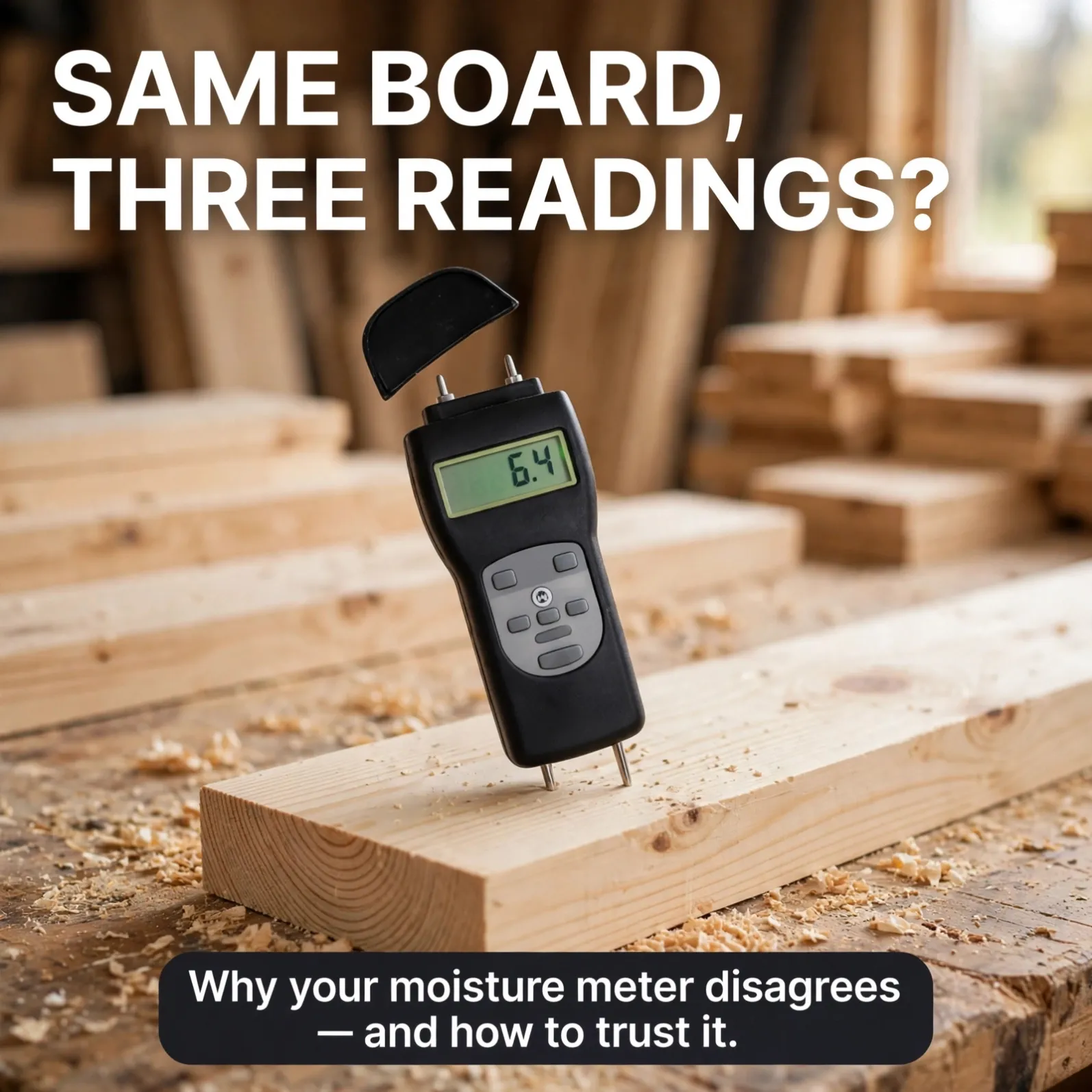
Why Your Moisture Meter Gives Different Readings
Take three readings on the same board and get 8%, 12% and 17%. Is the meter broken? Usually not. A moisture meter does not measure water directly. A pin meter measures electrical resistance between two pins; a pinless meter measures how the wood changes an electromagnetic field. Both convert that signal into a percentage using a calibration curve built for one reference species at one temperature. Change the spot, the depth, the species setting or the temperature, and the number changes — even when the board has not.
1. The board itself is not uniform
Wood rarely dries evenly. The outer shell dries faster than the core, the ends dry faster than the middle, and sapwood and heartwood release water at different rates. Knots, grain changes and resin pockets add more variation, so two readings a short distance apart can describe two genuinely different pieces of wood. Take several readings across the board, away from the ends, and read the pattern: readings climbing steadily toward one corner show where the moisture is.
2. Pin and pinless meters measure different depths
The most common reason two meters disagree is that they are not measuring the same thing. A pin meter reads resistance between its pin tips, typically 5–8 mm deep, and it is the only handheld type that shows a moisture gradient — shell versus core — especially with insulated pins. A pinless meter reads through a flat pad, averaging the wood roughly 20–40 mm deep. Both can be right and still disagree: one reports the outer layer, the other a deeper average. The USDA Forest Products Laboratory notes that practically all the current flows through the wettest wood touching both electrodes.
| Pin meter | Pinless meter |
|---|---|---|
Measures | Resistance between pin tips | Dielectric properties under a sensor pad |
Depth | About 5–8 mm | About 20–40 mm, surface-weighted |
Best for | Moisture gradient, shell vs core | Fast scanning of many boards without marks |
3. The species setting is wrong
Every pin meter is calibrated on a reference species — usually Douglas fir — and other species read differently at the same moisture content because their electrical characteristics differ. For pinless meters the same problem comes from density. An uncorrected reading on a dense tropical hardwood can be 3–5 percentage points off: enough to pass a board that should have been rejected, or reject one that was fine. Set the species before you measure — the MC-7825P in our catalogue covers up to 150 species — and record the setting with the number.
4. The wood is hot or cold
Pin meters measure resistance, and resistance changes with temperature. Meters are calibrated for wood at about 70 °F (21 °C). Between roughly 55 °F and 85 °F the error is small, but outside that range the reading should be corrected for the actual wood temperature. Cold wood conducts worse, so it reads drier than it is — a low number from a cold warehouse in winter deserves suspicion, not relief.
5. Surface water, metal and salts fool the meter
A board can be dry inside and wet on the face. Rain on the face can push a pinless meter to 20% while the core is still at 8%. Pressure-treated lumber carries conductive preservative salts, so a pin meter can read extremely high until the wood has cured for months. Nails, screws or a metal workbench under a thin board do the same thing — a pinless meter over a metal bench reads the bench, not the board. It is worse on masonry: British Standard BS 5250:2011 states that accurate moisture content of brick or mortar cannot be obtained with electrical moisture meters, because salts give falsely high readings; only a drilled sample tested gravimetrically is reliable. The meter is not faulty — it found conductivity, and conductivity is not the same as water.
6. You may be reading a relative scale, not a percentage
A meter calibrated for timber gives a true moisture percentage on wood. On concrete, plasterboard or brick, the same number is a relative scale: useful for comparing one spot with another, meaningless as an absolute value. Two brands will routinely give different numbers on the same spot on concrete. That is still useful: sweep the meter across a slab in a grid, and the spots that read consistently higher than the rest are where to run a proper test, such as the ASTM D4263 plastic-sheet test. The reference is always the oven-dry method: weigh a sample, dry it, weigh it again.
7. The meter itself: battery, damage or a reading floor
Sometimes the meter is the problem, and the signs are specific. Low batteries frequently cause skewed or erratic percentages, so check the battery before doubting the wood. Visible damage means the measurements are no longer reliable. And every meter has a default reading: the value it shows with the pins in the air and nothing connected. One flooring inspector found two meters reading the same floor consistently 6% and 8% — the difference was their default readings. A meter will never read below its default.
Before each test series: with the pins in the air, the meter should show its lowest value; with both pins touched by two fingers, it should read at least 12%.
How to get a reading you can trust
- Set the species first. No setting, no interpretable number.
- Take three or more readings at different spots, away from ends, knots and metal, and look at the pattern.
- Mind the temperature. Measure near room temperature, or correct for it.
- Establish a dry reference of the same material; the difference is the finding.
- Check the battery and the default reading before each test series.
- Confirm outliers with the other type. Scan with pinless, verify with pin.
For timber framing, the widely used target is under 15% before closing a wall; 15–17% is borderline, and above 17% is too wet for most applications.
What to ask your supplier before you buy
If you are sourcing moisture meters, ask what separates a usable instrument from a display with pins. How many wood species can the meter correct for, and is the correction built in or a paper chart? Pin, pinless or both — and what depth does each actually read to? A long-probe model such as the GM620, with a 160 mm probe, reaches far deeper than standard 10 mm electrodes. Is a calibration check block included? Can you test a sample on your own species before ordering in volume? And for private-label orders, what OEM/ODM options exist for logo, packaging, manual and barcode?
A supplier that answers directly, with a sample to test on your own timber, beats a lower unit price on a meter your customers will not trust. Shenzhen Zhanyueda Technology Co., Ltd. (zydhardware.com) supplies wood, grain, soil and building moisture meters — including 150-species pin-type models, long-probe meters and soil meters — with OEM/ODM service for distributors and private-label buyers. Contact us through zydhardware.com for the catalogue and a quotation.
Related internal links: moisture meter category; temperature and humidity meter category; infrared thermometer category.