
Buying Guides
Why Your NCV Tester Beeps on a Dead Wire
Your NCV tester beeps on a dead wire? Induced voltage, stray fields and static are the usual causes. Learn how to tell a false positive from real voltage.
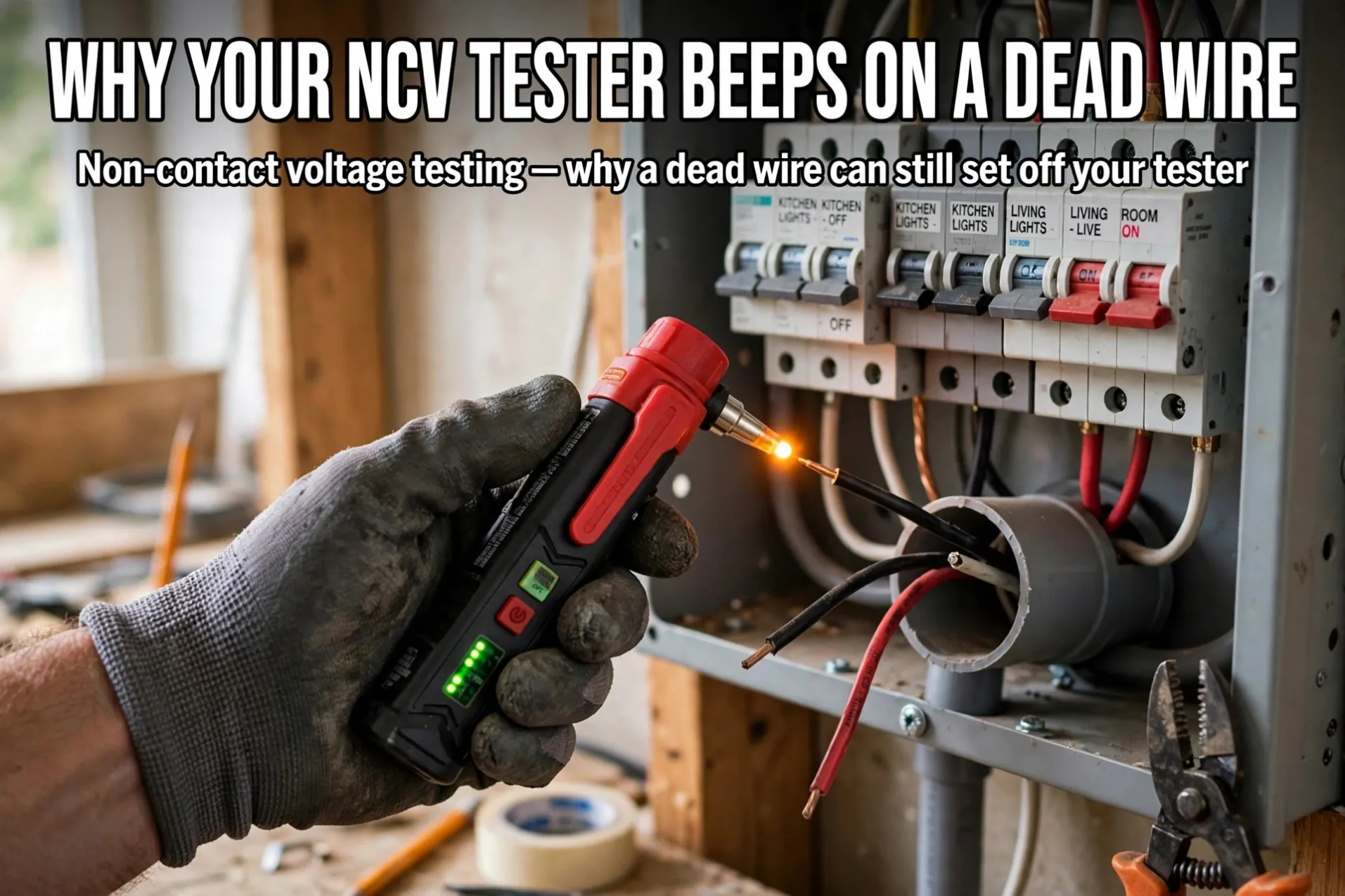
The short answer: it senses a field, not usable voltage
Your non-contact voltage (NCV) tester beeps on a dead wire because it detects an electric field, not voltage you can actually use. A switched-off wire running next to a live one picks up a small induced voltage — often called ghost voltage — through capacitive coupling. The field is real, and the tester is not broken. But that induced voltage carries almost no current: it cannot power a load, and it is not the same as a live circuit. A beep means "check further before you touch it," not always "live."
What an NCV tester actually detects
An NCV pen does not measure voltage the way a multimeter does. Inside the tip is a small antenna. Near a conductor carrying alternating current, the conductor's electric field induces a tiny voltage on that antenna; the electronics amplify it, and once it crosses a threshold, the pen lights up and beeps.
That design has three consequences. It gives a yes/no answer, not a number — it cannot tell 5 volts of induced voltage from 230 volts of mains voltage. It needs no contact, which is its advantage for fast screening — and its weakness, because it also picks up fields from wires it was never pointed at. And it works on AC fields only.
6 reasons your NCV tester beeps on a dead wire
1. Induced voltage from a parallel live wire — the most common cause
A dead wire in the same conduit or cable bundle as a live wire picks up a small voltage through capacitive coupling — often under 5 volts, but enough to trip a sensitive NCV pen. It is most common where long parallel runs share a conduit or a crowded switch box.
2. A shared neutral or a backfed circuit
Several circuits may share one neutral, or one circuit may stay energised while a related one is switched off. A floating neutral picks up induced voltage from a nearby live conductor, and the pen reports it as live. The same happens when a circuit was never fully isolated.
3. Stray fields from nearby equipment
NCV pens react to fields that have nothing to do with the wire under test: unshielded fluorescent ballasts, large motors, transformers, even phone chargers. One field report describes a pen beeping on a phone plugged into a wall charger — the unearthed device floats tens of volts above earth potential, with almost no current behind it.
4. Static electricity
In dry air, static causes one-off chirps. Rubbing the plastic casing against clothing, or sweeping the tip across a plastic junction box, builds a charge that creates a brief field strong enough to trip the sensor. The sign of a static false positive: one chirp, then silence, and it does not repeat in the same spot.
5. Sensitivity set too high
Many pens offer two ranges — for example, a high range starting around 12 V and a low range starting around 48 V. On the high range, the pen can react to a live cable from several centimetres away, before it is even touching the wire under test. In a crowded distribution board, it may be sensing the neighbour, not the wire in front of it.
6. A weak battery — or a faulty unit
A low battery makes readings erratic: weaker indication on a live source, or random chirps on dead ones. Change the batteries before you conclude anything about the wiring. If the behaviour persists with fresh batteries, retire the unit.
The opposite failure is the dangerous one
False positives are annoying. False negatives can kill. An NCV pen can also stay silent on a live conductor — when thick insulation, metal conduit, or a metal panel blocks the electric field.
This is not theoretical. In 2021, Klein Tools recalled about 1.69 million NCVT-1 testers because the power button could stick, leaving the tester unable to sound an alarm on a live circuit. The lesson: an NCV pen is a screening tool, never the final proof that a circuit is dead.
A 5-minute check before you trust the beep
- Live-dead-live test. Check the pen on a known live socket, then on the suspect wire, then on the live socket again. If it fails on the known live source, stop — the tester itself is suspect.
- Confirm with a contact instrument. Put a multimeter across the conductor and a known good neutral or earth. Real mains voltage reads at full line value; ghost voltage reads only a few volts — and on a low-impedance (LoZ) range it collapses to near zero.
- Pull the pen away from the bundle. If the beeping fades as you move away from neighbouring cables, you are sensing a nearby live wire.
- Switch to low sensitivity. If the low range stays quiet while the high range beeps, the signal is weak — consistent with induced voltage.
- Check the battery. Fresh batteries first, conclusions second.
If any step leaves doubt, treat the conductor as live until a contact measurement proves otherwise. Never touch a wire to "see if it is really live."
What this means when you buy NCV testers in volume
For importers, distributors, and own-brand buyers, false positives drive returns, warranty claims, and lost trust. A buyer who thinks the pen is faulty will send it back; a buyer who learns to use it properly will reorder.
Tool | What it proves | Best use | Limitation |
|---|---|---|---|
NCV pen tester | An electric field is present nearby | Fast live/dead screening | No numeric reading; fooled by induced voltage |
Two-pole (contact) tester | Real voltage between two points | Proving a circuit dead before work | Needs contact; slower |
Multimeter with LoZ mode | Voltage that can deliver current | Confirming ghost voltage vs real voltage | Needs a good reference and training |
Questions to ask your supplier: What are the detection thresholds of each sensitivity range? What is the safety rating, and which standard was it tested against — ask for the test report, not just the marking on the housing. And how does it behave on a switched-off wire running next to a live one? Ask for a sample and run that test yourself.
Sample evaluation in five minutes: test on a known live socket, then a known dead circuit, then a live source again; hold the pen near a live cable and then near a switched-off cable in the same trunking.
Zhanyueda supports OEM/ODM orders — logo, packaging, user manual, and barcode customisation.
The bottom line
A beeping NCV pen on a dead wire is usually not a faulty tool. It is a sensitive tool reporting a real electric field that carries no usable power — most often induced voltage from a neighbouring live conductor. Learn the six causes, confirm every surprise beep with a contact measurement, and never let a silent pen be your only proof that a circuit is safe.
Looking for a reliable NCV tester or handheld test instruments for your market? Contact Shenzhen Zhanyueda Technology Co., Ltd. at zydhardware.com for product details, samples, and OEM/ODM support.