
Why Your Plug-In Power Meter Reads the Wrong Watts
Plug-in power meter reads 0 watts on a 7W LED bulb? Power factor, low-power limits and distorted waveforms are usually the cause. Here is how to check yours.
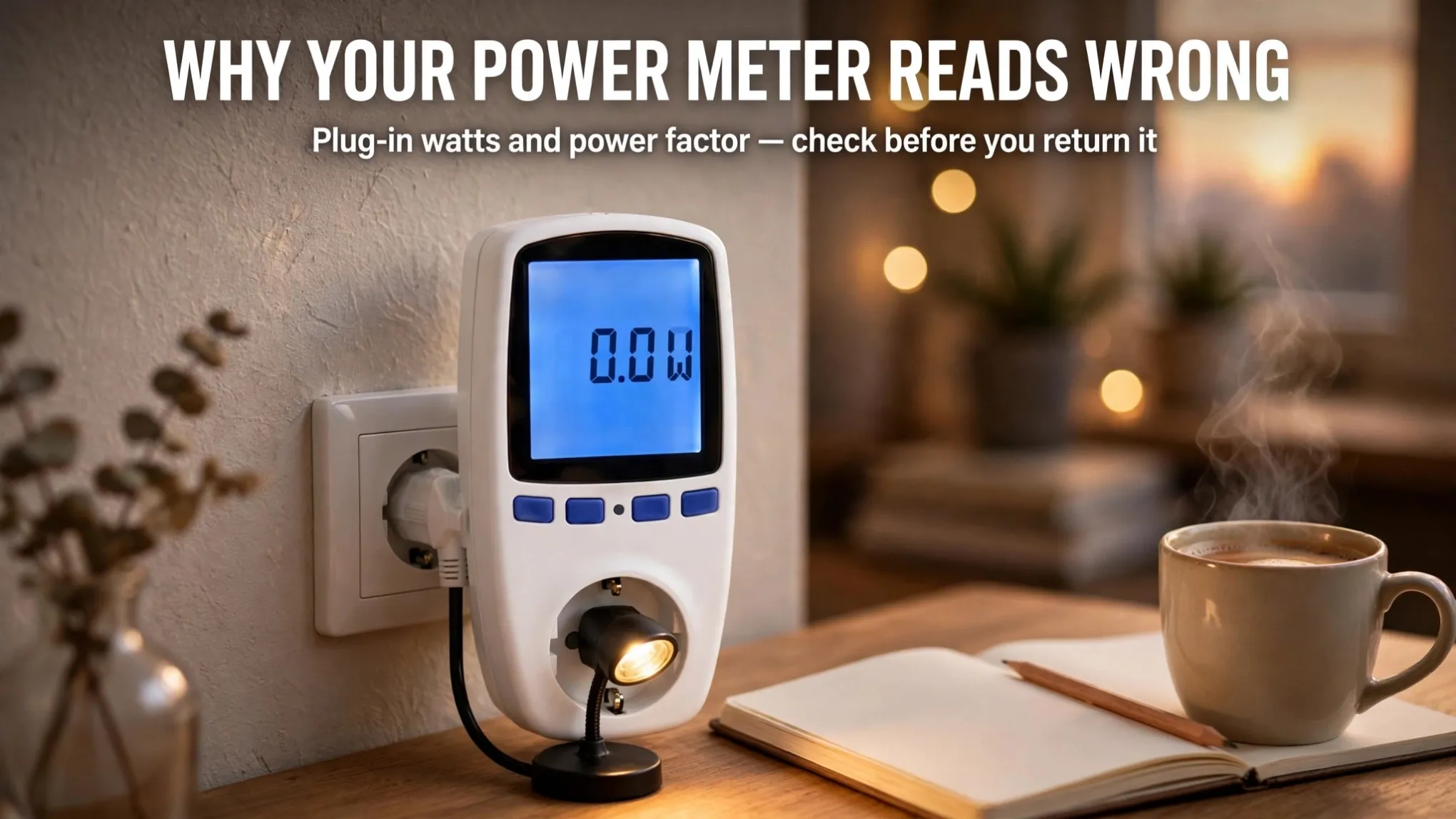
Why Your Plug-In Power Meter Reads the Wrong Watts
A plug-in power meter that reads 0 watts on a 7-watt LED bulb, or 1,040 watts where volts times amps says 1,512, is usually not broken. Plug-in meters are at their best on resistive loads such as heaters and kettles. On switching supplies, LED drivers, dimmers and motors, the same meter can be far off — and at very low power it may read nothing at all.
1. Watts Are Not Volts Times Amps
Multiply 12.6 amps by 120 volts and you get 1,512 — yet a Kill-A-Watt on the same ballast-driven HMI light read 1,040 watts, and the meter was right. The missing piece is power factor. Real power in watts is what you pay for. Apparent power in volt-amperes is volts times amps, and the two are only equal in a pure resistor, where voltage and current are in step. With a ballast or motor, whose current lags the voltage, the real power is lower: power factor is watts divided by volt-amperes, 0.69 in that case. Trust watts for cost, amps for sizing.
2. Below a Few Watts, the Meter Cannot See the Load
A Kill A Watt EZ owner found a 7W LED bulb read zero, and a 6W incandescent bulb too; the standard model would not read a 3W bulb either. The cause is the measurement floor: the chip can only resolve current above a minimum level. One manual states loads under 0.5 watts are not counted at all. Standby loads are the worst case: a DVD player that a Kill-A-Watt reported at about 5 watts measured 2.64 watts on a Fluke 1735. Add up readings from several plugs and the errors all point the same way, so the total comes out low. Measure several identical devices together and divide — four bulbs at 0.2 watts standby each make 0.8 watts the meter can see.
3. Switching Supplies and Dimmers Distort the Waveform
LED drivers, laptop chargers and dimmed lamps draw current in short pulses near the voltage peak. A meter that samples slowly, or assumes a clean sine wave, loses most of the shape. University of Twente researchers tested nine electronic energy meters: five read much higher than the real consumption — in some setups more than five times higher — while two read 30 percent low. The Dutch Metrology Institute confirmed the results. Rogowski-coil meters tended to over-read; Hall-effect meters tended to under-read. A dimmer makes it worse, because triac dimming chops the waveform itself — the largest errors were where a dimmer met an LED or energy-saving lamp.
4. The Meter Samples Too Slowly to Catch Spikes
Even on a load the meter handles well, the display is a snapshot. In one comparison, a 51-inch TV at switch-on gave 410 to 504 watts on a Kill-A-Watt, while the reference meter stayed between 448 and 453 watts. Its low sampling rate misses fast changes, so a load that surges at start-up gives a reading that jumps each time you look. A refrigerator the Kill-A-Watt reported at 921 watts measured 841.8 watts on the reference meter. Over a week, accumulated kilowatt-hours matter more than any single watts reading.
5. Wrong Voltage Version, Wrong Tariff, or an Overloaded Meter
Plug-in meters are built for one mains system. The PMB02-EU is a 230V, 50Hz, 16A meter rated to 3,680W; the PMB02-US is a 120V, 60Hz, 15A meter rated to 1,800W. Use the wrong version and the voltage, watts and cost figures are all wrong. Most plug-in meters stop at 13 to 16 amps. The cost display is a second trap: the price is only as good as the tariff you entered. If the tariff is wrong or was never set, the money figure is fiction while the kilowatt-hours may be correct.
Five-Minute Check Before You Return It
- Plug in a kettle and compare the watts with the nameplate. If close, the meter is probably fine.
- Read volts, amps and watts together and divide watts by volt-amperes. A power factor well below 1 explains the gap.
- Test a 7W LED bulb on standby. If it reads zero, you have found the meter's low-power floor, not a fault.
- Run the meter for a full day on a steady load and compare kilowatt-hours with nameplate power times hours.
- Confirm the voltage version, the tariff setting, and the maximum current.
How Different Loads Behave on a Plug-In Meter
| Load type | What the meter usually does | Why |
|---|---|---|
| Heater, kettle, incandescent lamp | Accurate | In step; clean sine wave |
| LED bulb, phone charger, laptop supply | Low or zero | Spiky current, low power factor |
| Dimmed LED or CFL | Far too high | Chopped waveform confuses the chip |
| Fridge, compressor, motor | High or jumping | Inductive load, slow sampling |
| Standby electronics | Zero or double | Below the resolution floor |
What to Ask a Supplier Before You Buy
- What is the lowest power it can measure reliably, and its accuracy there, not just at full load?
- Does it measure true power from sampled voltage and current, or calculate from volts, amps and an assumed angle?
- Which plug and voltage versions are available — EU, UK, US or BR — and the maximum current and wattage?
- Ask for the accuracy statement in writing: without stated accuracy at low power factor, a meter cannot be quoted in an energy audit. Ask what safety testing it has passed: the SafePlug Model 1202 was recalled in Canada in 2020 for overheating.
Zhanyueda supplies these meters in EU, UK, US and BR versions, with OEM and ODM options.
Frequently Asked Questions
Why does my power meter read 0 watts on a 7W LED bulb?
The bulb is below the meter's floor — one popular model will not read below 10 watts. Measure several identical bulbs together and divide.
Why does my meter show 1,040W when volts times amps equals 1,512?
Because watts are not volts times amps unless the load is purely resistive — power factor was 0.69 in that case. Trust watts for cost, amps for sizing.
Can I use a plug-in meter to measure standby power?
Mostly no — standby loads sit below the resolution floor, so the meter reads zero or roughly double the real value.
Why does my meter read differently every time I switch the TV on?
The meter samples too slowly to catch the switch-on surge: the same TV gave 410 to 504 watts on a plug-in meter while a reference meter stayed between 448 and 453 watts. Judge by kilowatt-hours over a full cycle.
Can I use a plug-in meter to check my electricity bill?
No — small loads round toward zero and the errors accumulate in one direction. Use the meter to rank loads, not to account for the bill.
If you need plug-in power meters in EU, UK, US or BR versions, or a meter specified for low-power and low-power-factor loads, contact Shenzhen Zhanyueda Technology Co., Ltd. at zydhardware.com for a quotation.